

alb5409097
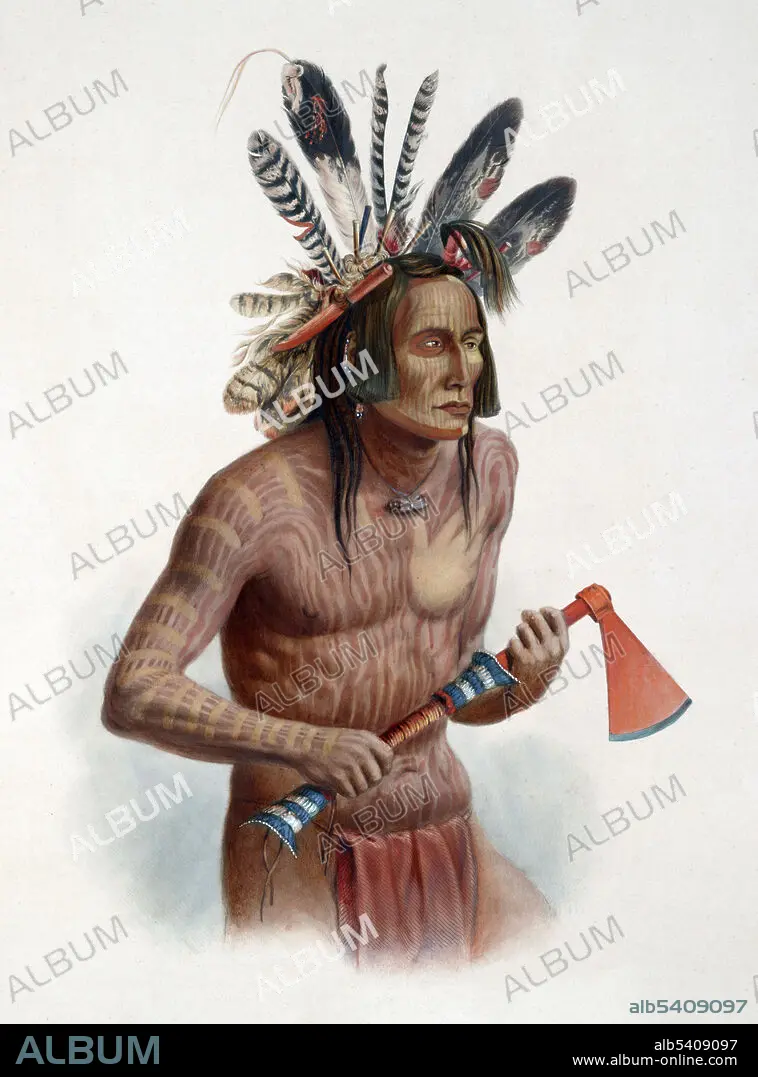
Mato-tope, Native American Mandan Indian Chief
| Compartir |
|---|
 Pinterest Pinterest |
 Twitter Twitter |
 Facebook Facebook |
 Copiar enlace Copiar enlace |
 Email Email |
|
Añadir a otro lightbox |
|
Añadir a otro lightbox |


¿Ya tienes cuenta? Iniciar sesión
¿No tienes cuenta? Regístrate
Compra esta imagen.
Selecciona el uso:

Título: Mato-tope, Native American Mandan Indian Chief
Descripción: Ver traducción automática
Mato-tope. The six sticks in his hair represent killing six men with a gun and the wooden knife represents he killed a Cheyenne chief with a knife. The split turkey feather is said to stand for an arrow wound. The hand on Four Bears' torso may indicate that he once seized an enemy for his comrades to kill. Mato-tope (1784-1837) was the second chief of the Mandan tribe to be known as Four Bears, a name he earned after charging the Assiniboine tribe during battle with the strength of four bears. The 1837 Great Plains smallpox epidemic wiped out most of Four Bears' tribe, leaving 27 (or by some accounts 100 to 150) survivors out of a former population of around 2,000.. Voyage dans l'interieur de l'Amerique du Nord, execute pendant les annees 1832-34. Karl Bodmer (1809-1893) was a Swiss printmaker, lithographer, painter, illustrator and hunter. He accompanied the German explorer Prince Maximilian zu Wied-Neuwied on his Missouri River expedition.
Mato-tope. The six sticks in his hair represent killing six men with a gun and the wooden knife represents he killed a Cheyenne chief with a knife. The split turkey feather is said to stand for an arrow wound. The hand on Four Bears' torso may indicate that he once seized an enemy for his comrades to kill. Mato-tope (1784-1837) was the second chief of the Mandan tribe to be known as Four Bears, a name he earned after charging the Assiniboine tribe during battle with the strength of four bears. The 1837 Great Plains smallpox epidemic wiped out most of Four Bears' tribe, leaving 27 (or by some accounts 100 to 150) survivors out of a former population of around 2,000.. Voyage dans l'interieur de l'Amerique du Nord, execute pendant les annees 1832-34. Karl Bodmer (1809-1893) was a Swiss printmaker, lithographer, painter, illustrator and hunter. He accompanied the German explorer Prince Maximilian zu Wied-Neuwied on his Missouri River expedition.
Personas: BODMER • MAH-TO-TOH-PA
Crédito: Album / LOC/Rare Books Selections/Science Source
Autorizaciones: ? Cesión de modelo: No - ? Cesión de propiedad: No
¿Preguntas relacionadas con los derechos?
¿Preguntas relacionadas con los derechos?
Tamaño imagen: 3220 × 4350 px | 40.1 MB
Tamaño impresión: 27.3 × 36.8 cm | 1267.7 × 1712.6 in (300 dpi)
Palabras clave: 1800S • AMERICA • AMERICANO • BODMER • CARL • CUATRO • ESTADOS UNIDOS DE AMERICA • EXPEDICION • FAMOSA • FAMOSO • FAMOSOS • HISTORIA • HISTORICO • HOMBRE • HOMBRES • IMPORTANTE • INDÍGENA • INDIO • INDIOS • JEFE • MAH-TO-TOH-PA • MAXIMILIANO • NATIVO • NORTE • PERSONALIDAD • PERSONALIDADES • PRINCE • PRINCIPE • RETRATO DE HOMBRE • RIO • S. XIX • SIGLO XIX • SIGLO • TRIBAL • TRIBU • VIRUELA
