

alb3666392
JUAN DE BOLONIA. TRITON
| Compartir |
|---|
 Pinterest Pinterest |
 Twitter Twitter |
 Facebook Facebook |
 Copiar enlace Copiar enlace |
 Email Email |
|
Añadir a otro lightbox |
|
Añadir a otro lightbox |


¿Ya tienes cuenta? Iniciar sesión
¿No tienes cuenta? Regístrate
Compra esta imagen.
Selecciona el uso:

Título: TRITON
Descripción: Ver traducción automática
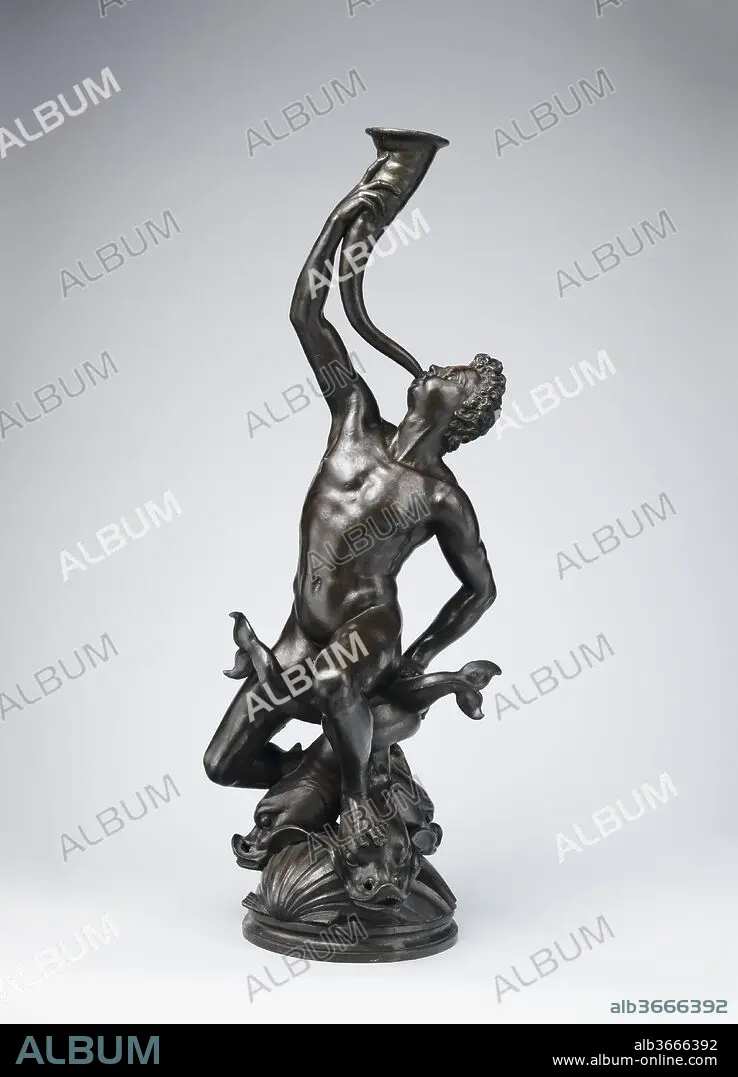
Triton. Artist: Giambologna (Netherlandish, Douai 1529-1608 Florence). Culture: Italian, Florence. Dimensions: Height: 36 in., 53.9 lb. (91.4 cm, 24.4 kg). Date: 1560-70. The Triton, seated on a circular base formed of three dolphins with tails interlaced and heads resting on three inverted scallop shells, originally served as a fountain figure. Like most of the sculptor's compositions, this work was meant to be viewed from all sides. With its supple modeling and its vigorous chasing, the present bronze is the earliest example of this composition to survive and should be dated to the artist's early maturity, in the 1560s, shortly after he arrived in Florence from his native Flanders. Giambologna was renowned for his skill in casting bronze, the medium in which almost all his work (ranging in scale from minute to monumental) was executed. The nature of the casting process lent itself to the multiplication of original models under the sculptor's supervision as well as the production of so-called aftercasts. One of Giambologna's own casts of the Triton, presumably fairly large like this example, was sent to France along with a cast of his celebrated Mercury. Known reductions of the Triton composition show the streamlined simplifications that mark the majority of later bronzes after Giovanni Bologna's models, which became increasingly popular during the seventeenth century.
Triton. Artist: Giambologna (Netherlandish, Douai 1529-1608 Florence). Culture: Italian, Florence. Dimensions: Height: 36 in., 53.9 lb. (91.4 cm, 24.4 kg). Date: 1560-70. The Triton, seated on a circular base formed of three dolphins with tails interlaced and heads resting on three inverted scallop shells, originally served as a fountain figure. Like most of the sculptor's compositions, this work was meant to be viewed from all sides. With its supple modeling and its vigorous chasing, the present bronze is the earliest example of this composition to survive and should be dated to the artist's early maturity, in the 1560s, shortly after he arrived in Florence from his native Flanders. Giambologna was renowned for his skill in casting bronze, the medium in which almost all his work (ranging in scale from minute to monumental) was executed. The nature of the casting process lent itself to the multiplication of original models under the sculptor's supervision as well as the production of so-called aftercasts. One of Giambologna's own casts of the Triton, presumably fairly large like this example, was sent to France along with a cast of his celebrated Mercury. Known reductions of the Triton composition show the streamlined simplifications that mark the majority of later bronzes after Giovanni Bologna's models, which became increasingly popular during the seventeenth century.
Técnica/material: Bronce
Museo: Metropolitan Museum of Art, New York, USA
Crédito: Album
Tamaño imagen: 3171 × 4400 px | 39.9 MB
Tamaño impresión: 26.8 × 37.3 cm | 1248.4 × 1732.3 in (300 dpi)
Palabras clave: ALEACIÓN DE COBRE • BRONCE • BRONZE • ESCULTURA EUROPEA Y ARTES DECORATIVAS • ESCULTURA • ESTATUAS • ESTATUILLA • EUROPA • FLORENCIA • GIAMBOLOGNA • ITALIA • METAL • METROPOLITAN MUSEUM OF ART, NEW YORK, USA • OBRA DE BRONCE • TUSCANY
