

alb3769965
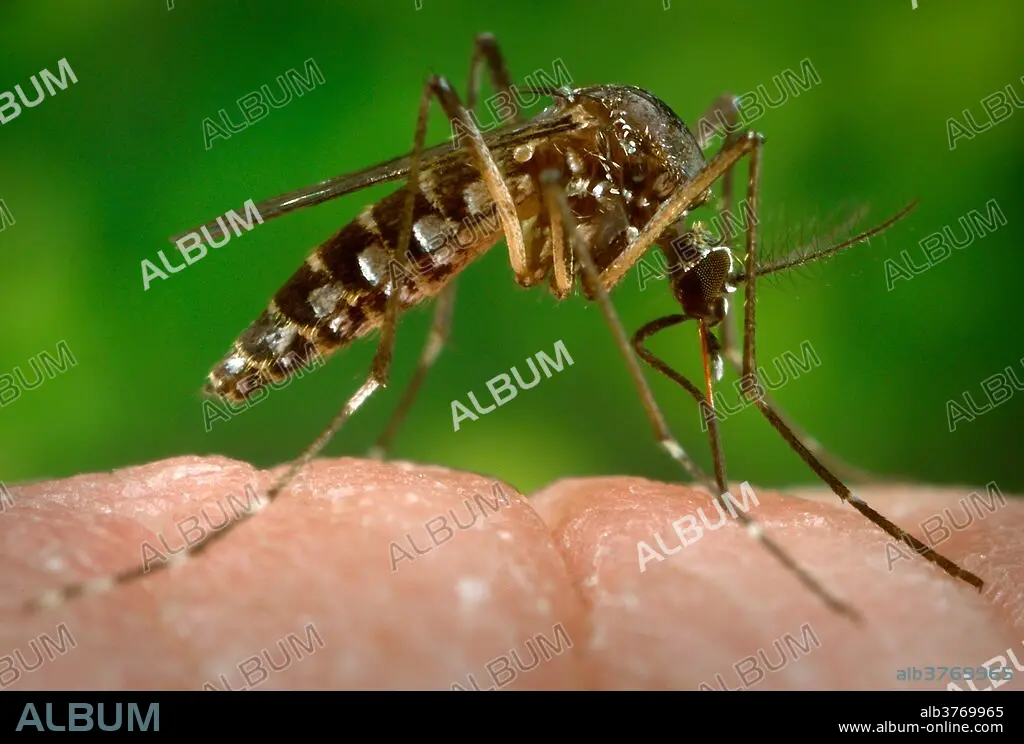
Aedes aegypti Mosquito, Tropical Fever Vector
| Compartir |
|---|
 Pinterest Pinterest |
 Twitter Twitter |
 Facebook Facebook |
 Copiar enlace Copiar enlace |
 Email Email |
|
Añadir a otro lightbox |
|
Añadir a otro lightbox |


¿Ya tienes cuenta? Iniciar sesión
¿No tienes cuenta? Regístrate
Compra esta imagen.
Selecciona el uso:

Título: Aedes aegypti Mosquito, Tropical Fever Vector
Descripción: Ver traducción automática
Female Aedes aegypti mosquito as she was in the process of flying from its human host. Note that her abdomen had become distended due to the fact that her stomach now filled with her blood meal, and how the proboscis' labial sheath was now pulled up, pointing forward, while no longer was the fascicle inserted in the host's skin. As the primary vector responsible for the transmission of the Zika virus, Flavivirus Dengue (DF), and Dengue hemorrhagic fever (DHF), the day-biting Aedes aegypti mosquito prefers to feed on its human hosts. Ae. aegypti also plays a major role as a vector for another Flavivirus, "Yellow fever". Frequently found in its tropical environs, the white banded markings on the tarsal segments of its jointed legs, though distinguishing it as Ae. aegypti, are similar to some other mosquito species. Also note the lyre-shaped, silvery-white markings on its thoracic region as well, which is also a determining morphologic identifying characteristic.
Female Aedes aegypti mosquito as she was in the process of flying from its human host. Note that her abdomen had become distended due to the fact that her stomach now filled with her blood meal, and how the proboscis' labial sheath was now pulled up, pointing forward, while no longer was the fascicle inserted in the host's skin. As the primary vector responsible for the transmission of the Zika virus, Flavivirus Dengue (DF), and Dengue hemorrhagic fever (DHF), the day-biting Aedes aegypti mosquito prefers to feed on its human hosts. Ae. aegypti also plays a major role as a vector for another Flavivirus, "Yellow fever". Frequently found in its tropical environs, the white banded markings on the tarsal segments of its jointed legs, though distinguishing it as Ae. aegypti, are similar to some other mosquito species. Also note the lyre-shaped, silvery-white markings on its thoracic region as well, which is also a determining morphologic identifying characteristic.
Crédito: Album / Science Source / CDC/James Gathany
Autorizaciones: ? Cesión de modelo: No - ? Cesión de propiedad: No
¿Preguntas relacionadas con los derechos?
¿Preguntas relacionadas con los derechos?
Tamaño imagen: 4500 × 3036 px | 39.1 MB
Tamaño impresión: 38.1 × 25.7 cm | 1771.7 × 1195.3 in (300 dpi)
Palabras clave: AEDES AEGYPTI • AEDES • ARTROPODO • ARTROPODOS • CIENCIA • CONTAGIOSO • CULICIDAE • DIPTERA • DÍPTEROS • ENFERMEDAD • ENFERMEDADES INFECCIOSAS • EPIDEMIOLOGÍA • INSECTO • MOSQUITO • MOSQUITOS • MUJER • PATÓGENOS • VECTOR • ZOOLOGIA
