

alb4014120
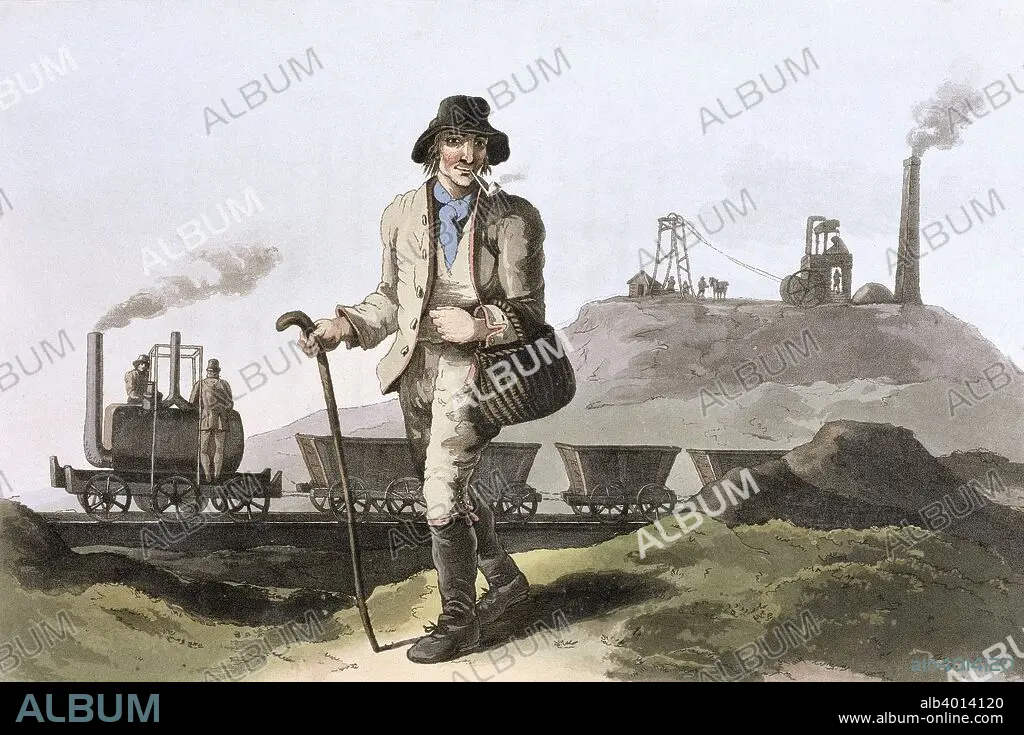
Blenkinsop steam locomotive at Middleton colliery near Leeds, West Yorkshire, 1814. Artist: Robert Havell
| Compartir |
|---|
 Pinterest Pinterest |
 Twitter Twitter |
 Facebook Facebook |
 Copiar enlace Copiar enlace |
 Email Email |
|
Añadir a otro lightbox |
|
Añadir a otro lightbox |


¿Ya tienes cuenta? Iniciar sesión
¿No tienes cuenta? Regístrate
Compra esta imagen.
Selecciona el uso:

Título: Blenkinsop steam locomotive at Middleton colliery near Leeds, West Yorkshire, 1814. Artist: Robert Havell
Descripción:
Traducción automática: Locomotora de vapor Blenkinsop en la mina de carbón de Middleton, cerca de Leeds, West Yorkshire, 1814. Del traje de Yorkshire de George Walker, 1814. El ingeniero de minas e inventor John Blenkinsop (1783-1831) diseñó la primera locomotora de vapor practicable, la 'Salamanca', en 1812. Funcionaba mediante un sistema de piñón y cremallera. Richard Trevithick había construido una locomotora de vapor en 1805 para la mina de carbón Wylam, pero era demasiado pesada para los rieles de hierro fundido sobre los que debía circular. La mina de carbón de Middleton colocó rieles de borde de hierro, que eran más fuertes que los utilizados en Wylam. Blenkinsop construyó tres locomotoras más para la mina de carbón, que siguió funcionando en el ferrocarril hasta la década de 1830. Mientras tanto, nuevas mejoras en el diseño de los rieles significaron que se podían usar locomotoras de adhesión más pesadas, reemplazando a los motores de piñón y cremallera de Blenkinsop.
Blenkinsop steam locomotive at Middleton colliery near Leeds, West Yorkshire, 1814. From Costume of Yorkshire by George Walker, 1814. Mining engineer and inventor John Blenkinsop (1783-1831) designed the first practicable steam locomotive, the 'Salamanca', in 1812. It operated by means of a rack and pinion system. Richard Trevithick had built a steam locomotive in 1805 for Wylam colliery, but it had been too heavy for the cast iron rails it was meant to run on. Middleton colliery laid iron edge rails, which were stronger than those used at Wylam. Blenkinsop went on to build three further locomotives for the colliery, which carried on operating on the railway into the 1830s. In the meantime, further improvements in rail design meant that heavier adhesion locomotives could be used, superseding Blenkinsop's rack and pinion engines.
Crédito: Album / Heritage Images / Historica Graphica Collection
Autorizaciones: ? Cesión de modelo: No - ? Cesión de propiedad: No
¿Preguntas relacionadas con los derechos?
¿Preguntas relacionadas con los derechos?
Tamaño imagen: 5126 × 3415 px | 50.1 MB
Tamaño impresión: 43.4 × 28.9 cm | 2018.1 × 1344.5 in (300 dpi)
Palabras clave: ACONTECIMIENTO • BRITANICO • CHICO • CIENCIA • COLOR • COLORIDO • CONCEPTO • FERROCARRIL • GENTE • GRAN BRETAÑA • HOMBRE • HOMBRES • INDUSTRIA • INDUSTRIAS • INGLATERRA • INGLES • INNOVACIÓN • INVENCION • LOCOMOTORA A VAPOR • LOCOMOTORA VAPOR • MAQUINA DE VAPOR • MASCULINO • MINA CARBON • MINA DE CARBON • PAÍS • RETRATO DE HOMBRE • REVOLUCION INDUSTRIAL • ROPA • SIGLO • SOMBRERO • TECNOLOGÍA • TRANSPORTE • VAPOR • VESTIDO • WEST YORKSHIRE
