

alb3794604
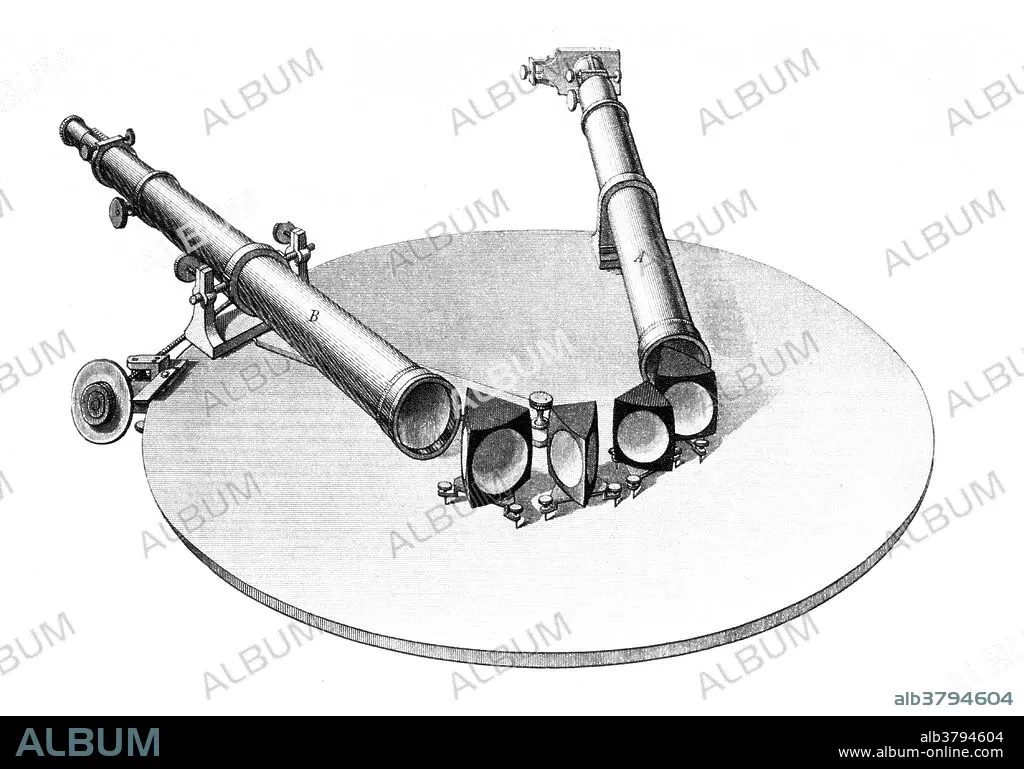
Spectroscope, 1861
| Compartir |
|---|
 Pinterest Pinterest |
 Twitter Twitter |
 Facebook Facebook |
 Copiar enlace Copiar enlace |
 Email Email |
|
Añadir a otro lightbox |
|
Añadir a otro lightbox |


¿Ya tienes cuenta? Iniciar sesión
¿No tienes cuenta? Regístrate
Compra esta imagen.
Selecciona el uso:

Título: Spectroscope, 1861
Descripción: Ver traducción automática
Illustration of a spectroscope taken from the 1861 German edition of Kirchoff's, Studies of the Solar Spectrum and the Spectra of the Chemical Elements'. In 1855 Robert Bunsen had created the Bunsen burner for use in flame tests of various metals and salts: its non-luminous flame did not interfere with the colored flame given off by the test material. This line of work led to the spectroscope. It was Kirchhoff who suggested that similarly colored flames could possibly be differentiated by looking at their emission spectra through a prism. When he shone bright light through such flames, the dark lines in the absorption spectrum of the light corresponded in wavelengths, with the wavelengths of the bright, sharp lines characteristic of the emission spectra of the same test materials. A spectroscope is an instrument for producing and observing spectra. In the 1890's scientists began using spectroscopy for medical research and criminal investigations. The field of toxicology was the first to benefit. Late 19th-century forensic pathologists were enthusiastic about the potential uses of spectroscopic analysis to detect the presence of carbon monoxide and other poisons in blood. A small specimen of blood, diluted in water, absorbed light of certain colors and could be subjected to spectroscopic analysis. This analysis could reveal the presence of carbon monoxide and other poisons. However this technique, using the naked eye to view the spectrum, was imprecise.
Illustration of a spectroscope taken from the 1861 German edition of Kirchoff's, Studies of the Solar Spectrum and the Spectra of the Chemical Elements'. In 1855 Robert Bunsen had created the Bunsen burner for use in flame tests of various metals and salts: its non-luminous flame did not interfere with the colored flame given off by the test material. This line of work led to the spectroscope. It was Kirchhoff who suggested that similarly colored flames could possibly be differentiated by looking at their emission spectra through a prism. When he shone bright light through such flames, the dark lines in the absorption spectrum of the light corresponded in wavelengths, with the wavelengths of the bright, sharp lines characteristic of the emission spectra of the same test materials. A spectroscope is an instrument for producing and observing spectra. In the 1890's scientists began using spectroscopy for medical research and criminal investigations. The field of toxicology was the first to benefit. Late 19th-century forensic pathologists were enthusiastic about the potential uses of spectroscopic analysis to detect the presence of carbon monoxide and other poisons in blood. A small specimen of blood, diluted in water, absorbed light of certain colors and could be subjected to spectroscopic analysis. This analysis could reveal the presence of carbon monoxide and other poisons. However this technique, using the naked eye to view the spectrum, was imprecise.
Crédito: Album / Science Source / New York Public Library
Autorizaciones: ? Cesión de modelo: No - ? Cesión de propiedad: No
¿Preguntas relacionadas con los derechos?
¿Preguntas relacionadas con los derechos?
Tamaño imagen: 4500 × 3145 px | 40.5 MB
Tamaño impresión: 38.1 × 26.6 cm | 1771.7 × 1238.2 in (300 dpi)
Palabras clave: 1861 • ALEMAN • ALEMANA • ALEMANES • ANALISIS • ARTE • BLANCO Y NEGRO • BUNSEN • CIENCIA • DIBUJO • EQUIPAMIENTO • EQUIPO • ESPECTRO • ESPECTRÓGRAFO • ESPECTRÓMETRO • ESPECTROS • ESPECTROSCOPIA • ESPECTROSCOPIO • EUROPEA • EUROPEAS • EUROPEO • EUROPEOS • FÍSICA (CIENCIA) • FÍSICO (CIENTIFICO) • HERRAMIENTA • HISTORIA • HISTORICO • ILUSTRACION • ILUSTRACIONES • INSTRUMENTO • INVENCION • INVESTIGACION • LUZ • MEDICINA • MEDICINAL • METODO • OBRA DE ARTE • PATÓLOGO FORENSE • QUIMICA • QUIMICO • SIGLO XVII • TOXICOLOGO
