

alb5408592
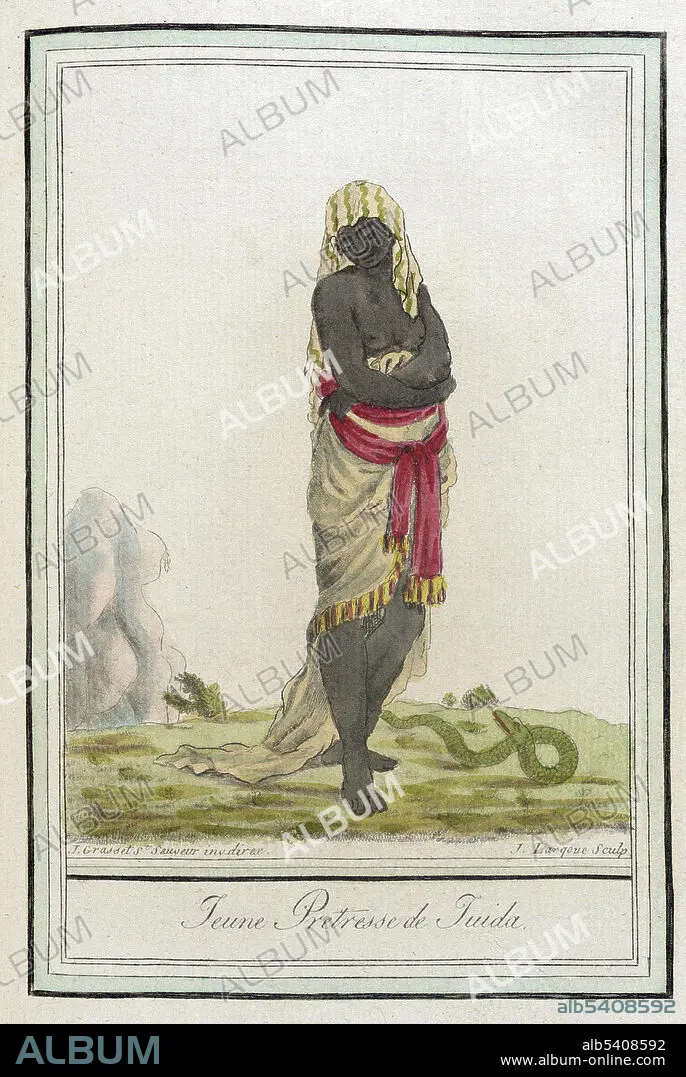
West Africa, Ouidah Vodun Priestess,1797
| Compartir |
|---|
 Pinterest Pinterest |
 Twitter Twitter |
 Facebook Facebook |
 Copiar enlace Copiar enlace |
 Email Email |
|
Añadir a otro lightbox |
|
Añadir a otro lightbox |


¿Ya tienes cuenta? Iniciar sesión
¿No tienes cuenta? Regístrate
Compra esta imagen.
Selecciona el uso:

Título: West Africa, Ouidah Vodun Priestess,1797
Descripción: Ver traducción automática
Jeune Pretresse de Juida. Young Priestess of Juida. Vodun is practiced by the Fon people of Benin, and southern and central Togo; as well in Ghana, and Nigeria. The high priestess is the woman chosen by the oracle to care for the convent. Priestesses, like priests, receive a calling from an oracle, which may come at any moment during their lives. They will then join their clan's convent to pursue spiritual instruction. European colonialism, followed by some of the totalitarian regimes in West Africa, have tried to suppress Vodun, but because the vodun deities are born to each clan, tribe, and nation, and their clergy are central to maintaining the moral, social and political order and ancestral foundation of its village, these efforts have not been successful. Ouidah or Whydah, formerly the Kingdom of Whydah, is a city on the coast of the Republic of Benin. Whydah troops pushed their way into the African interior, capturing millions of people through tribal wars, and selling them to the Europeans and Arabs. By 1716, the Kingdom of Whydah had become the second largest slave port in the Triangular trade. Costumes of Different Countries, hand-tinted engraving by Labrousse, published by Jacques Grasset de Saint-Sauveur, 1797.
Jeune Pretresse de Juida. Young Priestess of Juida. Vodun is practiced by the Fon people of Benin, and southern and central Togo; as well in Ghana, and Nigeria. The high priestess is the woman chosen by the oracle to care for the convent. Priestesses, like priests, receive a calling from an oracle, which may come at any moment during their lives. They will then join their clan's convent to pursue spiritual instruction. European colonialism, followed by some of the totalitarian regimes in West Africa, have tried to suppress Vodun, but because the vodun deities are born to each clan, tribe, and nation, and their clergy are central to maintaining the moral, social and political order and ancestral foundation of its village, these efforts have not been successful. Ouidah or Whydah, formerly the Kingdom of Whydah, is a city on the coast of the Republic of Benin. Whydah troops pushed their way into the African interior, capturing millions of people through tribal wars, and selling them to the Europeans and Arabs. By 1716, the Kingdom of Whydah had become the second largest slave port in the Triangular trade. Costumes of Different Countries, hand-tinted engraving by Labrousse, published by Jacques Grasset de Saint-Sauveur, 1797.
Personas: BÉNIN (16th century)
Crédito: Album / Science Source / Los Angeles County Museum
Autorizaciones: ? Cesión de modelo: No - ? Cesión de propiedad: No
¿Preguntas relacionadas con los derechos?
¿Preguntas relacionadas con los derechos?
Tamaño imagen: 3215 × 4800 px | 44.2 MB
Tamaño impresión: 27.2 × 40.6 cm | 1265.7 × 1889.8 in (300 dpi)
Palabras clave: AFRICA OCCIDENTAL • AFRICA • BÉNIN • HISTORIA • RELIGION • ROPA • S. XVIII • SIGLO XVIII • TRADICIONAL • TRIBU • VESTIDO DE NATIVO • VODUN
