

alb5531897
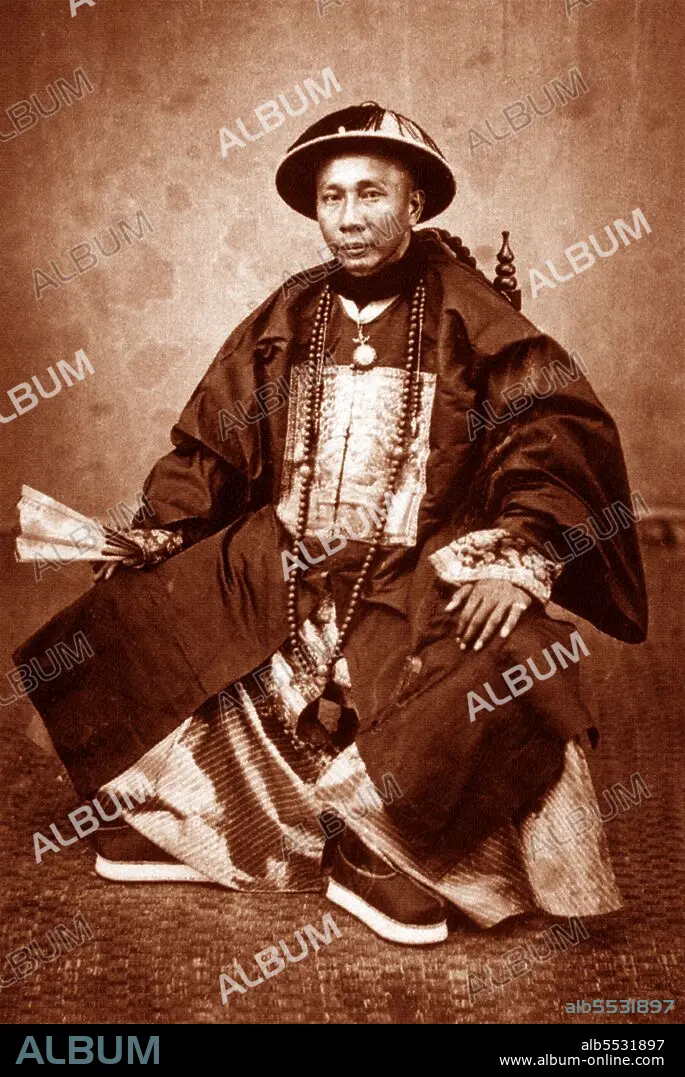
Malaysia: Yap Loong Hin (1873-1937), the head of the Chinese Yap Clan and owner of a number of tin mines in the Malay States, in full Manchu ceremonial garb, late 19th century.
| Compartir |
|---|
 Pinterest Pinterest |
 Twitter Twitter |
 Facebook Facebook |
 Copiar enlace Copiar enlace |
 Email Email |
|
Añadir a otro lightbox |
|
Añadir a otro lightbox |


¿Ya tienes cuenta? Iniciar sesión
¿No tienes cuenta? Regístrate
Compra esta imagen.
Selecciona el uso:

Título: Malaysia: Yap Loong Hin (1873-1937), the head of the Chinese Yap Clan and owner of a number of tin mines in the Malay States, in full Manchu ceremonial garb, late 19th century.
Descripción: Ver traducción automática
Peranakan Chinese and Baba-Nyonya are terms used for the descendants of late 15th and 16th-century Chinese immigrants to the Malay-Indonesian archipelago of Nusantara during the Colonial era. Members of this community in Malaysia identify themselves as 'Nyonya-Baba' or 'Baba-Nyonya'. Nyonya is the term for the females and Baba for males. It applies especially to the ethnic Chinese populations of the British Straits Settlements of Malaya and the Dutch-controlled island of Java and other locations, who adopted partially or in full Malay-Indonesian customs to become partially assimilated into the local communities. While the term Peranakan is most commonly used among the ethnic Chinese for those of Chinese descent also known as Straits Chinese (????; named after the Straits Settlements), it may also be applied to the Baba-Yaya community in Phuket and other provinces of southern Thailand.
Peranakan Chinese and Baba-Nyonya are terms used for the descendants of late 15th and 16th-century Chinese immigrants to the Malay-Indonesian archipelago of Nusantara during the Colonial era. Members of this community in Malaysia identify themselves as 'Nyonya-Baba' or 'Baba-Nyonya'. Nyonya is the term for the females and Baba for males. It applies especially to the ethnic Chinese populations of the British Straits Settlements of Malaya and the Dutch-controlled island of Java and other locations, who adopted partially or in full Malay-Indonesian customs to become partially assimilated into the local communities. While the term Peranakan is most commonly used among the ethnic Chinese for those of Chinese descent also known as Straits Chinese (????; named after the Straits Settlements), it may also be applied to the Baba-Yaya community in Phuket and other provinces of southern Thailand.
Crédito: Album / Pictures from History/Universal Images Group
Autorizaciones: ? Cesión de modelo: No - ? Cesión de propiedad: No
¿Preguntas relacionadas con los derechos?
¿Preguntas relacionadas con los derechos?
Tamaño imagen: 3343 × 5000 px | 47.8 MB
Tamaño impresión: 28.3 × 42.3 cm | 1316.1 × 1968.5 in (300 dpi)
