

alb5477430
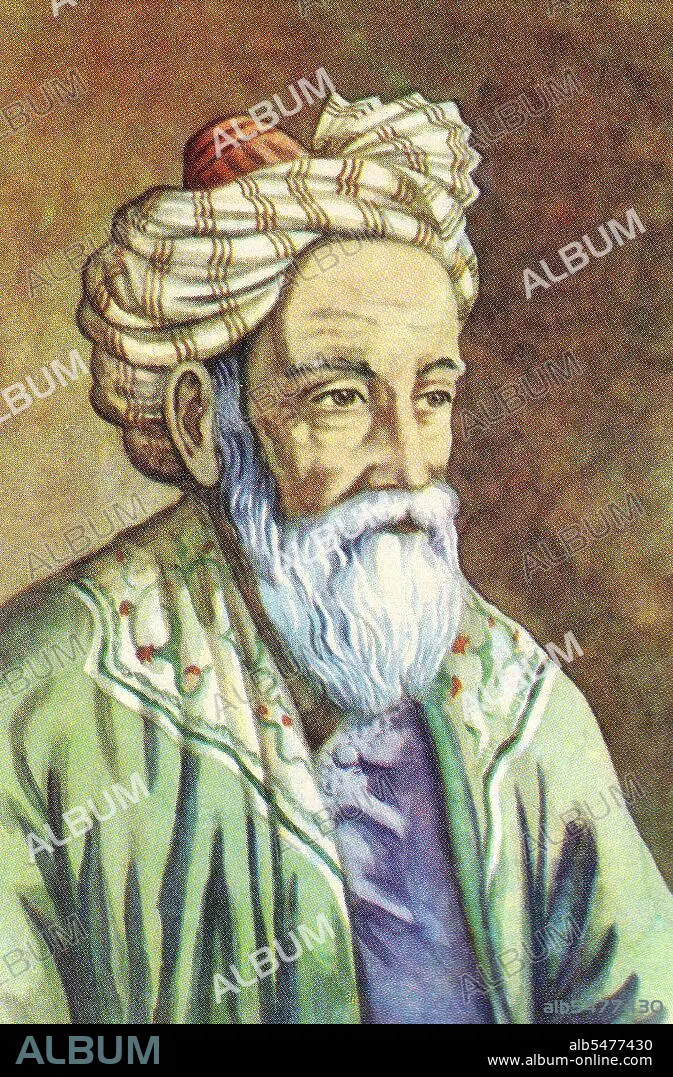
Iran-Persia: Omar Khayyam as envisaged by an unknown Persian artist,19th century
| Compartir |
|---|
 Pinterest Pinterest |
 Twitter Twitter |
 Facebook Facebook |
 Copiar enlace Copiar enlace |
 Email Email |
|
Añadir a otro lightbox |
|
Añadir a otro lightbox |


¿Ya tienes cuenta? Iniciar sesión
¿No tienes cuenta? Regístrate
Compra esta imagen.
Selecciona el uso:

Título: Iran-Persia: Omar Khayyam as envisaged by an unknown Persian artist,19th century
Descripción: Ver traducción automática
Omar Khayyám (1048–1131; Persian: ???? ????) was a Persian polymath: philosopher, mathematician, astronomer and poet. He also wrote treatises on mechanics, geography, mineralogy, music, climatology and theology. Born in Nishapur, at a young age he moved to Samarkand and obtained his education there, afterwards he moved to Bukhara and became established as one of the major mathematicians and astronomers of the medieval period. He is the author of one of the most important treatises on algebra written before modern times, the Treatise on Demonstration of Problems of Algebra, which includes a geometric method for solving cubic equations by intersecting a hyperbola with a circle. He contributed to a calendar reform. His significance as a philosopher and teacher, and his few remaining philosophical works, have not received the same attention as his scientific and poetic writings. Zamakhshari referred to him as 'the philosopher of the world'. Many sources have testified that he taught for decades the philosophy of Ibn Sina in Nishapur where Khayyám was born and buried and where his mausoleum today remains a masterpiece of Iranian architecture visited by many people every year.
Omar Khayyám (1048–1131; Persian: ???? ????) was a Persian polymath: philosopher, mathematician, astronomer and poet. He also wrote treatises on mechanics, geography, mineralogy, music, climatology and theology. Born in Nishapur, at a young age he moved to Samarkand and obtained his education there, afterwards he moved to Bukhara and became established as one of the major mathematicians and astronomers of the medieval period. He is the author of one of the most important treatises on algebra written before modern times, the Treatise on Demonstration of Problems of Algebra, which includes a geometric method for solving cubic equations by intersecting a hyperbola with a circle. He contributed to a calendar reform. His significance as a philosopher and teacher, and his few remaining philosophical works, have not received the same attention as his scientific and poetic writings. Zamakhshari referred to him as 'the philosopher of the world'. Many sources have testified that he taught for decades the philosophy of Ibn Sina in Nishapur where Khayyám was born and buried and where his mausoleum today remains a masterpiece of Iranian architecture visited by many people every year.
Crédito: Album / Pictures From History/Universal Images Group
Autorizaciones: ? Cesión de modelo: No - ? Cesión de propiedad: No
¿Preguntas relacionadas con los derechos?
¿Preguntas relacionadas con los derechos?
Tamaño imagen: 3350 × 5100 px | 48.9 MB
Tamaño impresión: 28.4 × 43.2 cm | 1318.9 × 2007.9 in (300 dpi)
Palabras clave: ART • ARTE • ARTES • ASIA • ASIATICO • ASTRONOMIA • ASTRONOMO • FILOSOFIA • FILOSOFO • HISTORIA • HISTORICO • IRAN • IRANIO • LIRICA • LIRICO • LITERATO • LITERATURA • LITERATURE • MATEMATICA • MATEMATICAS • MATEMÁTICO • MATEMATICOS • MITOLOGIA: PERSA • PERSA • PERSAS • PERSIA • PINTURA • POESIA • POETA
