

alb9110092
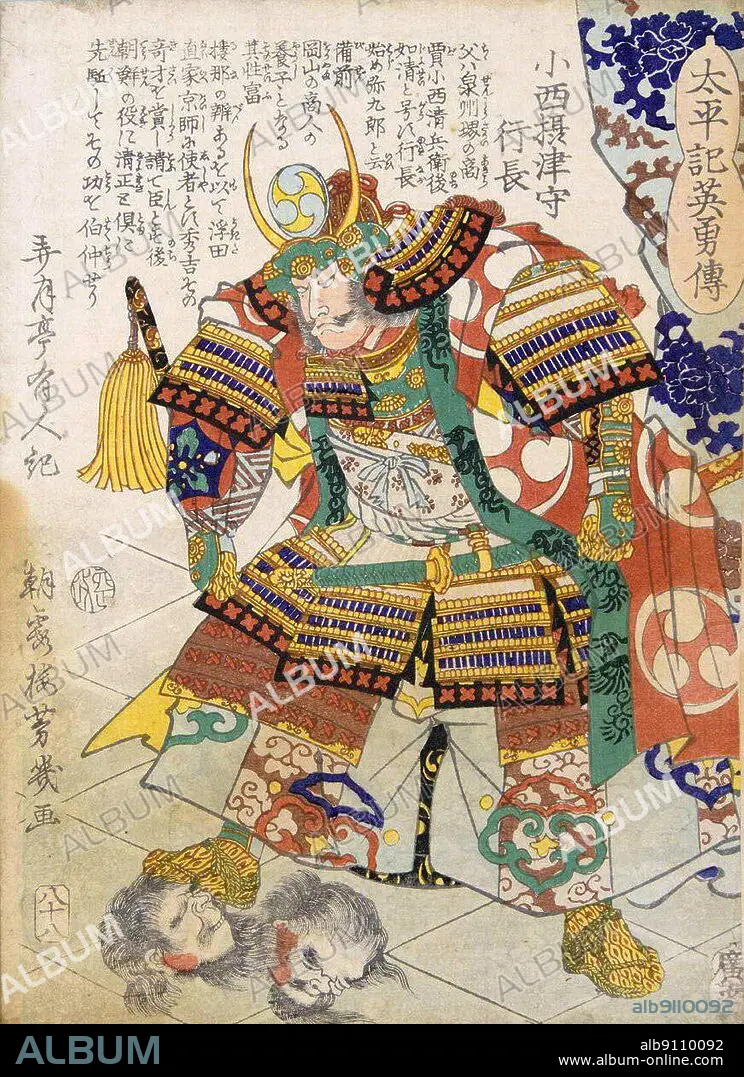
Daimyo Konishi
| Compartir |
|---|
 Pinterest Pinterest |
 Twitter Twitter |
 Facebook Facebook |
 Copiar enlace Copiar enlace |
 Email Email |
|
Añadir a otro lightbox |
|
Añadir a otro lightbox |


¿Ya tienes cuenta? Iniciar sesión
¿No tienes cuenta? Regístrate
Compra esta imagen.
Selecciona el uso:

Título: Daimyo Konishi
Descripción:
Traducción automática: Konishi Yukinaga (1555 - 1600) Samurai japonés y daimyo bajo el mando de Toyotomi Hideyoshi durante el período Azuchi-Momoyama de la historia japonesa. En 1587, durante la invasión de Kyushu, sofocó una revuelta local en la provincia de Figa, por lo que fue recompensado con un feudo en esa provincia. Yukinaga comandó las primeras tropas enviadas durante las invasiones japonesas a Corea, donde se destacó por la captura de Busan y Seúl y la defensa de Pyongyang. Tras la muerte de Hideyoshi, Yukinaga se unió al bando de Ishida Mitsunari durante la Batalla de Sekigahara en 1600, donde derrotó al lado de Tokugawa Ieyasu y tuvo que huir al Monte Ibuki, pero luego fue capturado. Habiéndose convertido al cristianismo, se negó a cometer Seppuku (una forma de suicidio ritual japonés por destripamiento, originalmente reservado para los samuráis en su código de honor, pero también fue practicado por otros japoneses durante el período Showa para restaurar el honor para ellos mismos o para ellos). sus familias). El fue ejecutado
Konishi Yukinaga (1555 - 1600 ) Japanese samurai and daimyo under the command of Toyotomi Hideyoshi during the Azuchi-Momoyama period of Japanese history . In 1587, during the invasion of Kyushu, he quelled a local revolt in the province of Figa so he was rewarded with a fief in that province. Yukinaga commanded the first troops sent during the Japanese invasions of Korea, where he stood out for the capture of Busan and Seoul and the defense of Pyongyang.. After Hideyoshi's death, Yukinaga joined Ishida Mitsunari 's side during the Battle of Sekigahara in 1600, where he defeated Tokugawa Ieyasu's side and had to flee to Mount Ibuki but was later captured. Having converted to Christianity, he refused to commit Seppuku (a form of Japanese ritual suicide by disembowelment, it was originally reserved for samurai in their code of honor but was also practiced by other Japanese people during the Showa period to restore honor for themselves or for their families). He was executed.
Crédito: Album / Universal History Archive/Universal Images Group
Autorizaciones: ? Cesión de modelo: No - ? Cesión de propiedad: No
¿Preguntas relacionadas con los derechos?
¿Preguntas relacionadas con los derechos?
Tamaño imagen: 3904 × 5372 px | 60.0 MB
Tamaño impresión: 33.1 × 45.5 cm | 1537.0 × 2115.0 in (300 dpi)
Palabras clave: CHRISTIANITY • COREA • COREANO • CRISTIANDAD • CRISTIANISMO • CRISTIANSMO • HONOR • INVASION • JAPON • JAPONES • OCUPACION • RITUAL • S. XVI • SAMURAI • SEUL • SIGLO XVI • SIGLO XVII • SUICIDIO
