

alb5469564
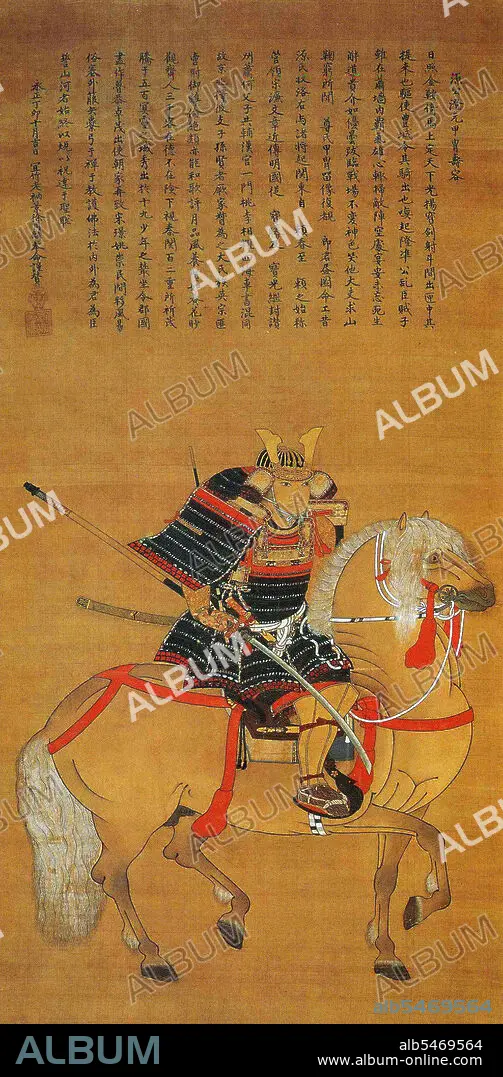
Japan: Portrait of a Samurai warrior in Yamato-e style, undated.
| Compartir |
|---|
 Pinterest Pinterest |
 Twitter Twitter |
 Facebook Facebook |
 Copiar enlace Copiar enlace |
 Email Email |
|
Añadir a otro lightbox |
|
Añadir a otro lightbox |


¿Ya tienes cuenta? Iniciar sesión
¿No tienes cuenta? Regístrate
Compra esta imagen.
Selecciona el uso:

Título: Japan: Portrait of a Samurai warrior in Yamato-e style, undated.
Descripción: Ver traducción automática
Yamato-e is a style of Japanese painting inspired by Tang Dynasty paintings and developed in the late Heian period. It is considered the classical Japanese style. From the Muromachi period (15th century), the term Yamato-e has been used to distinguish work from contemporary Chinese style paintings (kara-e), which were inspired by Song and Yuan Dynasty Zen Buddhism paintings. The Yamato-e often tell narrative themes with text along with them, show the beauty of nature, e.g. famous places (meisho-e), and the four seasons (shiki-e). The pictures are non-symbolic and have the objective of depicting the beauty in nature. The pictures are often on scrolls that can be hung on a wall (kakemono) or handscrolls (emakimono) that could be read from right to left with the accompanying story or on a folding screen (byoubu) or panel (shouji). Although they received their name from the Yamato period (250-710 CE), Yamato-e pictures rather stand for a style and are not restricted to a particular period. Although the most famous artists painted in sumi-e style in the Muromachi period, this was not characteristic of early pictures. Samurai is the term for the military nobility of pre-industrial Japan. By the end of the 12th century, samurai became almost entirely synonymous with bushi, and the word was closely associated with the middle and upper echelons of the warrior class. The samurai followed a set of rules that came to be known as Bushido. While they numbered less than ten percent of Japan's population, samurai teachings can still be found today in both everyday life and in martial arts such as Kendo, meaning the way of the sword.
Yamato-e is a style of Japanese painting inspired by Tang Dynasty paintings and developed in the late Heian period. It is considered the classical Japanese style. From the Muromachi period (15th century), the term Yamato-e has been used to distinguish work from contemporary Chinese style paintings (kara-e), which were inspired by Song and Yuan Dynasty Zen Buddhism paintings. The Yamato-e often tell narrative themes with text along with them, show the beauty of nature, e.g. famous places (meisho-e), and the four seasons (shiki-e). The pictures are non-symbolic and have the objective of depicting the beauty in nature. The pictures are often on scrolls that can be hung on a wall (kakemono) or handscrolls (emakimono) that could be read from right to left with the accompanying story or on a folding screen (byoubu) or panel (shouji). Although they received their name from the Yamato period (250-710 CE), Yamato-e pictures rather stand for a style and are not restricted to a particular period. Although the most famous artists painted in sumi-e style in the Muromachi period, this was not characteristic of early pictures. Samurai is the term for the military nobility of pre-industrial Japan. By the end of the 12th century, samurai became almost entirely synonymous with bushi, and the word was closely associated with the middle and upper echelons of the warrior class. The samurai followed a set of rules that came to be known as Bushido. While they numbered less than ten percent of Japan's population, samurai teachings can still be found today in both everyday life and in martial arts such as Kendo, meaning the way of the sword.
Crédito: Album / Pictures From History/Universal Images Group
Autorizaciones: ? Cesión de modelo: No - ? Cesión de propiedad: No
¿Preguntas relacionadas con los derechos?
¿Preguntas relacionadas con los derechos?
Tamaño imagen: 3000 × 6106 px | 52.4 MB
Tamaño impresión: 25.4 × 51.7 cm | 1181.1 × 2403.9 in (300 dpi)
