

alb5484277
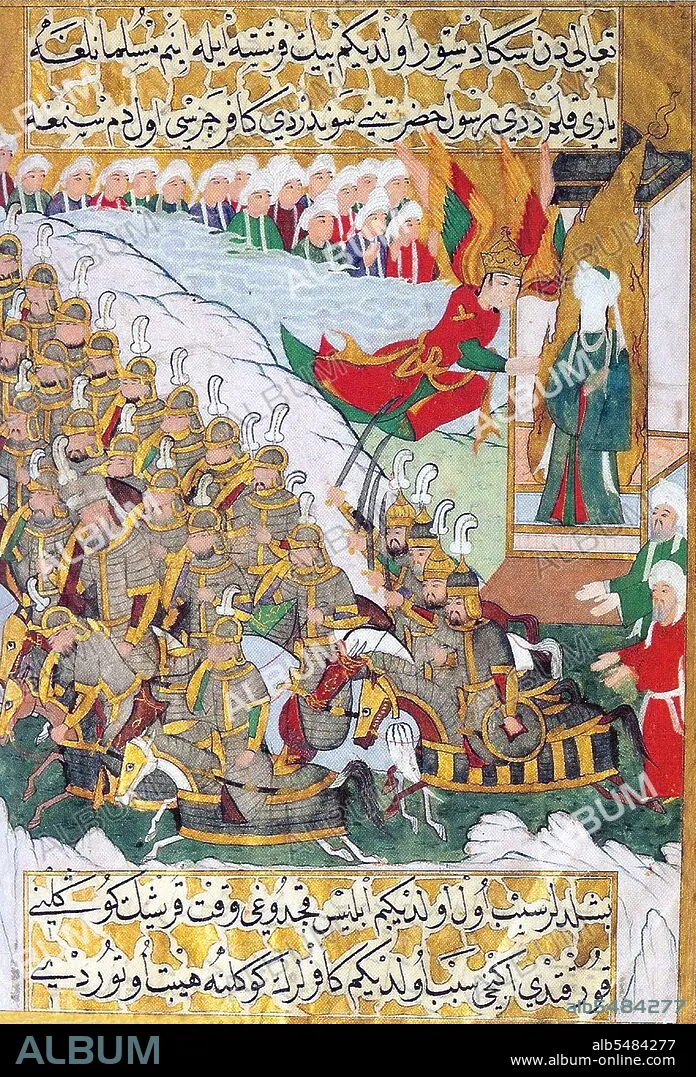
Egypt: Moses holding up his arms during the Battle of Badr, assisted by Aaron and Hur. 19th century engraving
| Compartir |
|---|
 Pinterest Pinterest |
 Twitter Twitter |
 Facebook Facebook |
 Copiar enlace Copiar enlace |
 Email Email |
|
Añadir a otro lightbox |
|
Añadir a otro lightbox |


¿Ya tienes cuenta? Iniciar sesión
¿No tienes cuenta? Regístrate
Compra esta imagen.
Selecciona el uso:

Título: Egypt: Moses holding up his arms during the Battle of Badr, assisted by Aaron and Hur. 19th century engraving
Descripción: Ver traducción automática
The Battle of Badr (Arabic: ???? ????), fought Saturday, March 13, 624 AD (17 Ramadan, 2 AH in the Islamic calendar) in the Hejaz region of western Arabia (present-day Saudi Arabia), was a key battle in the early days of Islam and a turning point in Muhammad's struggle with his opponents among the Quraish in Mecca. The battle has been passed down in Islamic history as a decisive victory attributable to divine intervention, or by secular sources to the strategic genius of Muhammad. It is one of the few battles specifically mentioned in the Qur'an. Most contemporary knowledge of the battle at Badr comes from traditional Islamic accounts, both hadiths and biographies of Muhammad, recorded in written form some time after the battle. Prior to the battle, the Muslims and Meccans had fought several smaller skirmishes in late 623 and early 624, as the Muslim ghazawat (prophet-led battles) had become more frequent. Badr, however, was the first large-scale engagement between the two forces. Advancing to a strong defensive position, Muhammad's well-disciplined force broke the Meccan lines, killing several important Quraishi leaders including Muhammad's chief antagonist, 'Amr ibn Hisham. For the early Muslims the battle was the first sign that they might eventually defeat their enemies among the Meccans. Mecca at that time was one of the richest and most powerful cities in Arabia, fielding an army three times larger than that of the Muslims. The Muslim victory also signalled to other tribes that a new power had arisen in Arabia and strengthened Muhammad’s position as leader of the often fractious community in Medina.
The Battle of Badr (Arabic: ???? ????), fought Saturday, March 13, 624 AD (17 Ramadan, 2 AH in the Islamic calendar) in the Hejaz region of western Arabia (present-day Saudi Arabia), was a key battle in the early days of Islam and a turning point in Muhammad's struggle with his opponents among the Quraish in Mecca. The battle has been passed down in Islamic history as a decisive victory attributable to divine intervention, or by secular sources to the strategic genius of Muhammad. It is one of the few battles specifically mentioned in the Qur'an. Most contemporary knowledge of the battle at Badr comes from traditional Islamic accounts, both hadiths and biographies of Muhammad, recorded in written form some time after the battle. Prior to the battle, the Muslims and Meccans had fought several smaller skirmishes in late 623 and early 624, as the Muslim ghazawat (prophet-led battles) had become more frequent. Badr, however, was the first large-scale engagement between the two forces. Advancing to a strong defensive position, Muhammad's well-disciplined force broke the Meccan lines, killing several important Quraishi leaders including Muhammad's chief antagonist, 'Amr ibn Hisham. For the early Muslims the battle was the first sign that they might eventually defeat their enemies among the Meccans. Mecca at that time was one of the richest and most powerful cities in Arabia, fielding an army three times larger than that of the Muslims. The Muslim victory also signalled to other tribes that a new power had arisen in Arabia and strengthened Muhammad’s position as leader of the often fractious community in Medina.
Crédito: Album / Pictures From History/Universal Images Group
Autorizaciones: ? Cesión de modelo: No - ? Cesión de propiedad: No
¿Preguntas relacionadas con los derechos?
¿Preguntas relacionadas con los derechos?
Tamaño imagen: 3450 × 5076 px | 50.1 MB
Tamaño impresión: 29.2 × 43.0 cm | 1358.3 × 1998.4 in (300 dpi)
