

alb5527942
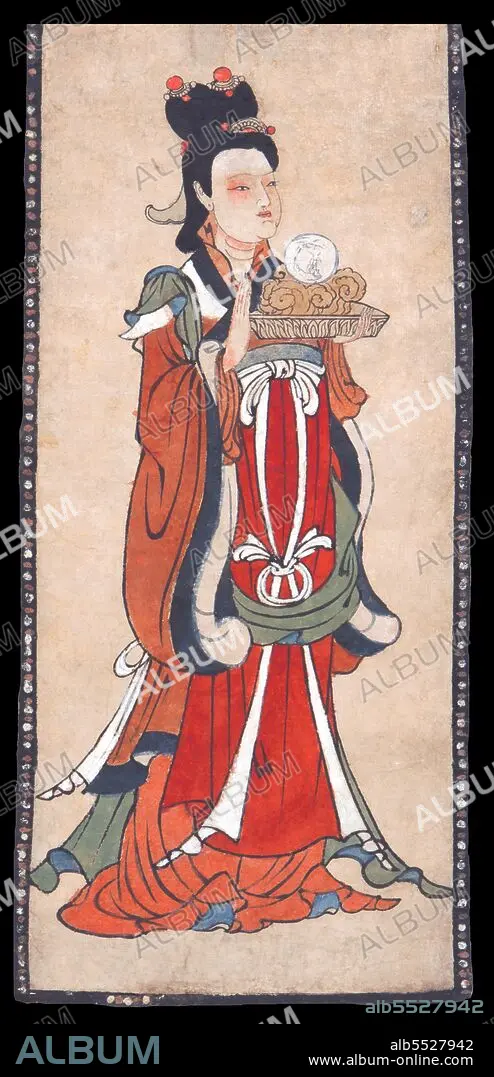
China: Moon Goddess, Kara Khoto, Inner Mongolia, c. 13th-14th century.
| Compartir |
|---|
 Pinterest Pinterest |
 Twitter Twitter |
 Facebook Facebook |
 Copiar enlace Copiar enlace |
 Email Email |
|
Añadir a otro lightbox |
|
Añadir a otro lightbox |


¿Ya tienes cuenta? Iniciar sesión
¿No tienes cuenta? Regístrate
Compra esta imagen.
Selecciona el uso:

Título: China: Moon Goddess, Kara Khoto, Inner Mongolia, c. 13th-14th century.
Descripción: Ver traducción automática
Kara Khoto city was founded in 1032 and became a thriving center of Tangut Empire trade in the 11th century. There are remains of 30-foot (9.1 m)-high ramparts and 12-foot (3.7 m)-thick outer walls. The outer walls ran for some 421 m (1,381 ft) east-west by 374 m (1,227 ft) north-south. The walled fortress was first taken by Genghis Khan in 1226, but—contrary to a widely circulated misunderstanding—the city continued to flourish under Mongol overlordship. During Kublai Khan's time, the city was expanded, reaching a size three times bigger than during the Tangut Empire. Togoontemur Khan concentrated his preparation for reconquest of China at Khara-Khoto. The city was located on the crossroads connecting Karakorum, Xanadu and Kumul. In The Travels of Marco Polo, Marco Polo describes a visit to a city called Etzina or Edzina, which has been identified with Khara-Khoto.
Kara Khoto city was founded in 1032 and became a thriving center of Tangut Empire trade in the 11th century. There are remains of 30-foot (9.1 m)-high ramparts and 12-foot (3.7 m)-thick outer walls. The outer walls ran for some 421 m (1,381 ft) east-west by 374 m (1,227 ft) north-south. The walled fortress was first taken by Genghis Khan in 1226, but—contrary to a widely circulated misunderstanding—the city continued to flourish under Mongol overlordship. During Kublai Khan's time, the city was expanded, reaching a size three times bigger than during the Tangut Empire. Togoontemur Khan concentrated his preparation for reconquest of China at Khara-Khoto. The city was located on the crossroads connecting Karakorum, Xanadu and Kumul. In The Travels of Marco Polo, Marco Polo describes a visit to a city called Etzina or Edzina, which has been identified with Khara-Khoto.
Crédito: Album / State Hermitage Museum/Pictures from History/Universal Images Group
Autorizaciones: ? Cesión de modelo: No - ? Cesión de propiedad: No
¿Preguntas relacionadas con los derechos?
¿Preguntas relacionadas con los derechos?
Tamaño imagen: 2462 × 5100 px | 35.9 MB
Tamaño impresión: 20.8 × 43.2 cm | 969.3 × 2007.9 in (300 dpi)
Palabras clave: ART • ARTE • ARTES • ASIA • ASIATICO • BODHISATTVA • BUDISMO • BUDISTA • BUDISTAS • CHINA • CHINO • HISTORIA • HISTORICO • KHARA-KHOTO • MUNDIAL DE LA UNESCO PATRIMONIO DE LA HUMANIDAD • PINTURA • PORCELANA • RELIGION • RUTA DE LA SEDA
