

alb3806949
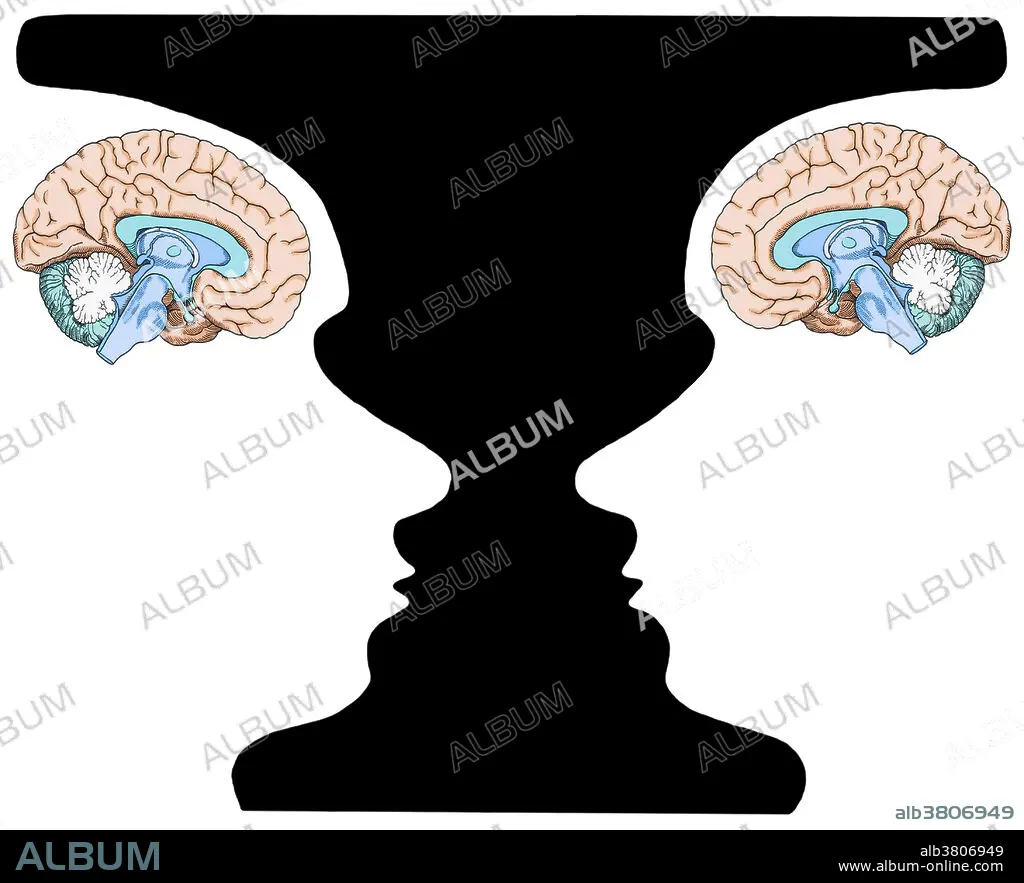
Rubin Vase and Brain, illustration
| Compartir |
|---|
 Pinterest Pinterest |
 Twitter Twitter |
 Facebook Facebook |
 Copiar enlace Copiar enlace |
 Email Email |
|
Añadir a otro lightbox |
|
Añadir a otro lightbox |


¿Ya tienes cuenta? Iniciar sesión
¿No tienes cuenta? Regístrate
Compra esta imagen.
Selecciona el uso:

Título: Rubin Vase and Brain, illustration
Descripción:
Traducción automática: Ilustración conceptual de cerebros superpuestos a la ilusión óptica de un jarrón Rubin. El jarrón Rubin es un famoso conjunto de formas bidimensionales ambiguas o biestables (es decir, invertidas) desarrollado alrededor de 1915 por el psicólogo danés Edgar Rubin. El espectador ve la imagen como dos caras mirándose frente a un fondo negro o como un jarrón negro. La forma de la imagen depende del lado de la línea que el espectador elige como parte de la figura. Esto es importante porque el cerebro humano generalmente tiene un solo objeto en el campo de percepción y los demás objetos pasan a un segundo plano.
Conceptual illustration of brains superimposed on the optical illusion of a Rubin vase. The Rubin vase is a famous set of ambiguous or bi-stable (i.e., reversing) two-dimensional forms developed around 1915 by the Danish psychologist Edgar Rubin. A viewer sees the image either as two faces looking at each other in front of a black background, or as a black vase. The shape of the image depends on the side of the line a viewer chooses as part of the figure. This is important because the human brain has in general just one object in the field of perception and the other objects go into the background.
Crédito: Album / Science Source / Jessica Wilson
Autorizaciones: ? Cesión de modelo: No - ? Cesión de propiedad: No
¿Preguntas relacionadas con los derechos?
¿Preguntas relacionadas con los derechos?
Tamaño imagen: 4392 × 3560 px | 44.7 MB
Tamaño impresión: 37.2 × 30.1 cm | 1729.1 × 1401.6 in (300 dpi)
Palabras clave: 1915 • ARTE • CARA • CEREBRO • CIENCIA • CONCEPTO • DIBUJO • FENÓMENOS • HISTORIA • HISTORICO • ILUSTRACION • ILUSTRACIONES • INVERSIÓN • JARRON • OBRA DE ARTE • PERCEPCION • PERSPECTIVAS • PSICOLOGIA • S. XX • SIGLO XX • SIGLO • VISUALES
