

alb3823676
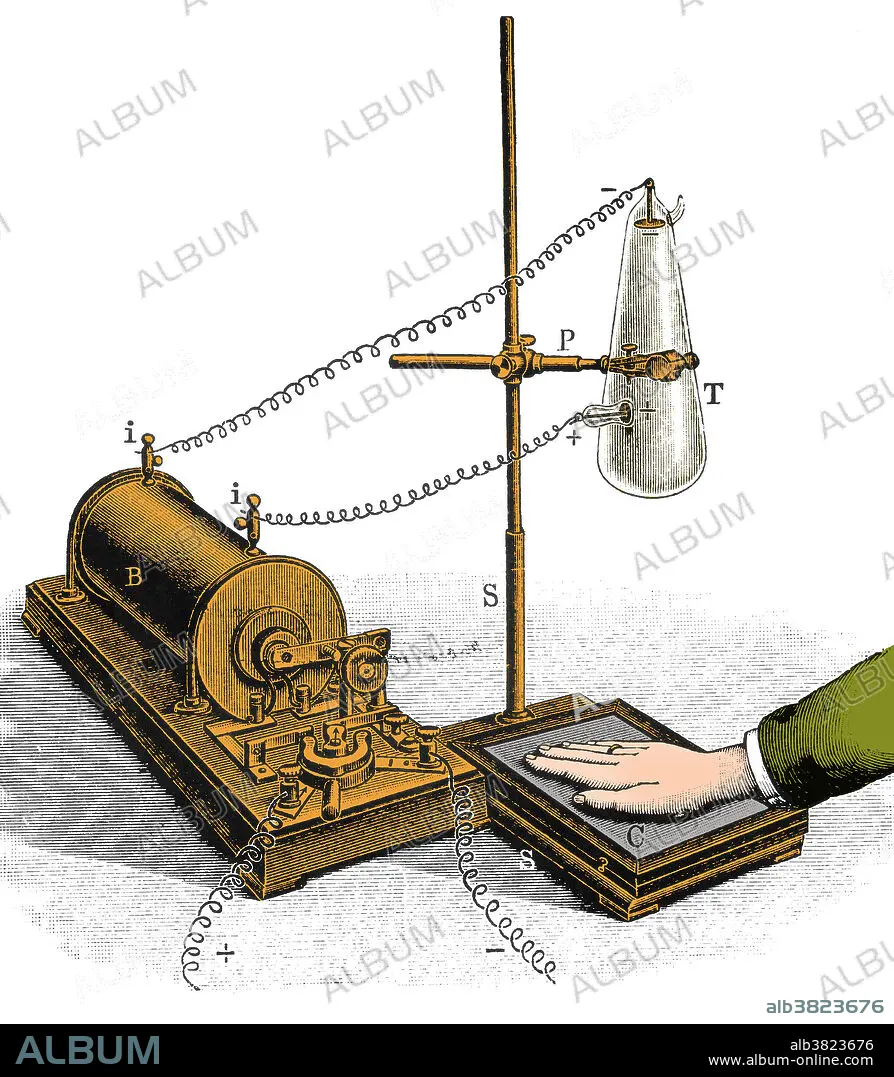
Roentgen's X-Ray Machine, 19th Century
| Compartir |
|---|
 Pinterest Pinterest |
 Twitter Twitter |
 Facebook Facebook |
 Copiar enlace Copiar enlace |
 Email Email |
|
Añadir a otro lightbox |
|
Añadir a otro lightbox |


¿Ya tienes cuenta? Iniciar sesión
¿No tienes cuenta? Regístrate
Compra esta imagen.
Selecciona el uso:

Título: Roentgen's X-Ray Machine, 19th Century
Descripción: Ver traducción automática
Wilhelm Conrad Roentgen (1845-1923), German experimental physicist and discoverer of X-rays. While using a discharge tube (in which an electric discharge is passed through a gas at low pressure) in a darkened room, Roentgen noticed that a card coated with barium platinocyanide glowed when the tube was switched on. The effect was not blocked by an intervening wall, or even a thin sheet of metal. Roentgen termed this newly discovered phenomenon X-ray radiation, and suggested that it consisted of electromagnetic rays with a shorter wavelength than light. He was awarded the first Nobel Prize for Physics in 1901. Drawing of the X-ray machine used by German physicist Wilhelm Roentgen to produce images of the hand. The generator (B) supplied a high voltage to the cathode ray tube (Crookes tube) at upper right (T). This tube produced X-rays which left an image of the hand on a covered, photographic plate (C).
Wilhelm Conrad Roentgen (1845-1923), German experimental physicist and discoverer of X-rays. While using a discharge tube (in which an electric discharge is passed through a gas at low pressure) in a darkened room, Roentgen noticed that a card coated with barium platinocyanide glowed when the tube was switched on. The effect was not blocked by an intervening wall, or even a thin sheet of metal. Roentgen termed this newly discovered phenomenon X-ray radiation, and suggested that it consisted of electromagnetic rays with a shorter wavelength than light. He was awarded the first Nobel Prize for Physics in 1901. Drawing of the X-ray machine used by German physicist Wilhelm Roentgen to produce images of the hand. The generator (B) supplied a high voltage to the cathode ray tube (Crookes tube) at upper right (T). This tube produced X-rays which left an image of the hand on a covered, photographic plate (C).
Crédito: Album / Science Source
Autorizaciones: ? Cesión de modelo: No - ? Cesión de propiedad: No
¿Preguntas relacionadas con los derechos?
¿Preguntas relacionadas con los derechos?
Tamaño imagen: 3082 × 3531 px | 31.1 MB
Tamaño impresión: 26.1 × 29.9 cm | 1213.4 × 1390.2 in (300 dpi)
Palabras clave: 1845 • 1901 • 1923 • ALEMAN • ALEMANA • ALEMANES • ARTE • BARIO • C. • CIENTIFICO • COLOREADA • CUARTO DE BAÑO • DESCUBRIMIENTO • DETECCIÓN • DIBUJO • EQUIPAMIENTO • EQUIPO • EQUIS • EUROPEA • EUROPEAS • EUROPEO • EUROPEOS • EXPERIMENTO • FAMOSA • FAMOSO • FAMOSOS • FÍSICA (CIENCIA) • FÍSICO (CIENTIFICO) • FOTOGRÁFICA • GRABADO • HERRAMIENTA • HISTORIA • HISTORICO • ILUSTRACION • ILUSTRACIONES • IMAGENES • IMPORTANTE • INSTRUMENTO • LAVABO (WC) • LAVABO • LONGITUD DE ONDA • MAQUINA • MEDICINAL • MEJORA • NOBEL • OBRA DE ARTE • ONDA • PLATO • PREMIO NOBEL • PRIMERO • PRODUCIDO • PROFESOR UNIVERSITARIO • RADIACION • RADIACIONES • RADIOGRAFIA • RADIOGRAMA • RADIOLOGIA • RAYA • RAYOS X • S. XIX • S. XX • SIGLO XIX • SIGLO XX • SIGLO • TOMOGRAFÍA • WILHELM • X
