

alb9889650
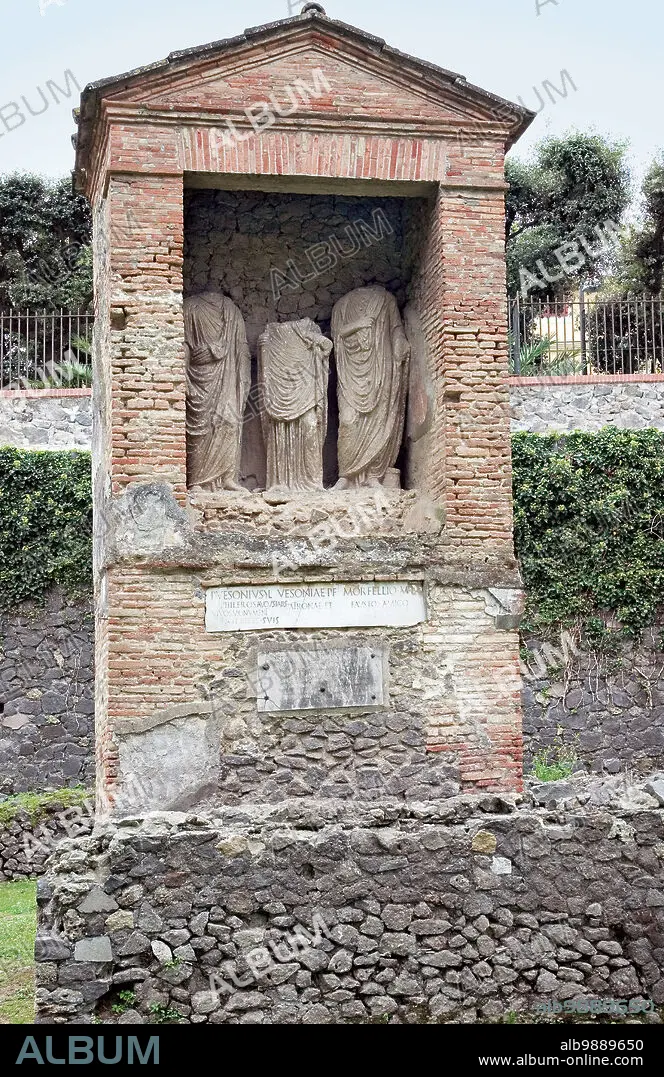
Funeral Monument of Vesonius Phileros
| Compartir |
|---|
 Pinterest Pinterest |
 Twitter Twitter |
 Facebook Facebook |
 Copiar enlace Copiar enlace |
 Email Email |
|
Añadir a otro lightbox |
|
Añadir a otro lightbox |


¿Ya tienes cuenta? Iniciar sesión
¿No tienes cuenta? Regístrate
Compra esta imagen.
Selecciona el uso:

Título: Funeral Monument of Vesonius Phileros
Descripción:
Traducción automática: Monumento funerario de Vesonio Fileros, finales del siglo I a.C.-principios del siglo I d.C. Italia, Campania, Pompeya, necrópolis de Porta Nocera. Total. En el edículo hay tres estatuas de toba, la central femenina y la lateral masculina. Son visibles dos inscripciones: en la primera, más arriba, se especifica que la tumba fue realizada, en vida, por Publio Vesonio Fileros, augustale, liberto de Vesonia, para él, su esposa y su amigo Marco Orfelio Fausto. La segunda losa, incrustada en el estuco del revestimiento y añadida posteriormente, dice: "Pasajero, detente un poco, si no te molesta, y sabe de qué debes tener cuidado. Aquel (cuyo nombre está inscrito) a quien Esperaba que fuera mi amigo, me acusó falsamente. En el juicio, por la gracia de los dioses y mi inocencia, quedé libre de todo acoso. Que el que me calumnió sea rechazado por los dioses arrepentidos y los del inframundo.
Funerary monument of Vesonius Phileros, late 1st century BC-early 1st century AD. Italy, Campania, Pompeii, necropolis of Porta Nocera. Total. In the aedicule are three tufa statues, the central female, the lateral male. Two inscriptions are visible: in the first higher up it is specified that the tomb was made, while he was still alive, by P. Vesonius Phileros, augustale, a freedman of Vesonia, for himself, his wife and his friend Marcus Orfelius Faustus. The second slab, embedded in the stucco of the facing and added at a later time, reads, "Passenger, stop a little, if it does not inconvenience you, and know what you should beware of. He (whose name is inscribed) whom I hoped was my friend, falsely accused me. In judgment, by the grace of the gods and my innocence, I was freed from all harassment. May he who slandered me be rejected by the penitent gods and those of the underworld."
Crédito: Album / Mondadori Portfolio/Electa/Museo Archeologico Nazionale di Napoli
Autorizaciones: ? Cesión de modelo: No - ? Cesión de propiedad: No
¿Preguntas relacionadas con los derechos?
¿Preguntas relacionadas con los derechos?
Tamaño imagen: 2362 × 3644 px | 24.6 MB
Tamaño impresión: 20.0 × 30.9 cm | 929.9 × 1434.6 in (300 dpi)
Palabras clave: ALFABETO • ARCHITECTURAL • ARCHITECTURE • ARQUEOLOGIA • ARQUITECTONICA • ARQUITECTONICO • ARQUITECTURA • CAMPANIA • CAPILLA ARDIENTE • CATAFALCO • CENOTAFIO • DEDICATORIA • EPIGRAFE • ESCRITURA • ESCULPIDA • ESCULTURA • ESCULTURAS • ESTATUA • EXTERIOR • INSCRIPCIÓN • INTERIORES: TODOS • ITALIA • ITALY • LEYENDA • MONUMENTO FUNERARIO • PERSONAJE FEMENINO • PERSONAJE MASCULINO • POMPEI • POMPEYA • STATUE • TODOS • VERTICAL
