

alb5537092
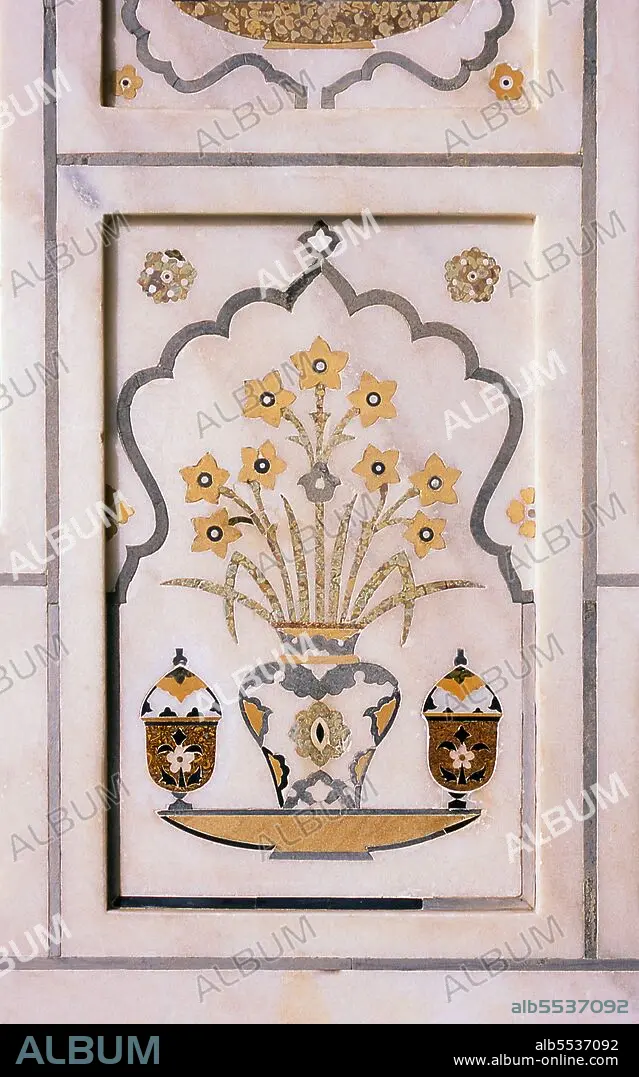
India: Elaborate pietra dura marble inlay at the tomb of I'timad-ud-Daulah, Agra.
| Compartir |
|---|
 Pinterest Pinterest |
 Twitter Twitter |
 Facebook Facebook |
 Copiar enlace Copiar enlace |
 Email Email |
|
Añadir a otro lightbox |
|
Añadir a otro lightbox |


¿Ya tienes cuenta? Iniciar sesión
¿No tienes cuenta? Regístrate
Compra esta imagen.
Selecciona el uso:

Título: India: Elaborate pietra dura marble inlay at the tomb of I'timad-ud-Daulah, Agra.
Descripción: Ver traducción automática
Pietra dura or pietre dure (see below), called parchin kari in South Asia, is a term for the inlay technique of using cut and fitted, highly-polished colored stones to create images. Etimad-ud-Daula's Tomb (Urdu: ?????? ?????? ?? ??????, I'timad-ud-Daulah ka Maqbara) is a Mughal mausoleum in the city of Agra in the Indian state of Uttar Pradesh. Along with the main building, the structure consists of numerous outbuildings and gardens. The tomb, built between 1622 and 1628 represents a transition between the first phase of monumental Mughal architecture - primarily built from red sandstone with marble decorations, as in Humayun's Tomb in Delhi and Akbar's tomb in Sikandra - to its second phase, based on white marble and pietra dura inlay, most elegantly realized in the Taj Mahal. The mausoleum was commissioned by Nur Jahan, the wife of Mughal emperor Jahangir, for her father Mirza Ghiyas Beg, originally a Persian Amir in exile, who had been given the title of I'timad-ud-Daulah (Pillar of the State). Mirza Ghiyas Beg was also the grandfather of Mumtaz Mahal (originally named Arjumand Bano, daughter of Asaf Khan), the wife of the emperor Shah Jahan, responsible for the construction of the Taj Mahal.
Pietra dura or pietre dure (see below), called parchin kari in South Asia, is a term for the inlay technique of using cut and fitted, highly-polished colored stones to create images. Etimad-ud-Daula's Tomb (Urdu: ?????? ?????? ?? ??????, I'timad-ud-Daulah ka Maqbara) is a Mughal mausoleum in the city of Agra in the Indian state of Uttar Pradesh. Along with the main building, the structure consists of numerous outbuildings and gardens. The tomb, built between 1622 and 1628 represents a transition between the first phase of monumental Mughal architecture - primarily built from red sandstone with marble decorations, as in Humayun's Tomb in Delhi and Akbar's tomb in Sikandra - to its second phase, based on white marble and pietra dura inlay, most elegantly realized in the Taj Mahal. The mausoleum was commissioned by Nur Jahan, the wife of Mughal emperor Jahangir, for her father Mirza Ghiyas Beg, originally a Persian Amir in exile, who had been given the title of I'timad-ud-Daulah (Pillar of the State). Mirza Ghiyas Beg was also the grandfather of Mumtaz Mahal (originally named Arjumand Bano, daughter of Asaf Khan), the wife of the emperor Shah Jahan, responsible for the construction of the Taj Mahal.
Crédito: Album / David Henley/Pictures from History/Universal Images Group
Autorizaciones: ? Cesión de modelo: No - ? Cesión de propiedad: No
¿Preguntas relacionadas con los derechos?
¿Preguntas relacionadas con los derechos?
Tamaño imagen: 3126 × 5009 px | 44.8 MB
Tamaño impresión: 26.5 × 42.4 cm | 1230.7 × 1972.0 in (300 dpi)
Palabras clave: AGRA • ARCHITECTURAL • ARCHITECTURE • ARQUITECTONICA • ARQUITECTONICO • ARQUITECTURA • ASIA • ASIATICO • HISTORIA • HISTORICO • INDIA • INDIO • ISLAM • ISLAMICAS • ISLÁMICO • ISLAMICOS • MARBLE • MARMOL • MAUSOLEO • MAUSOLEO. • MOGOL • MUSULMAN • MUSULMANA • RELIGION • SEPULCRO • SEPULTURA • SHAH JAHAN • TUMBA • TÜRBE
