

alb3618989
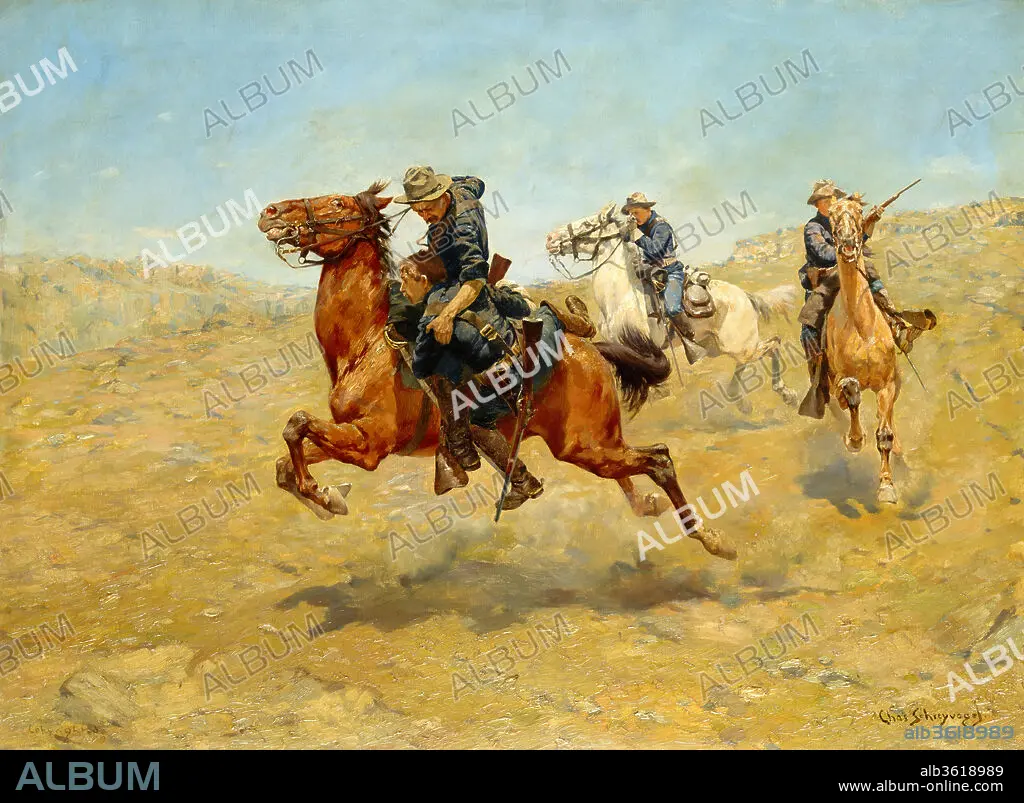
CHARLES SCHREYVOGEL. My Bunkie
 Pinterest
 Twitter
 Facebook
 Copiar enlace
 Email
Email


¿Ya tienes cuenta? Iniciar sesión
¿No tienes cuenta? Regístrate
Compra esta imagen.
Selecciona el uso:

Título: My Bunkie
Descripción: Ver traducción automática
My Bunkie. Artist: Charles Schreyvogel (1861-1912). Dimensions: 25 3/16 x 34in. (64 x 86.4cm) Framed: 33 3/8 x 47 5/8 x 4in. (84.8 x 121 x 10.2cm). Date: finished 1899. Schreyvogel, like Remington, based his portrayals of cowboys and cavalrymen on a combination of firsthand experience and masculine escapist fantasy. Between 1893 and 1905 he made frequent visits to the western states and territories, collecting Indian and military artifacts for the authentically detailed paintings he produced in his Hoboken, New Jersey, studio. "My Bunkie" portrays an event described to Schreyvogel by a veteran frontier trooper he met in Colorado. In the heat of a violent conflict on the plains, a soldier heroically rescues a bunkmate who has lost his mount in a skirmish with unseen Indians. Two other cavalrymen continue their fire, protecting and covering for their fellow soldiers. When the painting was exhibited in New York in 1900, it elicited comparisons to Remington's "Wounded Bunkie" (39.65.46a, b) with its shared codes of comradeship and freeze-frame suspended animation.
My Bunkie. Artist: Charles Schreyvogel (1861-1912). Dimensions: 25 3/16 x 34in. (64 x 86.4cm) Framed: 33 3/8 x 47 5/8 x 4in. (84.8 x 121 x 10.2cm). Date: finished 1899. Schreyvogel, like Remington, based his portrayals of cowboys and cavalrymen on a combination of firsthand experience and masculine escapist fantasy. Between 1893 and 1905 he made frequent visits to the western states and territories, collecting Indian and military artifacts for the authentically detailed paintings he produced in his Hoboken, New Jersey, studio. "My Bunkie" portrays an event described to Schreyvogel by a veteran frontier trooper he met in Colorado. In the heat of a violent conflict on the plains, a soldier heroically rescues a bunkmate who has lost his mount in a skirmish with unseen Indians. Two other cavalrymen continue their fire, protecting and covering for their fellow soldiers. When the painting was exhibited in New York in 1900, it elicited comparisons to Remington's "Wounded Bunkie" (39.65.46a, b) with its shared codes of comradeship and freeze-frame suspended animation.
Técnica/material: óleo sobre lienzo
Museo: Metropolitan Museum of Art, New York, USA
Crédito: Album
Tamaño imagen: 6128 × 4490 px | 78.7 MB
Tamaño impresión: 51.9 × 38.0 cm | 2412.6 × 1767.7 in (300 dpi)
