

alb5148036
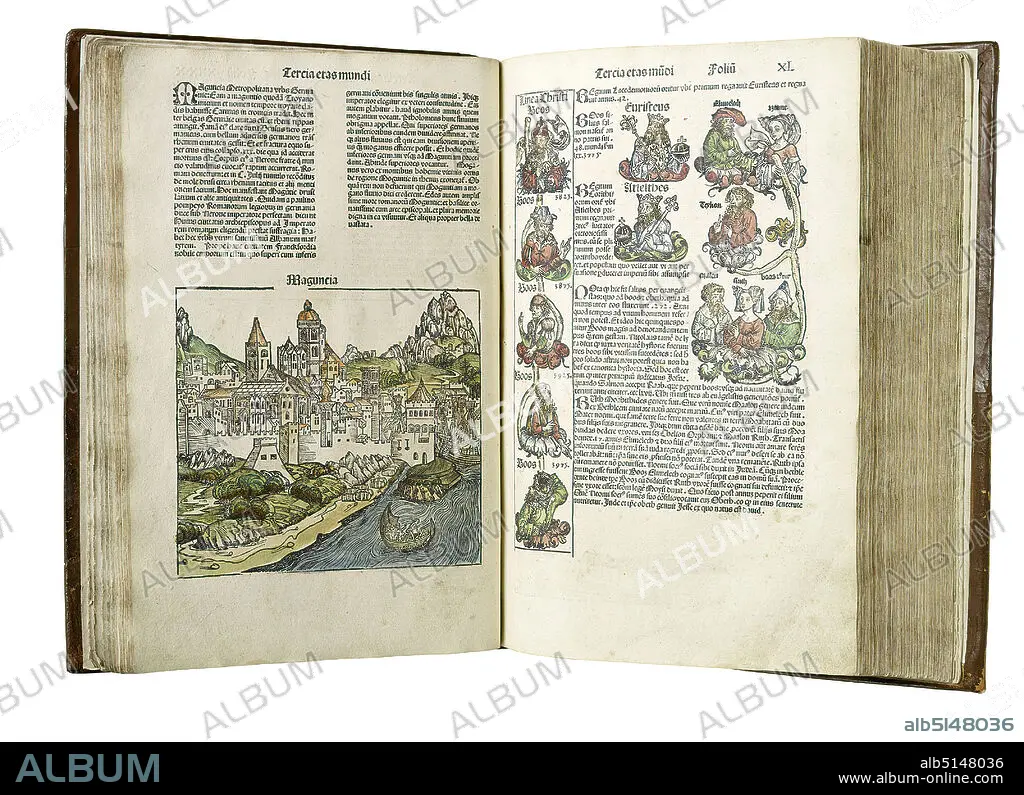
Anton Koberger, Wilhelm Pleydenwurff, Hartmann Schedel, Michael Wolgemut, Schedel's World Chronicle, paper, woodcut, Total: Height: 44,00 cm; Width: 32,00 cm; Depth: 8,50 cm, printed matter, town, city view (veduta), city maps, Renaissance, A highlight in book illustration on the threshold between the Middle Ages and modern times is the so-called Schedel's World Chronicle. The Nuremberg city physician and humanist Hartmann Schedel published a Latin and a German edition of his chronicle in 1493. The voluminous book is equipped with numerous woodcuts: On more than 600 pages, there are over 1,800 illustrations, which were created by Michael Wolgemut and his stepson Wilhelm Pleydenwurff. The chronicle is an atlas, lexicon and history book in one. On display are maps, portraits and family trees, coats of arms, wonders and legendary figures. The book illustrates the course of time with pictures of famous people and places. Some cities are shown for the first time in reproduction graphics. However, only some of these famous city views are authentic, others are highly typified, some woodcuts are even used for different cities. Schedel's World Chronicle can be understood as an ambitious attempt to capture the course of the world between two book covers. Following a traditional scheme, the chronicle is divided into seven world ages and unfolds the sequence of times from the biblical story of creation to the Last Judgement. However, it is not only based on the Bible, but also on insights from antiquity and views of the emerging humanism. The World Chronicle thus shows a picture of the world and of history in a state of upheaval, which still oscillates between faith, superstition and knowledge.
| Compartir |
|---|
 Pinterest Pinterest |
 Twitter Twitter |
 Facebook Facebook |
 Copiar enlace Copiar enlace |
 Email Email |
|
Añadir a otro lightbox |
|
Añadir a otro lightbox |


¿Ya tienes cuenta? Iniciar sesión
¿No tienes cuenta? Regístrate
Compra esta imagen.
Selecciona el uso:

Descripción: Ver traducción automática
Anton Koberger, Wilhelm Pleydenwurff, Hartmann Schedel, Michael Wolgemut, Schedel's World Chronicle, paper, woodcut, Total: Height: 44,00 cm; Width: 32,00 cm; Depth: 8,50 cm, printed matter, town, city view (veduta), city maps, Renaissance, A highlight in book illustration on the threshold between the Middle Ages and modern times is the so-called Schedel's World Chronicle. The Nuremberg city physician and humanist Hartmann Schedel published a Latin and a German edition of his chronicle in 1493. The voluminous book is equipped with numerous woodcuts: On more than 600 pages, there are over 1,800 illustrations, which were created by Michael Wolgemut and his stepson Wilhelm Pleydenwurff. The chronicle is an atlas, lexicon and history book in one. On display are maps, portraits and family trees, coats of arms, wonders and legendary figures. The book illustrates the course of time with pictures of famous people and places. Some cities are shown for the first time in reproduction graphics. However, only some of these famous city views are authentic, others are highly typified, some woodcuts are even used for different cities. Schedel's World Chronicle can be understood as an ambitious attempt to capture the course of the world between two book covers. Following a traditional scheme, the chronicle is divided into seven world ages and unfolds the sequence of times from the biblical story of creation to the Last Judgement. However, it is not only based on the Bible, but also on insights from antiquity and views of the emerging humanism. The World Chronicle thus shows a picture of the world and of history in a state of upheaval, which still oscillates between faith, superstition and knowledge.
Anton Koberger, Wilhelm Pleydenwurff, Hartmann Schedel, Michael Wolgemut, Schedel's World Chronicle, paper, woodcut, Total: Height: 44,00 cm; Width: 32,00 cm; Depth: 8,50 cm, printed matter, town, city view (veduta), city maps, Renaissance, A highlight in book illustration on the threshold between the Middle Ages and modern times is the so-called Schedel's World Chronicle. The Nuremberg city physician and humanist Hartmann Schedel published a Latin and a German edition of his chronicle in 1493. The voluminous book is equipped with numerous woodcuts: On more than 600 pages, there are over 1,800 illustrations, which were created by Michael Wolgemut and his stepson Wilhelm Pleydenwurff. The chronicle is an atlas, lexicon and history book in one. On display are maps, portraits and family trees, coats of arms, wonders and legendary figures. The book illustrates the course of time with pictures of famous people and places. Some cities are shown for the first time in reproduction graphics. However, only some of these famous city views are authentic, others are highly typified, some woodcuts are even used for different cities. Schedel's World Chronicle can be understood as an ambitious attempt to capture the course of the world between two book covers. Following a traditional scheme, the chronicle is divided into seven world ages and unfolds the sequence of times from the biblical story of creation to the Last Judgement. However, it is not only based on the Bible, but also on insights from antiquity and views of the emerging humanism. The World Chronicle thus shows a picture of the world and of history in a state of upheaval, which still oscillates between faith, superstition and knowledge.
Personas: WILHELM PLEYDENWURFF (15th century)
Crédito: Album / quintlox
Autorizaciones: ? Cesión de modelo: No - ? Cesión de propiedad: No
¿Preguntas relacionadas con los derechos?
¿Preguntas relacionadas con los derechos?
Tamaño imagen: 4320 × 3132 px | 38.7 MB
Tamaño impresión: 36.6 × 26.5 cm | 1700.8 × 1233.1 in (300 dpi)
Palabras clave: 1493 • ANTIGUO TESTAMENTO • ANTIGÜEDAD • ANTIGÜEDADES • ANTIQUITY • ATLAS • BIBLIA • BIBLICA • BÍBLICO • BÍBLICOS • CAPTURA • CASTIZO • CIUDAD • CIUDADES • CREACION • CREENCIA • CRONICA • CUADRO • CUADROS • DICCIONARIO • DIVIDIDO • EDAD MEDIA • ENCICLOPEDIA • EQUIPADA • ESTILO RENACENTISTA • FAMOSA • FAMOSO • FAMOSOS • FE • GRABADO EN MADERA • HISTORIA DE LA CREACION • ILUSTRACION DE LIBRO • IMPRESOS • LUGAR • LUGARES • MAPA • MAPAS • MUNDO • PAPEL • PROFUNDIDAD • RELIGION • RENACENTISTA • RENACENTISTAS • RENACIMIENTO • RESALTAR • RETRATOS • SECUENCIA • SIGUIENTES • SUPERSTICION • TIEMPO • TIEMPOS MODERNOS • VEDUTA • VIEJO TESTAMENTO • WILHELM PLEYDENWURFF • XILOGRAFIA • XILOGRAFÍAS
