

alb5536298
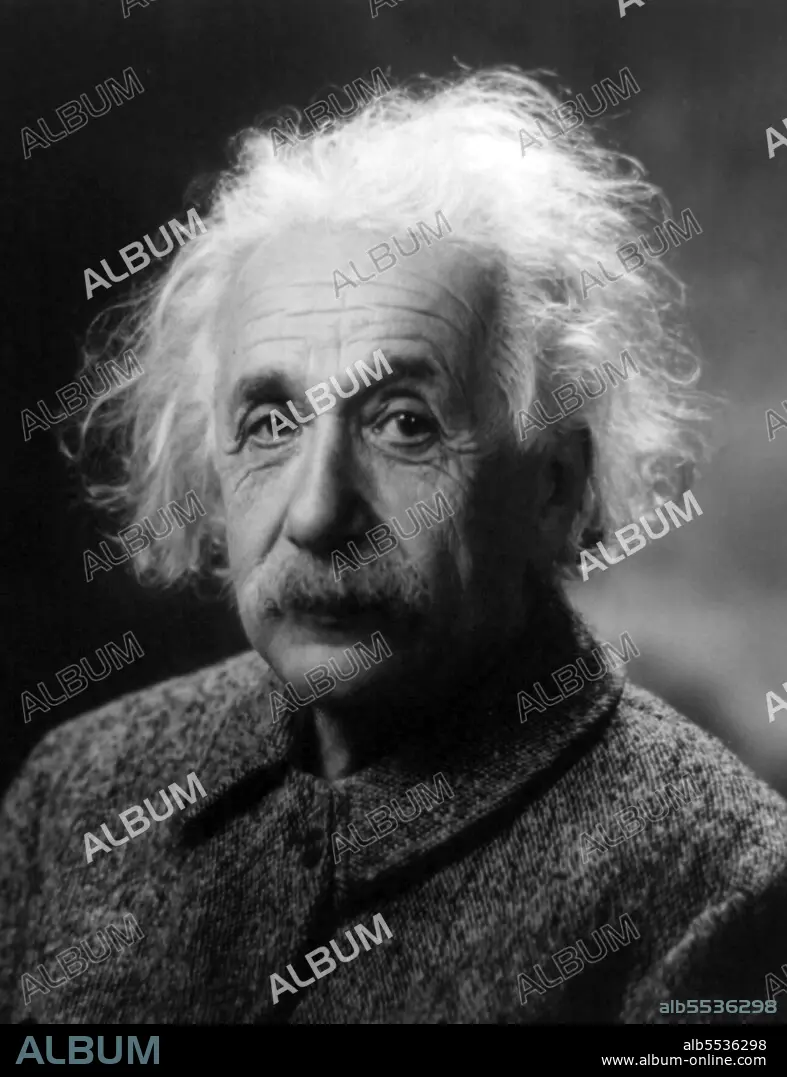
Germany / USA: Albert Einstein (1879-1955)
| Compartir |
|---|
 Pinterest Pinterest |
 Twitter Twitter |
 Facebook Facebook |
 Copiar enlace Copiar enlace |
 Email Email |
|
Añadir a otro lightbox |
|
Añadir a otro lightbox |


¿Ya tienes cuenta? Iniciar sesión
¿No tienes cuenta? Regístrate
Compra esta imagen.
Selecciona el uso:

Título: Germany / USA: Albert Einstein (1879-1955)
Descripción:
Traducción automática: Albert Einstein (14 de marzo de 1879 - 18 de abril de 1955) fue un físico teórico y filósofo de la ciencia nacido en Alemania. Desarrolló la teoría general de la relatividad, uno de los dos pilares de la física moderna (junto con la mecánica cuántica). Es conocido en la cultura popular por su fórmula de equivalencia masa-energía E = mc2 (denominada «la ecuación más famosa del mundo»). Recibió el Premio Nobel de Física en 1921 «por sus servicios a la física teórica, y especialmente por su descubrimiento de la ley del efecto fotoeléctrico». Este último fue fundamental para el establecimiento de la teoría cuántica. Einstein se encontraba de visita en Estados Unidos cuando Adolf Hitler llegó al poder en 1933 y, al ser judío, no regresó a Alemania, donde había sido profesor en la Academia de Ciencias de Berlín. Se estableció en Estados Unidos y se nacionalizó estadounidense en 1940. En vísperas de la Segunda Guerra Mundial, respaldó una carta al presidente Franklin D. Roosevelt alertándolo sobre el posible desarrollo de "bombas extremadamente potentes de un nuevo tipo" y recomendando que Estados Unidos iniciara investigaciones similares. Esto finalmente condujo a lo que se convertiría en el Proyecto Manhattan. Einstein publicó más de 300 artículos científicos, además de más de 150 obras no científicas. Sus logros intelectuales y su originalidad han hecho que la palabra "Einstein" sea sinónimo de genio.
Albert Einstein (14 March 1879 – 18 April 1955) was a German-born theoretical physicist and philosopher of science. He developed the general theory of relativity, one of the two pillars of modern physics (alongside quantum mechanics). He is best known in popular culture for his mass–energy equivalence formula E = mc2 (which has been dubbed 'the world's most famous equation'). He received the 1921 Nobel Prize in Physics 'for his services to theoretical physics, and especially for his discovery of the law of the photoelectric effect'. The latter was pivotal in establishing quantum theory. Einstein was visiting the United States when Adolf Hitler came to power in 1933 and, being Jewish, did not go back to Germany, where he had been a professor at the Berlin Academy of Sciences. He settled in the USA, becoming an American citizen in 1940. On the eve of World War II, he endorsed a letter to President Franklin D. Roosevelt alerting him to the potential development of 'extremely powerful bombs of a new type' and recommending that the U.S. begin similar research. This eventually led to what would become the Manhattan Project. Einstein published more than 300 scientific papers along with over 150 non-scientific works. His intellectual achievements and originality have made the word 'Einstein' synonymous with genius.
Crédito: Album / Pictures From History/Universal Images Group
Autorizaciones: ? Cesión de modelo: No - ? Cesión de propiedad: No
¿Preguntas relacionadas con los derechos?
¿Preguntas relacionadas con los derechos?
Tamaño imagen: 3600 × 4687 px | 48.3 MB
Tamaño impresión: 30.5 × 39.7 cm | 1417.3 × 1845.3 in (300 dpi)
Palabras clave: ALEMAN • ALEMANA • ALEMANES • ALEMANIA • AMERICA • AMERICAN • AMERICANA • AMERICANO • AMERICANOS • AMERICAS • AMERICAS, LAS • CONTINENTE AMERICANO • EE. UU • EE. UU. • EEUU / ESTADOS UNIDOS • EEUU • EINSTEIN, ALBERT • ESTADOS UNIDOS DE AMERICA • ESTADOS UNIDOS • FILOSOFIA • FILOSOFO • FISICA • FISICO • FISICOS • HISTORIA • HISTORICO • NOBEL • PREMIO NOBEL • U. S. A. • USA
