

alb8368659
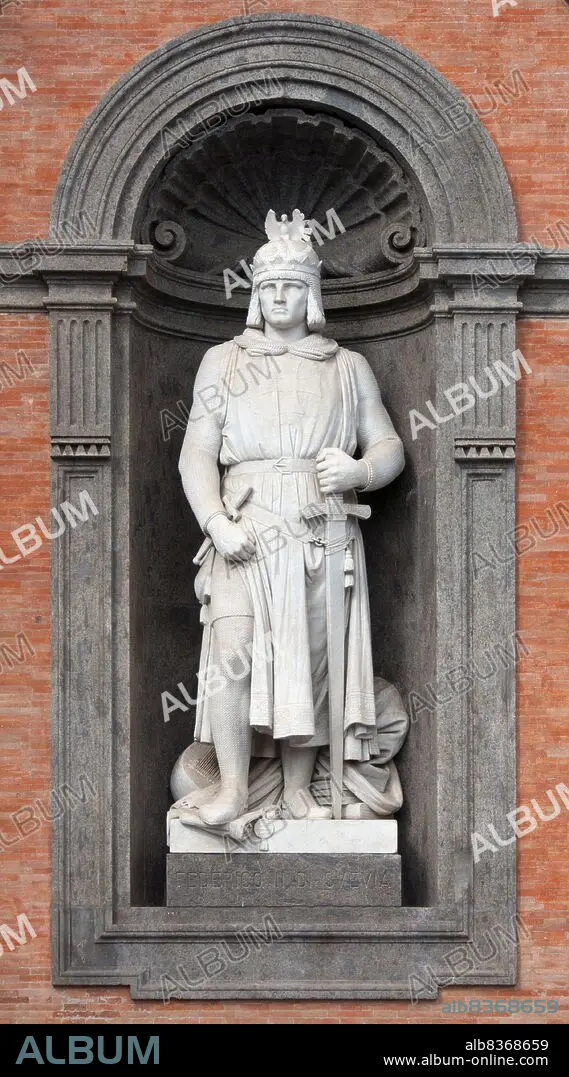
Italy: Frederick II (1194-1250), Holy Roman Emperor, King of Italy, Palazzo Reale di Napoli (Royal Palace), Piazza del Plebiscito, Naples
| Compartir |
|---|
 Pinterest Pinterest |
 Twitter Twitter |
 Facebook Facebook |
 Copiar enlace Copiar enlace |
 Email Email |
|
Añadir a otro lightbox |
|
Añadir a otro lightbox |


¿Ya tienes cuenta? Iniciar sesión
¿No tienes cuenta? Regístrate
Compra esta imagen.
Selecciona el uso:

Título: Italy: Frederick II (1194-1250), Holy Roman Emperor, King of Italy, Palazzo Reale di Napoli (Royal Palace), Piazza del Plebiscito, Naples
Descripción: Ver traducción automática
Frederick II (1194-1250) was the son of Emperor Henry VI, and was only an infant when crowned King of Sicily by his mother in 1198. When his mother died the same year, he was given to Pope Innocent III, who became his guardian.
. When Frederick came of age in 1208, he asserted his power over Sicily. Emperor Otto IV invaded Italy in 1209, hoping to conquer Sicily and bring Frederick to heel, but in 1211, Frederick was elected in absentia as King of Germany by various imperial princes fed up with Otto's rule. Frederick entered Germany with a small army and was formally crowned King of Germany in 1212. He became undisputed ruler in 1215 after Otto's abdication, and was crowned Holy Roman Emperor in 1220.
. Frederick fought often with the papacy, and was excommunicated four times, even once being called an Antichrist. He became King of Jerusalem in 1225 through the Sixth Crusade, marrying Yolande of Jerusalem, heiress to the Kingdom of Jerusalem. Frederick spoke six languages and was an avid patron of science and the arts, as well as a religious sceptic. He was the first king to explicitly outlaw trials by ordeal, considering them irrational. He fell ill and died peacefully in 1250, the Hohenstaufen dynasty perishing very soon afterwards.
Frederick II (1194-1250) was the son of Emperor Henry VI, and was only an infant when crowned King of Sicily by his mother in 1198. When his mother died the same year, he was given to Pope Innocent III, who became his guardian.
. When Frederick came of age in 1208, he asserted his power over Sicily. Emperor Otto IV invaded Italy in 1209, hoping to conquer Sicily and bring Frederick to heel, but in 1211, Frederick was elected in absentia as King of Germany by various imperial princes fed up with Otto's rule. Frederick entered Germany with a small army and was formally crowned King of Germany in 1212. He became undisputed ruler in 1215 after Otto's abdication, and was crowned Holy Roman Emperor in 1220.
. Frederick fought often with the papacy, and was excommunicated four times, even once being called an Antichrist. He became King of Jerusalem in 1225 through the Sixth Crusade, marrying Yolande of Jerusalem, heiress to the Kingdom of Jerusalem. Frederick spoke six languages and was an avid patron of science and the arts, as well as a religious sceptic. He was the first king to explicitly outlaw trials by ordeal, considering them irrational. He fell ill and died peacefully in 1250, the Hohenstaufen dynasty perishing very soon afterwards.
Crédito: Album / Universal Images Group / David Henley / Pictures From History
Autorizaciones: ? Cesión de modelo: No - ? Cesión de propiedad: No
¿Preguntas relacionadas con los derechos?
¿Preguntas relacionadas con los derechos?
Tamaño imagen: 2705 × 4864 px | 37.6 MB
Tamaño impresión: 22.9 × 41.2 cm | 1065.0 × 1915.0 in (300 dpi)
Palabras clave: ALEMAN • ALEMANA • ALEMANES • ALEMANIA • ART • ARTE • ARTES • BORGOÑA • CAMPANIA • CASTILLO • DINASTIA • EMPERADOR • ESTATUA • EUROPA • EUROPEA • EUROPEAS • EUROPEO • EUROPEOS • FORTALEZA • GOBERNANTE • IMPERIO • ITALIA • ITALIAN • ITALIANA • ITALIANO • ITALIANOS • JERUSALEN • KAISER • MONARCA • MONARQUIA • NAPLES • NAPOLES • PALACETE • PALACIO • PLAZA • REY • ROMANA • ROMANAS • ROMANO • ROMANOS • S. XII • S. XIII • SACRO IMPERIO ALEMAN • SACRO IMPERIO ROMANO GERMANICO • SAGRADO • SICILIA • SICILY • SIGLO XII • SIGLO XIII • STATUE
