

alb5412609
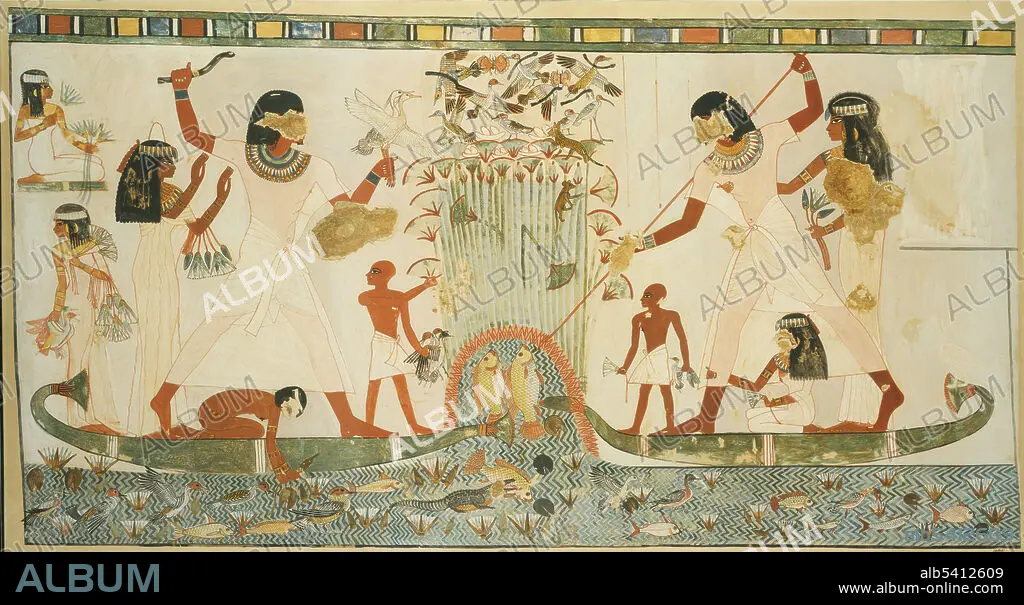
Egyptian tomb scene, illustration
| Compartir |
|---|
 Pinterest Pinterest |
 Twitter Twitter |
 Facebook Facebook |
 Copiar enlace Copiar enlace |
 Email Email |
|
Añadir a otro lightbox |
|
Añadir a otro lightbox |


¿Ya tienes cuenta? Iniciar sesión
¿No tienes cuenta? Regístrate
Compra esta imagen.
Selecciona el uso:

Título: Egyptian tomb scene, illustration
Descripción:
Traducción automática: Escena de la tumba egipcia, ilustración. Esta escena muestra una escena de caza de peces y aves en el Nilo, como se muestra en las paredes de la tumba de Menna. Data del Imperio Nuevo (Dinastía 18), durante el reinado de Tutmosis IV a Amenhotep III, alrededor del 1400-1352 a.C. Esta tumba se encuentra en Tebas, Alto Egipto. A la izquierda, Menna sostiene pájaros señuelo en una mano y con la otra levanta un palo por encima de su cabeza. A la derecha, utiliza una lanza larga para capturar dos peces grandes, probablemente tilapia. En ambas viñetas, está posado en la cubierta de un esquife de papiro, en el que se han amontonado miembros de su familia (aquí sin nombre, pero probablemente su esposa y varios de sus hijos). La vida silvestre incluye aves, peces y un cocodrilo. Los símbolos de fertilidad incluyen lotos. Simbólicamente, Menna ayuda a garantizar los ciclos diarios de creación y su propia regeneración y renacimiento. Esta ilustración (tempera sobre papel) fue realizada en 1924 por la egiptóloga Nina de Garis Davies (1881-1965) en una expedición para el Museo Metropolitano de Arte.
Egyptian tomb scene, illustration. This scene shows a hunting scene for fish and fowl on the Nile, as depicted on the walls of the tomb of Menna. It dates from the New Kingdom (Dynasty 18), during the reign of Thutmose IV to Amenhotep III, in around 1400-1352 BC. This tomb is in Thebes, Upper Egypt. At left, Menna holds decoy birds in one hand and raises a throwstick above his head with the other. On the right, he uses a long spear to catch two large fish, most likely Tilapia. In both vignettes, he is poised on the deck of a papyrus skiff, into which members of his family (unnamed here, but probably his wife and several of his children) have crowded. Wildlife includes birds, fish and a crocodile. Symbols of fertility include lotuses. Symbolically, Menna helps to guarantee daily cycles of creation and his own regeneration and rebirth. This illustration (tempera on paper) was produced in 1924 by Egyptologist Nina de Garis Davies (1881-1965) on an expedition for the Metropolitan Museum of Art.
Crédito: Album / Science Source / Metropolitan Museum of Art
Autorizaciones: ? Cesión de modelo: No - ? Cesión de propiedad: No
¿Preguntas relacionadas con los derechos?
¿Preguntas relacionadas con los derechos?
Tamaño imagen: 4100 × 2212 px | 25.9 MB
Tamaño impresión: 34.7 × 18.7 cm | 1614.2 × 870.9 in (300 dpi)
Palabras clave: 1924 • 90S • ADULTO • AFRICA DEL NORTE • AFRICA • AFRICANO • ANTIGUO EGIPTO • ANTIGÜEDAD • ARQUEOLOGIA • ARTE • AÑOS NOVENTA • BOTE (BARCO) • BOTES (BARCOS) • CAZA • CAZADOR • COCODRILO • CROCODILE • DE PESCA • DECADA NOVENTA • DINASTÍA 18 • EGIPCIO • EGIPTO • EGIPTOLOGIA • ESCENA • ESPOSA • ESPOSO • GALLINA • HISTORIA • HOMBRE • LANZA • MARIDO • MASCULINO • MUJER • NADIE • NILE • NILO (RIO) • NILO • NINO • NINOS • NIÑO • NUEVO REINO • PEZ • REGENERACION • REINO NUEVO • RELIGION • RETRATO DE HOMBRE • RIO NILO • RIO • S. XX • SEGUNDO MILENIO AC • SIGLO XX • SPEAR • TEBAS • TUMBA DE MENNA • TUMBA
