

alb9203876
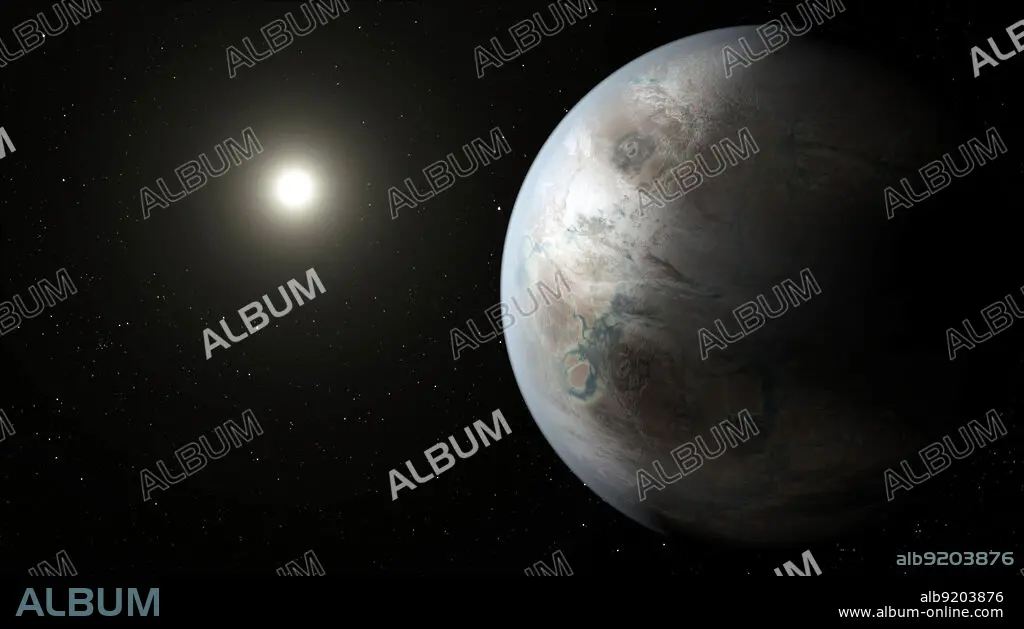
Exoplanet Kepler-452b
| Compartir |
|---|
 Pinterest Pinterest |
 Twitter Twitter |
 Facebook Facebook |
 Copiar enlace Copiar enlace |
 Email Email |
|
Añadir a otro lightbox |
|
Añadir a otro lightbox |


¿Ya tienes cuenta? Iniciar sesión
¿No tienes cuenta? Regístrate
Compra esta imagen.
Selecciona el uso:

Título: Exoplanet Kepler-452b
Descripción: Ver traducción automática
This artist's concept depicts one possible appearance of the planet Kepler-452b, the first near-Earth-size world to be found in the habitable zone of a star that is similar to our sun. The habitable zone is a region around a star where temperatures are right for water to pool on the surface. Scientists do not know if Kepler-452b can support life or not. What is known about the planet is that it is about 60 percent larger than Earth. Kepler-452b orbits its star every 385 days. The planet's star is about 1,400 light-years away in the constellation Cygnus. It is a G2-type star like our sun, with nearly the same temperature and mass. The star is 6 billion years old, 1.5 billion years older than our sun. If the planet Kepler-452b does in fact have liquid on its surface and has grown warmer due to the older age of its star, it could possibly be experiencing a runaway greenhouse effect, where oceans would begin to evaporate and contribute to increased cloud cover.
This artist's concept depicts one possible appearance of the planet Kepler-452b, the first near-Earth-size world to be found in the habitable zone of a star that is similar to our sun. The habitable zone is a region around a star where temperatures are right for water to pool on the surface. Scientists do not know if Kepler-452b can support life or not. What is known about the planet is that it is about 60 percent larger than Earth. Kepler-452b orbits its star every 385 days. The planet's star is about 1,400 light-years away in the constellation Cygnus. It is a G2-type star like our sun, with nearly the same temperature and mass. The star is 6 billion years old, 1.5 billion years older than our sun. If the planet Kepler-452b does in fact have liquid on its surface and has grown warmer due to the older age of its star, it could possibly be experiencing a runaway greenhouse effect, where oceans would begin to evaporate and contribute to increased cloud cover.
Crédito: Album / NASA/Ames/JPL-Caltech / Science Source
Autorizaciones: ? Cesión de modelo: No - ? Cesión de propiedad: No
¿Preguntas relacionadas con los derechos?
¿Preguntas relacionadas con los derechos?
Tamaño imagen: 4534 × 2550 px | 33.1 MB
Tamaño impresión: 38.4 × 21.6 cm | 1785.0 × 1003.9 in (300 dpi)
Palabras clave: ARTE • ARTISTA • ASTRONOMIA • CELESTE • CELESTIAL • CONCEPTO • CUERPO • ESPACIAL • ESPACIALES • ESPACIO • ESTRELLA • ILUSTRACION • ILUSTRACIONES • KEPLER • PROFUNDA
