

alb9202711
Exoplanet Kepler-69 and the Solar System
| Compartir |
|---|
 Pinterest Pinterest |
 Twitter Twitter |
 Facebook Facebook |
 Copiar enlace Copiar enlace |
 Email Email |
|
Añadir a otro lightbox |
|
Añadir a otro lightbox |


¿Ya tienes cuenta? Iniciar sesión
¿No tienes cuenta? Regístrate
Compra esta imagen.
Selecciona el uso:

Título: Exoplanet Kepler-69 and the Solar System
Descripción: Ver traducción automática
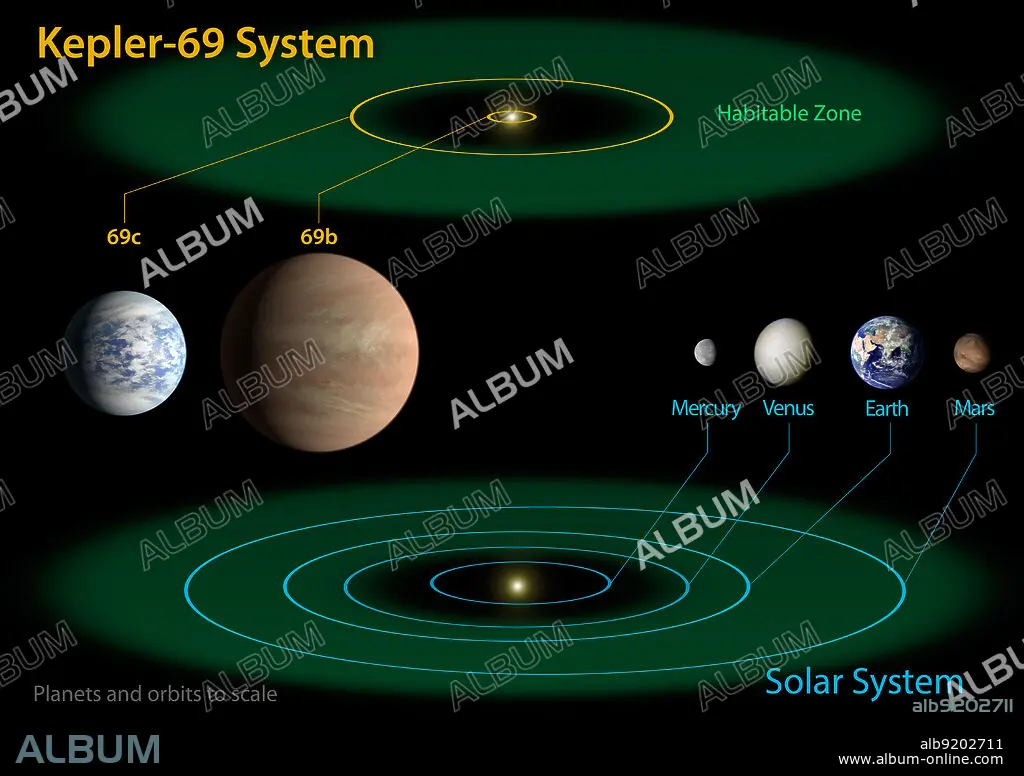
Diagram comparing the planets of the inner solar system to Kepler-69, a two-planet system about 2,700 light-years from Earth in the constellation Cygnus. The two planets of Kepler-69 orbit a star that belongs to the same class as our sun, called G-type. Kepler-69c, is 70 percent larger than the size of Earth, and is the smallest yet found to orbit in the habitable zone of a sun-like star. Astronomers are uncertain about the composition of Kepler-69c, but its orbit of 242 days around a sun-like star resembles that of our neighboring planet Venus. The companion planet, Kepler-69b, is just over twice the size of Earth and whizzes around its star once every 13 days.The artistic concepts of the Kepler-69 planets are the result of scientists and artists collaborating to help imagine the appearance of these distant worlds. The Kepler space telescope, which simultaneously and continuously measures the brightness of more than 150,000 stars, is NASA's first mission capable of detecting Earth-size planets around stars like our sun. NASA's Ames Research Center manages Kepler's ground system development, mission operations and science data analysis. JPL managed the Kepler mission's development. Release date April 18, 2013.
Diagram comparing the planets of the inner solar system to Kepler-69, a two-planet system about 2,700 light-years from Earth in the constellation Cygnus. The two planets of Kepler-69 orbit a star that belongs to the same class as our sun, called G-type. Kepler-69c, is 70 percent larger than the size of Earth, and is the smallest yet found to orbit in the habitable zone of a sun-like star. Astronomers are uncertain about the composition of Kepler-69c, but its orbit of 242 days around a sun-like star resembles that of our neighboring planet Venus. The companion planet, Kepler-69b, is just over twice the size of Earth and whizzes around its star once every 13 days.The artistic concepts of the Kepler-69 planets are the result of scientists and artists collaborating to help imagine the appearance of these distant worlds. The Kepler space telescope, which simultaneously and continuously measures the brightness of more than 150,000 stars, is NASA's first mission capable of detecting Earth-size planets around stars like our sun. NASA's Ames Research Center manages Kepler's ground system development, mission operations and science data analysis. JPL managed the Kepler mission's development. Release date April 18, 2013.
Crédito: Album / NASA/Ames/JPL-Caltech / Science Source
Autorizaciones: ? Cesión de modelo: No - ? Cesión de propiedad: No
¿Preguntas relacionadas con los derechos?
¿Preguntas relacionadas con los derechos?
Tamaño imagen: 4500 × 3176 px | 40.9 MB
Tamaño impresión: 38.1 × 26.9 cm | 1771.7 × 1250.4 in (300 dpi)
Palabras clave: 2013 • ARTE • ASTRONOMIA • AÑOS 2010 • CAMINO • CELESTE • CELESTIAL • COMPARAR • CUERPO • ESPACIAL • ESPACIALES • ESPACIO • ESTRELLA • GALÁCTICO • GRAFICO • ILUSTRACION • ILUSTRACIONES • KEPLER • LECHOSO • MISION • NUCLEO • OBSERVATORIO • PLANETA • PLANETARIO • PLANETARIOS • PROFUNDA • ROCOSO • S. XXI • SIGLO XXI • SIGLO • SISTEMA • SOLAR • TERRESTRE
