

alb3882379
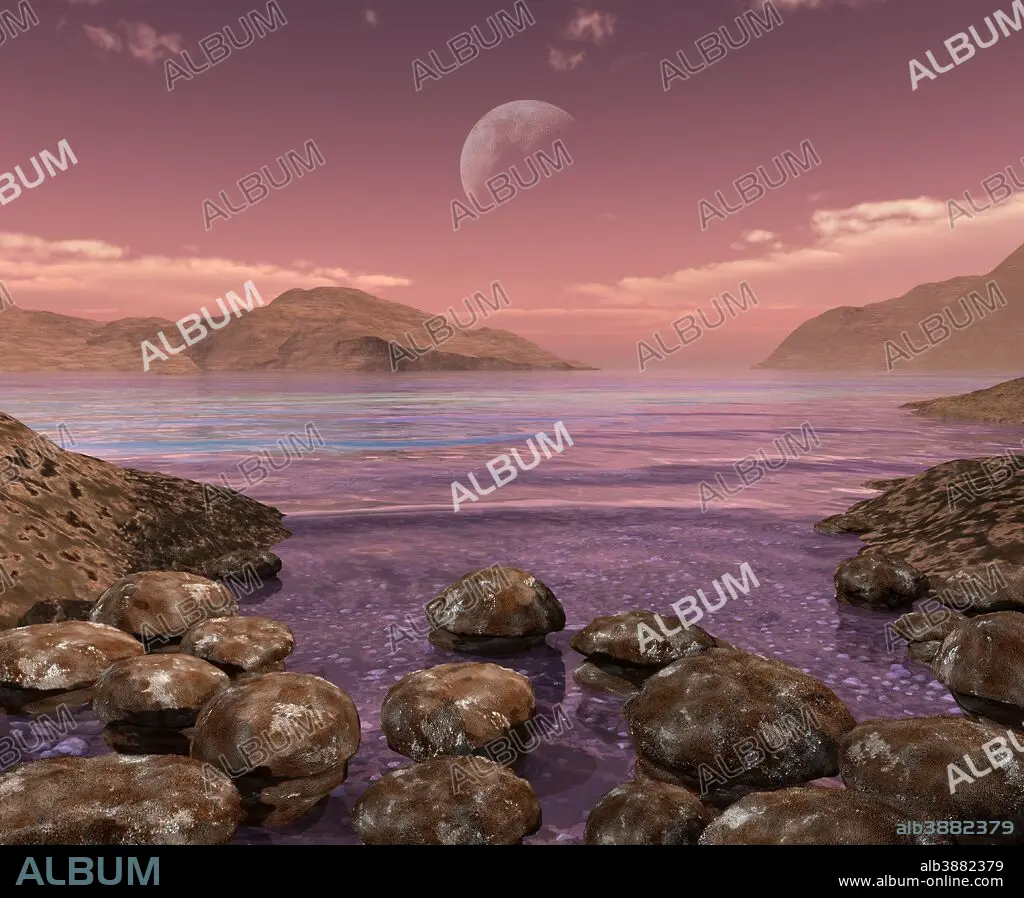
Artist's concept of Archean stromatolites on the shore of an ancient sea.
| Compartir |
|---|
 Pinterest Pinterest |
 Twitter Twitter |
 Facebook Facebook |
 Copiar enlace Copiar enlace |
 Email Email |
|
Añadir a otro lightbox |
|
Añadir a otro lightbox |


¿Ya tienes cuenta? Iniciar sesión
¿No tienes cuenta? Regístrate
Compra esta imagen.
Selecciona el uso:

Título: Artist's concept of Archean stromatolites on the shore of an ancient sea.
Descripción: Ver traducción automática
Dome-shaped stromatolites, averaging three feet high and four feet wide, populate the shallow shore of an ancient sea 3 billion years ago. The Moon looms near the horizon, much closer to the Earth than it is now and therefore appearing considerably larger, but otherwise looking much like the moon we know today.. . 3 billion years ago the first macro evidence of life on Earth may have appeared in the form of large aggregations of microorganisms and associated sediments known as stromatolites. Cyanobacteria, also known as blue-green algae, were likely one of the primary contributors to these aggregations. During the Archean Eon the Earth's atmosphere contained very little oxygen. Cyanobacteria would have thrived during this time as they employ photosynthesis to combine water, carbon dioxide, and sunlight to create their food, while the byproducts of this process are oxygen and calcium carbonate. . . Billions of years of photosynthetic processes by cyanobacteria and other living organisms are likely the primary source of the oxygen we breathe. They also provided the oxygen that forms the protective ozone layer, filtering the shorter wavelengths of ultraviolet light from the Sun that are harmful to most forms of life.. . Varieties of stromatolites still flourish to this day with well-known formations in parts of Australia, Brazil, and the Bahamas.
Dome-shaped stromatolites, averaging three feet high and four feet wide, populate the shallow shore of an ancient sea 3 billion years ago. The Moon looms near the horizon, much closer to the Earth than it is now and therefore appearing considerably larger, but otherwise looking much like the moon we know today.. . 3 billion years ago the first macro evidence of life on Earth may have appeared in the form of large aggregations of microorganisms and associated sediments known as stromatolites. Cyanobacteria, also known as blue-green algae, were likely one of the primary contributors to these aggregations. During the Archean Eon the Earth's atmosphere contained very little oxygen. Cyanobacteria would have thrived during this time as they employ photosynthesis to combine water, carbon dioxide, and sunlight to create their food, while the byproducts of this process are oxygen and calcium carbonate. . . Billions of years of photosynthetic processes by cyanobacteria and other living organisms are likely the primary source of the oxygen we breathe. They also provided the oxygen that forms the protective ozone layer, filtering the shorter wavelengths of ultraviolet light from the Sun that are harmful to most forms of life.. . Varieties of stromatolites still flourish to this day with well-known formations in parts of Australia, Brazil, and the Bahamas.
Crédito: Album / Stocktrek Images / Walter Myers
Tamaño imagen: 4618 × 3810 px | 50.3 MB
Tamaño impresión: 39.1 × 32.3 cm | 1818.1 × 1500.0 in (300 dpi)
Palabras clave: AGUA • AL AIRE LIBRE • ALGAS • ANTIGUO • ARQUEAS • ARQUEOLOGIA • BACTERIAS • CIANOBACTERIAS • CIENCIA • CIENCIAS NATURALES • COSTA • DÍA • EPOCA PREHISTORICA • ESCENICO • EVOLUCION • EXTINGUIDO • EXTRAÑO • FORMACION ROCOSA • FÓSIL • GEOGRAFÍA FÍSICA • GEOLOGIA • HISTORIA NATURAL • HORIZONTAL • ILUSTRACION • ILUSTRACIONES • IMAGEN EN COLOR • IMAGEN GENERADA DIGITALMENTE • IMAGINACION • INICIOS • LITORAL • LUNA • MAR • NATURALEZA • ORIGEN • OUTSIDE • PAISAJE • PAISAJES • PALEONTOLOGIA • PASADO • PLANETA TIERRA • SIN GENTE • SUPERFICIAL
