

alb3817111
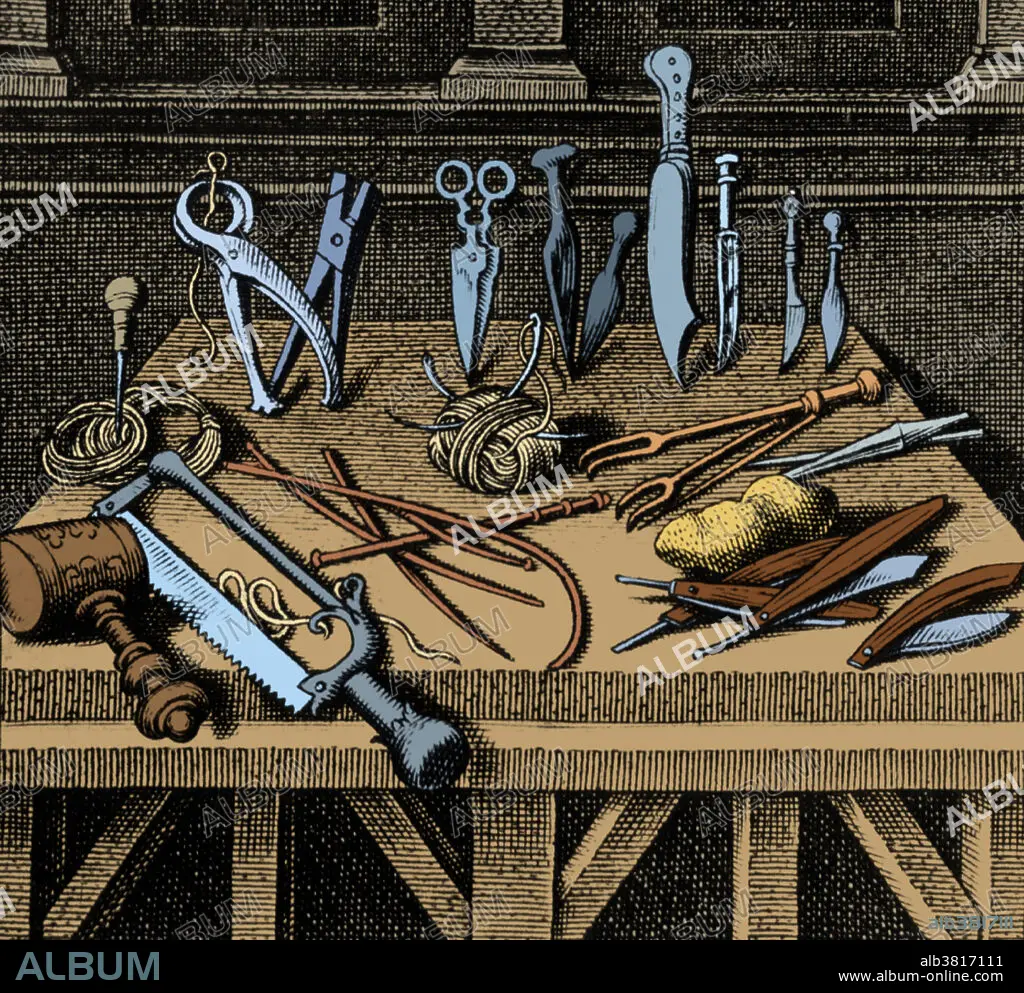
Surgical Equipment, 16th Century
| Compartir |
|---|
 Pinterest Pinterest |
 Twitter Twitter |
 Facebook Facebook |
 Copiar enlace Copiar enlace |
 Email Email |
|
Añadir a otro lightbox |
|
Añadir a otro lightbox |


¿Ya tienes cuenta? Iniciar sesión
¿No tienes cuenta? Regístrate
Compra esta imagen.
Selecciona el uso:

Título: Surgical Equipment, 16th Century
Descripción:
Traducción automática: Viñeta de la portada de Workes del famoso cirujano francés Ambroise Pare, 1634. Equipos e instrumentos quirúrgicos dispuestos sobre una mesa. Ambroise Paré (1510 - 20 de diciembre de 1590) fue un cirujano, anatomista e inventor francés. Fue cirujano real de los reyes Enrique II, Francisco II, Carlos IX y Enrique III y es considerado uno de los padres de la cirugía y la patología forense moderna. Fue un líder en técnicas quirúrgicas y pionero en el tratamiento moderno de heridas en el campo de batalla. La medicina del campo de batalla es el tratamiento de los soldados heridos en o cerca de un área de combate. La medicina civil ha avanzado mucho gracias a los procedimientos que se desarrollaron por primera vez para tratar las heridas infligidas durante el combate. Pare introdujo la ligadura de arterias en lugar de la cauterización durante la amputación. Creía que los dolores fantasmas ocurrían en el cerebro. Contribuyó a la práctica de la amputación quirúrgica y al diseño de prótesis de extremidades. Murió en 1590 de muerte natural.
Vignette from the title page of Workes of that famous French surgeon Ambroise Pare, 1634. Surgical equipment and instruments arranged on a table. Ambroise Pare (1510 - December 20, 1590) was a French surgeon, anatomist and inventor. He was royal surgeon for kings Henry II, Francis II, Charles IX and Henry III and is considered one of the fathers of surgery and modern forensic pathology. He was a leader in surgical techniques and pioneered modern battlefield wound treatment. Battlefield medicine is the treatment of wounded soldiers in or near an area of combat. Civilian medicine has been greatly advanced by procedures that were first developed to treat the wounds inflicted during combat. Pare introduced the ligature of arteries instead of cauterization during amputation. He believed that phantom pains occurred in the brain. He contributed to the practice of surgical amputation and the design of limb prostheses. He died in 1590 from natural
Crédito: Album / NLM/Science Source
Autorizaciones: ? Cesión de modelo: No - ? Cesión de propiedad: No
¿Preguntas relacionadas con los derechos?
¿Preguntas relacionadas con los derechos?
Tamaño imagen: 4200 × 3856 px | 46.3 MB
Tamaño impresión: 35.6 × 32.6 cm | 1653.5 × 1518.1 in (300 dpi)
Palabras clave: AMPUTACION • ARTE • CIRUGIA • COLOREADA • CUCHILLO • CUCHILLOS • DIBUJO • EQUIPAMIENTO • EQUIPO • GRABADO • HISTORIA • HISTORICO • ILUSTRACION • ILUSTRACIONES • INSTRUMENTO • MEDICINA • MEDICINAL • MEJORA • OBRA DE ARTE • OPERACION QUIRURGICA • OPERACION • QUIRURGICO • S. XVI • SIGLO XVI • SIGLO
