

alb3620090
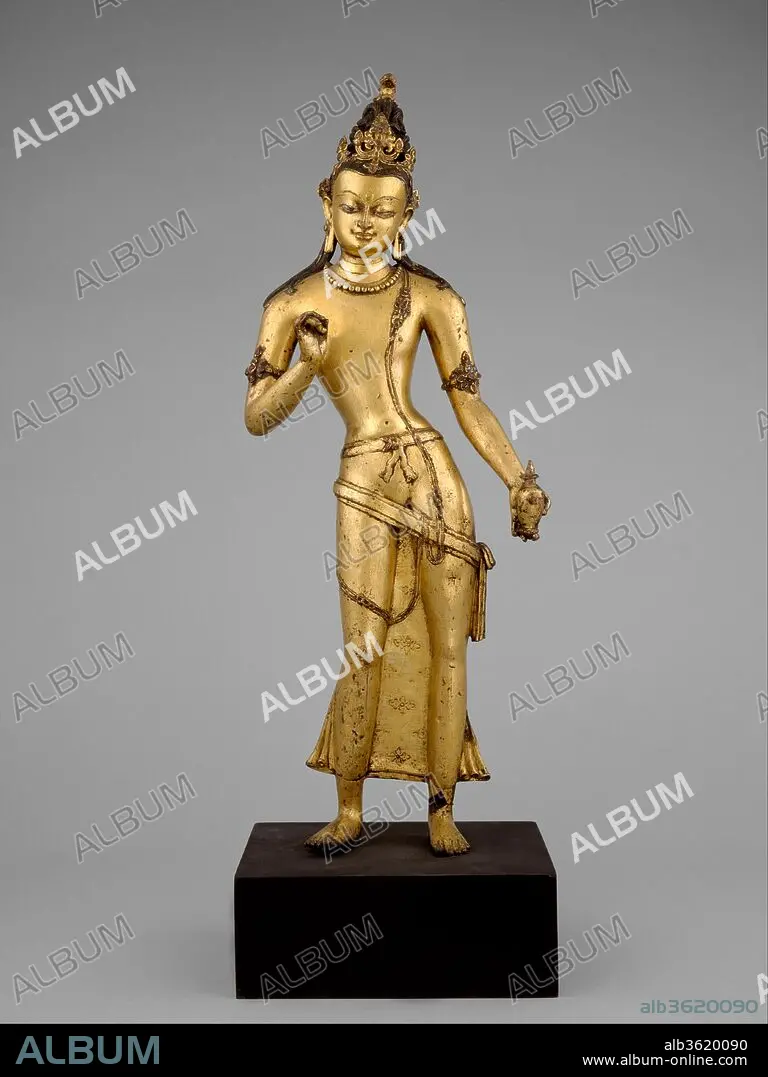
The Bodhisattva Maitreya, the Buddha of the Future
| Compartir |
|---|
 Pinterest Pinterest |
 Twitter Twitter |
 Facebook Facebook |
 Copiar enlace Copiar enlace |
 Email Email |
|
Añadir a otro lightbox |
|
Añadir a otro lightbox |


¿Ya tienes cuenta? Iniciar sesión
¿No tienes cuenta? Regístrate
Compra esta imagen.
Selecciona el uso:

Título: The Bodhisattva Maitreya, the Buddha of the Future
Descripción: Ver traducción automática
The Bodhisattva Maitreya, the Buddha of the Future. Culture: Nepal. Dimensions: H. 26 in. (66 cm); W. 8 1/4 in. (20.9 cm). Date: 11th century. Maitreya, the messianic bodhisattva characterized as the Buddha of the Future, stands in a graciously exaggerated posture, the body beautifully counterbalanced. He holds his raised hand in the gesture of exposition (vitarka mudra) and in his lowered hand displays a flask (kamandalu) universally understood in South Asian culture as the container of amrta, the elixir of life. In a Buddhist setting, the flask is understood as the promise of Maitreya's coming. The elegant aesthetics of this sculpture embody contemporary eastern Indian Pala styles, yet it displays a startling elegance combined with an almost austere economy of surface decoration: jewelry is restrained, textile patterns minimally suggested. The scale is exceptional, as is the aesthetic sensibility of the artist responsible for this work.
The Bodhisattva Maitreya, the Buddha of the Future. Culture: Nepal. Dimensions: H. 26 in. (66 cm); W. 8 1/4 in. (20.9 cm). Date: 11th century. Maitreya, the messianic bodhisattva characterized as the Buddha of the Future, stands in a graciously exaggerated posture, the body beautifully counterbalanced. He holds his raised hand in the gesture of exposition (vitarka mudra) and in his lowered hand displays a flask (kamandalu) universally understood in South Asian culture as the container of amrta, the elixir of life. In a Buddhist setting, the flask is understood as the promise of Maitreya's coming. The elegant aesthetics of this sculpture embody contemporary eastern Indian Pala styles, yet it displays a startling elegance combined with an almost austere economy of surface decoration: jewelry is restrained, textile patterns minimally suggested. The scale is exceptional, as is the aesthetic sensibility of the artist responsible for this work.
Técnica/material: Copper alloy with gilding and color
Periodo: Thakuri period
Museo: Metropolitan Museum of Art, New York, USA
Crédito: Album
Autorizaciones: ? Cesión de modelo: No - ? Cesión de propiedad: No
¿Preguntas relacionadas con los derechos?
¿Preguntas relacionadas con los derechos?
Tamaño imagen: 3071 × 4094 px | 36.0 MB
Tamaño impresión: 26.0 × 34.7 cm | 1209.1 × 1611.8 in (300 dpi)
Palabras clave: ALEACIÓN DE COBRE • ARTE ASIATICO • ASIA • COBRE • DORADO • ESCULTURA • METAL • METROPOLITAN MUSEUM OF ART, NEW YORK, USA • NEPAL
