

alb5473920
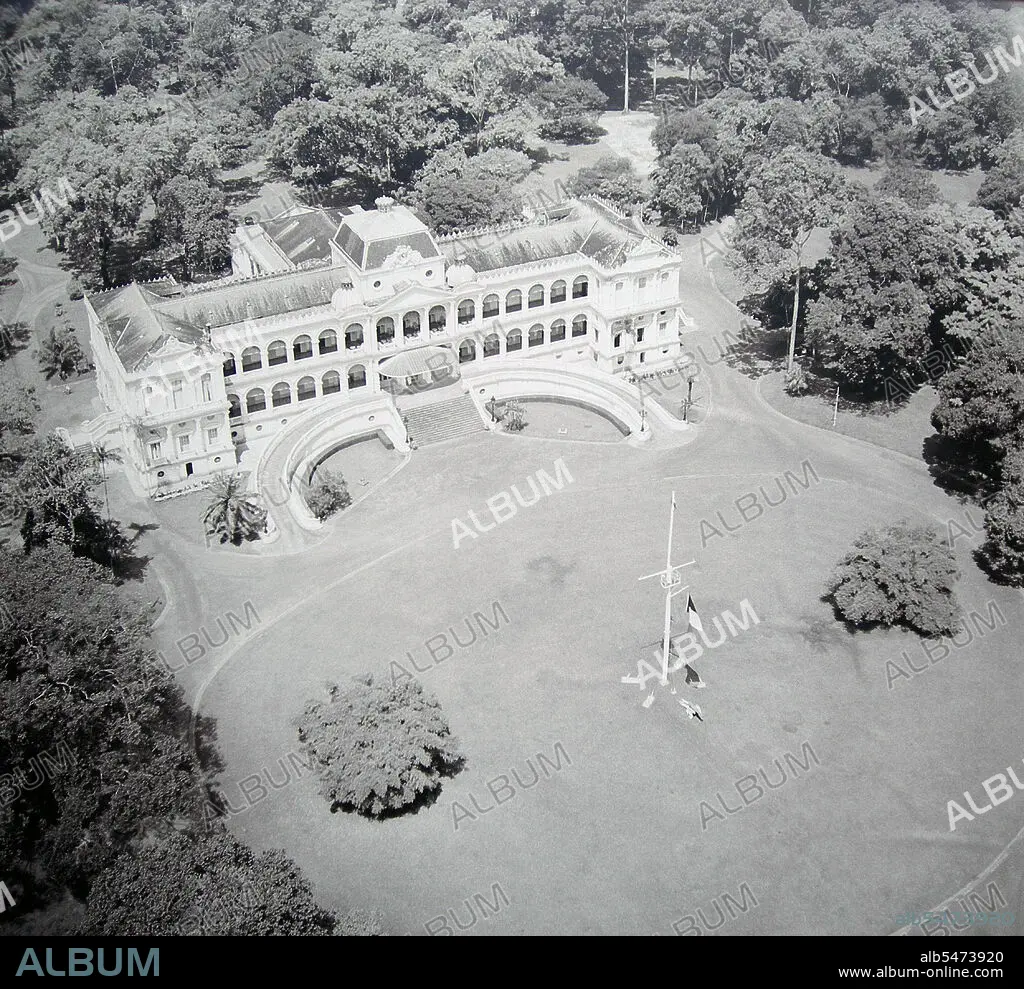
Vietnam: The former Norodom Palace, Saigon (Ho Chi Minh City) before 1962.
| Compartir |
|---|
 Pinterest Pinterest |
 Twitter Twitter |
 Facebook Facebook |
 Copiar enlace Copiar enlace |
 Email Email |
|
Añadir a otro lightbox |
|
Añadir a otro lightbox |


¿Ya tienes cuenta? Iniciar sesión
¿No tienes cuenta? Regístrate
Compra esta imagen.
Selecciona el uso:

Título: Vietnam: The former Norodom Palace, Saigon (Ho Chi Minh City) before 1962.
Descripción: Ver traducción automática
In 1858, France launched an attack on Ðà N?ng, starting its invasion of Vietnam. In 1867, France completed its conquest of southern Vietnam (Cochinchina), comprising the provinces of Biên Hoà, Gia Ð?nh, Ð?nh Tu?ng, Vinh Long, An Giang, and Hà Tiên. To consolidate the newly established colony, on 23 February 1868, Lagrandière, Governor of Cochinchina, held a ceremony to lay the foundation stone of a new palace to replace the old wooden palace built in 1863. The new palace was designed by Hermite, who was also the architect of the Hong Kong City Hall. The first cubic stone, measuring 50 cm along each edge, with indentations containing French gold and silver coins bearing Napoleon III's effigy, came from Biên Hòa. The complex covered an area of 12 hectares, including a palace with an 80-meter-wide façade, a guest-chamber capable of accommodating 800 people, with a spacious gardens covered by green trees and a lawn. Most of the building materials were imported from France. Owing to the Franco-Prussian War of 1870, construction fell behind schedule and was not completed until 1873. The palace was named Norodom Palace after the then king of Cambodia, Norodom (1834–1904). On 27 February 1962, two pilots of Ngo Dinh Di?m’s Vietnam Air Force rebelled and flew two A-1 Skyraider aircraft towards the palace and bombed it, instead of going on a raid against the Vi?t C?ng. As a result, almost the entire left wing was destroyed. However, Di?m and his family escaped the assassination attempt. As it was almost impossible to restore the palace, Di?m ordered it demolished and commissioned a new building - the current Reunification Palace - in its place.
In 1858, France launched an attack on Ðà N?ng, starting its invasion of Vietnam. In 1867, France completed its conquest of southern Vietnam (Cochinchina), comprising the provinces of Biên Hoà, Gia Ð?nh, Ð?nh Tu?ng, Vinh Long, An Giang, and Hà Tiên. To consolidate the newly established colony, on 23 February 1868, Lagrandière, Governor of Cochinchina, held a ceremony to lay the foundation stone of a new palace to replace the old wooden palace built in 1863. The new palace was designed by Hermite, who was also the architect of the Hong Kong City Hall. The first cubic stone, measuring 50 cm along each edge, with indentations containing French gold and silver coins bearing Napoleon III's effigy, came from Biên Hòa. The complex covered an area of 12 hectares, including a palace with an 80-meter-wide façade, a guest-chamber capable of accommodating 800 people, with a spacious gardens covered by green trees and a lawn. Most of the building materials were imported from France. Owing to the Franco-Prussian War of 1870, construction fell behind schedule and was not completed until 1873. The palace was named Norodom Palace after the then king of Cambodia, Norodom (1834–1904). On 27 February 1962, two pilots of Ngo Dinh Di?m’s Vietnam Air Force rebelled and flew two A-1 Skyraider aircraft towards the palace and bombed it, instead of going on a raid against the Vi?t C?ng. As a result, almost the entire left wing was destroyed. However, Di?m and his family escaped the assassination attempt. As it was almost impossible to restore the palace, Di?m ordered it demolished and commissioned a new building - the current Reunification Palace - in its place.
Crédito: Album / Pictures From History/Universal Images Group
Autorizaciones: ? Cesión de modelo: No - ? Cesión de propiedad: No
¿Preguntas relacionadas con los derechos?
¿Preguntas relacionadas con los derechos?
Tamaño imagen: 4500 × 4115 px | 53.0 MB
Tamaño impresión: 38.1 × 34.8 cm | 1771.7 × 1620.1 in (300 dpi)
Palabras clave: ARCHITECTURAL • ARCHITECTURE • ARQUITECTONICA • ARQUITECTONICO • ARQUITECTURA • ASIA • ASIATICO • CASTILLO • COCHINCHINA • FORTALEZA • HISTORIA • HISTORICO • PALACETE • PALACIO • SAIGON • VIETNAM • VIETNAMITA
