

alb3799291
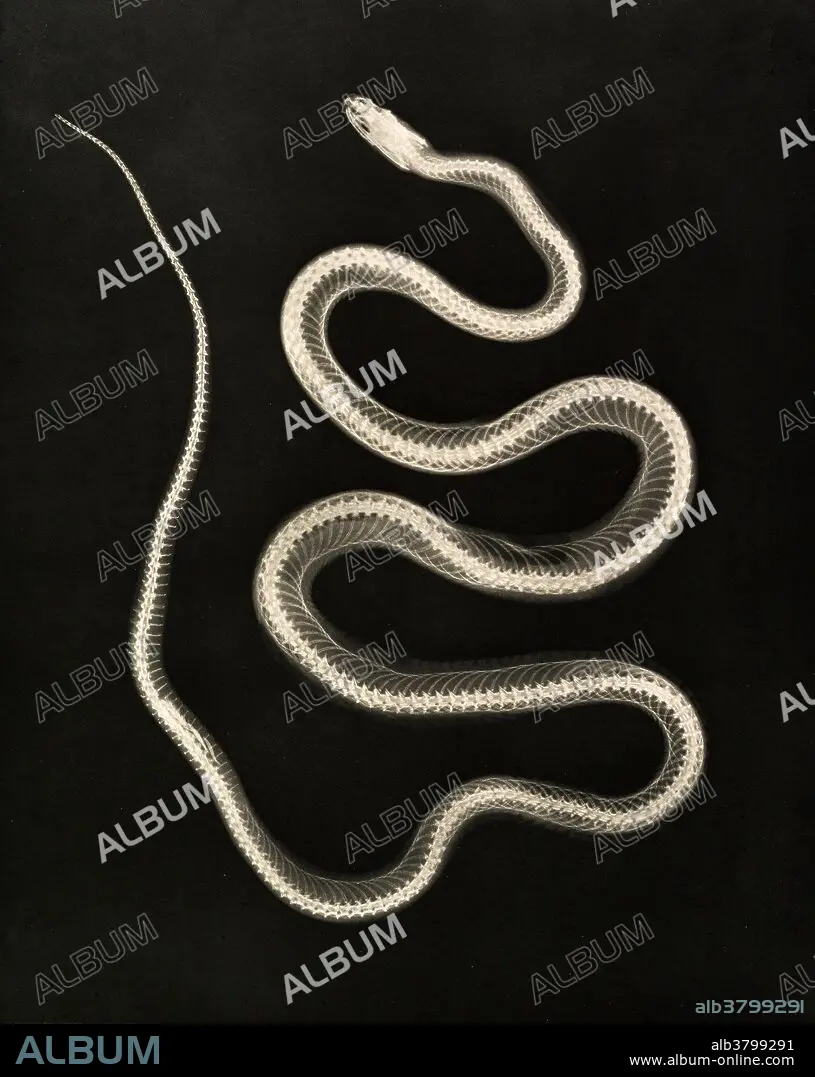
X-ray of Aesculapian Snake, 1896
| Compartir |
|---|
 Pinterest Pinterest |
 Twitter Twitter |
 Facebook Facebook |
 Copiar enlace Copiar enlace |
 Email Email |
|
Añadir a otro lightbox |
|
Añadir a otro lightbox |


¿Ya tienes cuenta? Iniciar sesión
¿No tienes cuenta? Regístrate
Compra esta imagen.
Selecciona el uso:

Título: X-ray of Aesculapian Snake, 1896
Descripción: Ver traducción automática
Historical X-ray of an Aesculapian snake, 1896. The Aesculapian snake (now Zamenis longissimus, previously Elaphe longissima), is a species of nonvenomous snake native to Europe. Growing up to 2 metres (6.6 ft) in total length, it has been of cultural and historical significance for its role in ancient Greek and Roman mythology and derived symbolism. Taken by Josef Maria Eder (Austrian, 1855-1944) and Eduard Valenta (Austrian, 1857-1937). Photogravure. Eder was the director of an institute for graphic processes and the author of an early history of photography. With the photochemist Valenta, he produced a portfolio in January 1896, less than a month after Wilhelm Conrad Rontgen published his discovery of X-rays. Eder and Valenta's volume, from which this plate derives, demonstrated the X-ray's magical ability to reveal the hidden structure of living things.
Historical X-ray of an Aesculapian snake, 1896. The Aesculapian snake (now Zamenis longissimus, previously Elaphe longissima), is a species of nonvenomous snake native to Europe. Growing up to 2 metres (6.6 ft) in total length, it has been of cultural and historical significance for its role in ancient Greek and Roman mythology and derived symbolism. Taken by Josef Maria Eder (Austrian, 1855-1944) and Eduard Valenta (Austrian, 1857-1937). Photogravure. Eder was the director of an institute for graphic processes and the author of an early history of photography. With the photochemist Valenta, he produced a portfolio in January 1896, less than a month after Wilhelm Conrad Rontgen published his discovery of X-rays. Eder and Valenta's volume, from which this plate derives, demonstrated the X-ray's magical ability to reveal the hidden structure of living things.
Personas: JOSEF MARIA EDER
Crédito: Album / Science Source / Metropolitan Museum of Art
Autorizaciones: ? Cesión de modelo: No - ? Cesión de propiedad: No
¿Preguntas relacionadas con los derechos?
¿Preguntas relacionadas con los derechos?
Tamaño imagen: 2700 × 3393 px | 26.2 MB
Tamaño impresión: 22.9 × 28.7 cm | 1063.0 × 1335.8 in (300 dpi)
Palabras clave: 1800S • ANATOMIA • ANCIENT GREEK • ANIMAL • AUSTRIACO • BLANCO Y NEGRO • CIENCIA • ESTRUCTURA • EUROPEA • EUROPEAS • EUROPEO • EUROPEOS • FAUNA • FOTOGRABADO • GRIEGO ANTIGUO • HISTORIA • HISTORICO • HUESOS, LOS • JOSEF MARIA EDER • RADIOGRAFIA • RAYOS X • REPTIL • ROMANO ANTIGUO • SIGLO XIX • SIMBÓLICA • SIMBÓLICO • SISTEMA ESQUELÉTICO • X-RAY
