

alb5474219
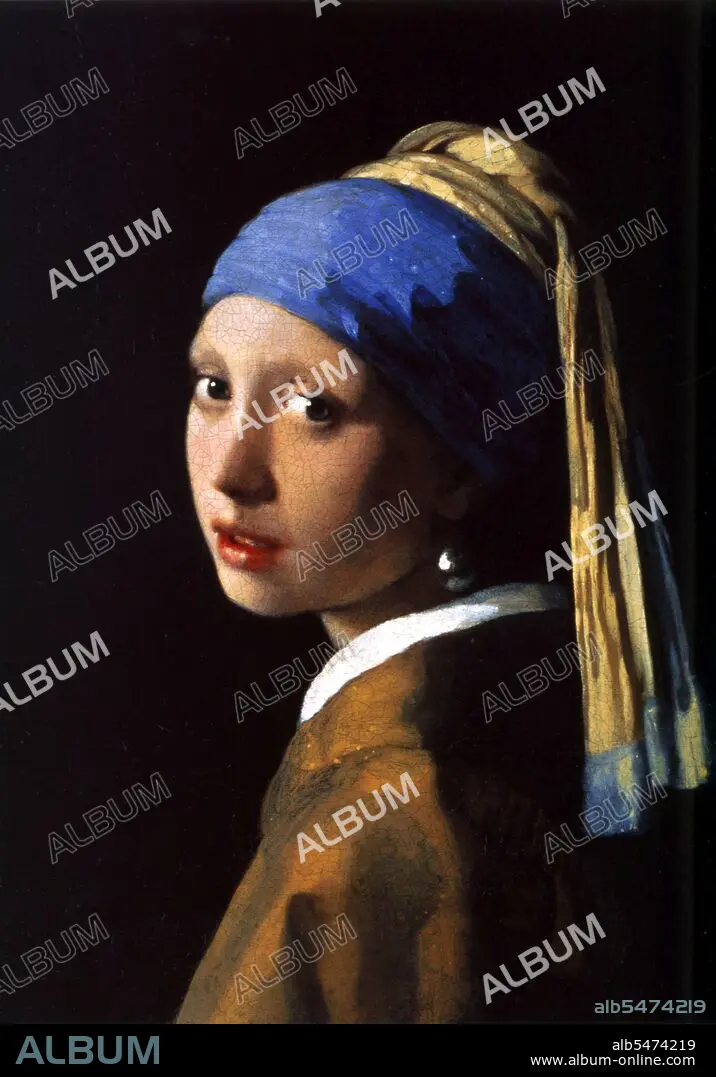
Holland-Netherlands: 'Girl with a Pearl Earring' 9c. 1665) by Dutch painter Johannes Vermeer (1632-1675)
| Compartir |
|---|
 Pinterest Pinterest |
 Twitter Twitter |
 Facebook Facebook |
 Copiar enlace Copiar enlace |
 Email Email |
|
Añadir a otro lightbox |
|
Añadir a otro lightbox |


¿Ya tienes cuenta? Iniciar sesión
¿No tienes cuenta? Regístrate
Compra esta imagen.
Selecciona el uso:

Título: Holland-Netherlands: 'Girl with a Pearl Earring' 9c. 1665) by Dutch painter Johannes Vermeer (1632-1675)
Descripción: Ver traducción automática
The painting Girl with a Pearl Earring (Dutch: Het Meisje met de Parel) is one of Dutch painter Johannes Vermeer's masterworks and as the name implies, uses a pearl earring for a focal point. Today the painting is kept in the Mauritshuis gallery in the Hague. It is sometimes referred to as 'the Mona Lisa of the North' or 'the Dutch Mona Lisa'. For thousands of years, most seawater pearls were retrieved by divers working in the Indian Ocean, in areas like the Persian Gulf, the Red Sea, and in the Gulf of Mannar. In the 14th-century Arabian Sea, the traveller Ibn Battuta provided the earliest known description of pearl diving by means of attaching a cord to the diver's waist. Before the beginning of the 20th century, pearl hunting was the most common way of harvesting pearls. Divers manually pulled oysters from ocean floors and river bottoms and checked them individually for pearls. Not all mussels and oysters produce pearls. In a haul of three tons, only three or four oysters may produce perfect pearls.
The painting Girl with a Pearl Earring (Dutch: Het Meisje met de Parel) is one of Dutch painter Johannes Vermeer's masterworks and as the name implies, uses a pearl earring for a focal point. Today the painting is kept in the Mauritshuis gallery in the Hague. It is sometimes referred to as 'the Mona Lisa of the North' or 'the Dutch Mona Lisa'. For thousands of years, most seawater pearls were retrieved by divers working in the Indian Ocean, in areas like the Persian Gulf, the Red Sea, and in the Gulf of Mannar. In the 14th-century Arabian Sea, the traveller Ibn Battuta provided the earliest known description of pearl diving by means of attaching a cord to the diver's waist. Before the beginning of the 20th century, pearl hunting was the most common way of harvesting pearls. Divers manually pulled oysters from ocean floors and river bottoms and checked them individually for pearls. Not all mussels and oysters produce pearls. In a haul of three tons, only three or four oysters may produce perfect pearls.
Crédito: Album / Pictures From History/Universal Images Group
Autorizaciones: ? Cesión de modelo: No - ? Cesión de propiedad: No
¿Preguntas relacionadas con los derechos?
¿Preguntas relacionadas con los derechos?
Tamaño imagen: 3500 × 5009 px | 50.2 MB
Tamaño impresión: 29.6 × 42.4 cm | 1378.0 × 1972.0 in (300 dpi)
