

alb3808974
Harmonices Mundi, 1619
| Compartir |
|---|
 Pinterest Pinterest |
 Twitter Twitter |
 Facebook Facebook |
 Copiar enlace Copiar enlace |
 Email Email |
|
Añadir a otro lightbox |
|
Añadir a otro lightbox |


¿Ya tienes cuenta? Iniciar sesión
¿No tienes cuenta? Regístrate
Compra esta imagen.
Selecciona el uso:

Título: Harmonices Mundi, 1619
Descripción: Ver traducción automática
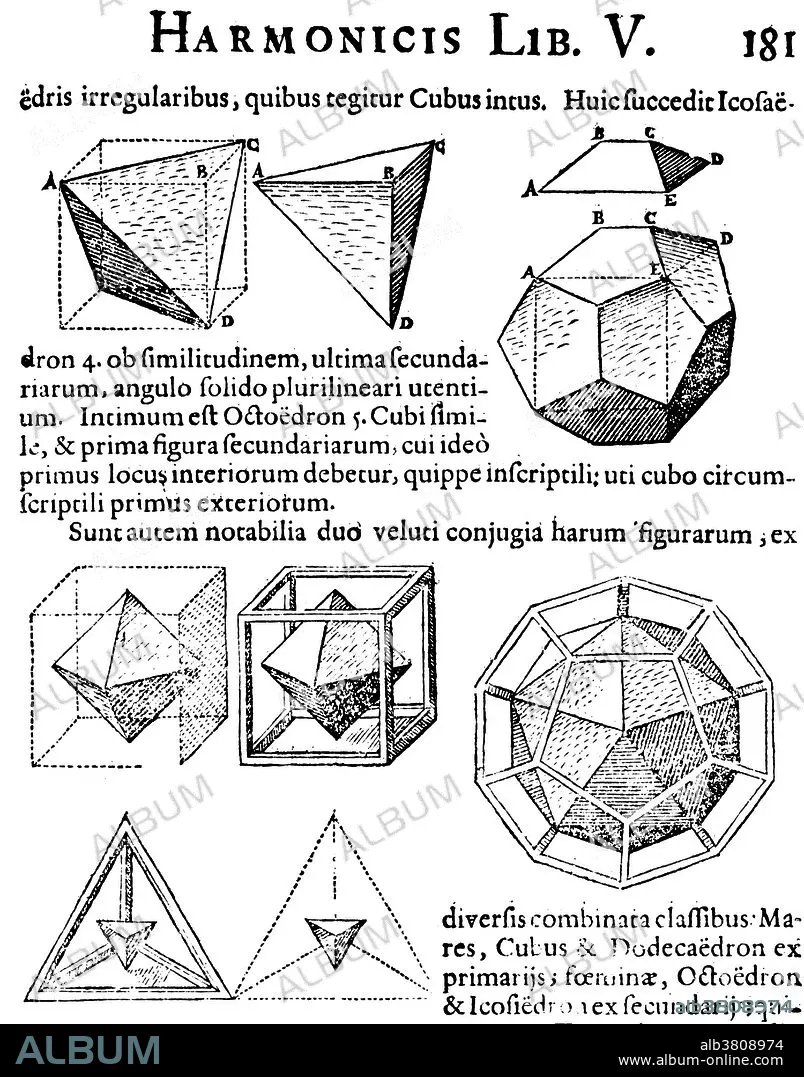
Geometric diagrams from a page of Kepler's Harmonices Mundi showing how one regular polyhedron fits inside another. He calls the cube and dodecahedron male, and the octahedron and icosahedron female, since the latter can fit inside the former, while the tetrahedron is androgynous, since it if fits in itself. Johannes Kepler (1571-1630) was a German mathematician, astronomer and astrologer. A key figure in the 17th century scientific revolution, he is best known for his works Astronomia nova, Harmonices Mundi, and Epitome Astronomiae Copernicanae. These works also provided one of the foundations for Isaac Newton's theory of universal gravitation. Kepler devised the three fundamental laws of planetary motion. These laws were based on detailed observations of the planets made by Tycho Brahe and himself. Kepler's first law states that the planets orbit the Sun in elliptical paths, with the Sun at one focus of the ellipse. The second law states that the closer a planet comes to the Sun, the faster it moves. Kepler's third law states that the ratio of the cube of a planet's mean distance from the Sun to the square of its orbital period is a constant.
Geometric diagrams from a page of Kepler's Harmonices Mundi showing how one regular polyhedron fits inside another. He calls the cube and dodecahedron male, and the octahedron and icosahedron female, since the latter can fit inside the former, while the tetrahedron is androgynous, since it if fits in itself. Johannes Kepler (1571-1630) was a German mathematician, astronomer and astrologer. A key figure in the 17th century scientific revolution, he is best known for his works Astronomia nova, Harmonices Mundi, and Epitome Astronomiae Copernicanae. These works also provided one of the foundations for Isaac Newton's theory of universal gravitation. Kepler devised the three fundamental laws of planetary motion. These laws were based on detailed observations of the planets made by Tycho Brahe and himself. Kepler's first law states that the planets orbit the Sun in elliptical paths, with the Sun at one focus of the ellipse. The second law states that the closer a planet comes to the Sun, the faster it moves. Kepler's third law states that the ratio of the cube of a planet's mean distance from the Sun to the square of its orbital period is a constant.
Crédito: Album / Science Source / New York Public Library
Autorizaciones: ? Cesión de modelo: No - ? Cesión de propiedad: No
¿Preguntas relacionadas con los derechos?
¿Preguntas relacionadas con los derechos?
Tamaño imagen: 4716 × 6004 px | 81.0 MB
Tamaño impresión: 39.9 × 50.8 cm | 1856.7 × 2363.8 in (300 dpi)
Palabras clave: 1571 • ALEMAN • ALEMANA • ALEMANES • ARTE • ASTROLOGIA • ASTRONOMIA • ASTRONOMO • CIENCIA • CIENTIFICO • DIAGRAMA • DIBUJO • EUROPEA • EUROPEAS • EUROPEO • EUROPEOS • FAMOSA • FAMOSO • FAMOSOS • FORMA • GEOMETRIC • GEOMETRICA • GEOMETRICAL • GEOMETRICO • GRABADO • HISTORIA • HISTORICO • ICOSAEDRO • ILUSTRACION • ILUSTRACIONES • IMPORTANTE • KEPLER • MATEMATICAS • MATEMÁTICO • OBRA DE ARTE • OCTAEDRO • PERSPECTIVAS • POLIEDRO • PORTRAIT • PROPORCION • RETRATO • REVOLUCION CIENTIFICA • S. XVI • SHAPE • SIGLO XVI • SIGLO XVII • TETRAEDRO
