

alb5143405
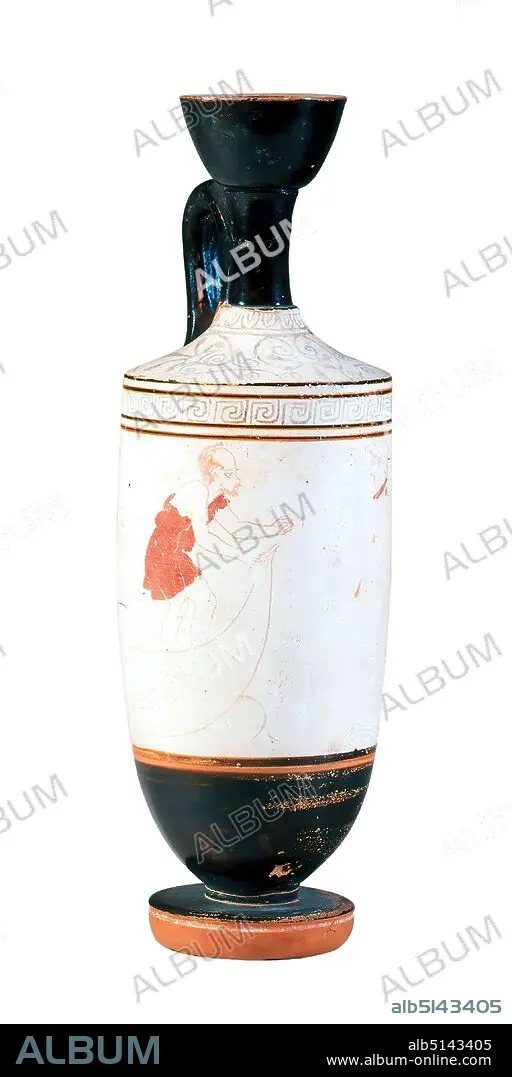
Painter of the Lekythos Cambridge 28.2, Lekythos (Charon and deceased), clay, quickly turned, fired (ceramic), painted (ceramic), cold painting, clay, Total: Height: 20.7 cm; Diameter: 6.7 cm; Muzzle diameter: 4 cm; Diameter: 4.8 cm (foot), Pottery, Charon, the ferryman, Acheron, Meander, High Classical (Greek antiquity), In Greek antiquity, all vessels for ointment or perfume oils were called lekyths; today the term is used for this special type of vessel. Around 530/520 BC, the so-called white-ground technique was developed, which probably served to imitate more valuable materials such as marble, alabaster, ostrich eggs or ivory. At the same time, it made possible a multi-colored painting. The iconography of the white-ground lekyths is dominated by depictions of graves and death. Here, the ferryman of the dead Charon approached with his neck-like tail from the left to pick up a deceased girl or young woman waiting on the shore. The boat is shown in only a few lines. Charon stands in a slightly stooped position, his left hand clenched, his right hand stretched out and open. He wears a short, reddish-brown coat, which leaves his right shoulder free. He has a high forehead bald head with sparse, pale red occipital hair, a small hooked nose and a pointed chin beard. The young woman is wrapped in a long coat that also covers her arms and legs. On her head she wears a hood, which is held together by ribbons. The shoulder is decorated with circumscribed palmettes and tendrils; it is closed at the top by an egg stick. The meander below the shoulder is limited to the width of the figurative scene, while the golden-brown rings surround it.
| Compartir |
|---|
 Pinterest Pinterest |
 Twitter Twitter |
 Facebook Facebook |
 Copiar enlace Copiar enlace |
 Email Email |
|
Añadir a otro lightbox |
|
Añadir a otro lightbox |


¿Ya tienes cuenta? Iniciar sesión
¿No tienes cuenta? Regístrate
Compra esta imagen.
Selecciona el uso:

Descripción:
Ver traducción automática
Painter of the Lekythos Cambridge 28.2, Lekythos (Charon and deceased), clay, quickly turned, fired (ceramic), painted (ceramic), cold painting, clay, Total: Height: 20.7 cm; Diameter: 6.7 cm; Muzzle diameter: 4 cm; Diameter: 4.8 cm (foot), Pottery, Charon, the ferryman, Acheron, Meander, High Classical (Greek antiquity), In Greek antiquity, all vessels for ointment or perfume oils were called lekyths; today the term is used for this special type of vessel. Around 530/520 BC, the so-called white-ground technique was developed, which probably served to imitate more valuable materials such as marble, alabaster, ostrich eggs or ivory. At the same time, it made possible a multi-colored painting. The iconography of the white-ground lekyths is dominated by depictions of graves and death. Here, the ferryman of the dead Charon approached with his neck-like tail from the left to pick up a deceased girl or young woman waiting on the shore. The boat is shown in only a few lines. Charon stands in a slightly stooped position, his left hand clenched, his right hand stretched out and open. He wears a short, reddish-brown coat, which leaves his right shoulder free. He has a high forehead bald head with sparse, pale red occipital hair, a small hooked nose and a pointed chin beard. The young woman is wrapped in a long coat that also covers her arms and legs. On her head she wears a hood, which is held together by ribbons. The shoulder is decorated with circumscribed palmettes and tendrils; it is closed at the top by an egg stick. The meander below the shoulder is limited to the width of the figurative scene, while the golden-brown rings surround it.
Personas:
Crédito:
Album / quintlox
Autorizaciones:
Tamaño imagen:
2160 x 4320 px | 26.7 MB
Tamaño impresión:
18.3 x 36.6 cm | 7.2 x 14.4 in (300 dpi)
Palabras clave:
ABIERTO • ADOQUINES • ALFARERIA • ARCILLA • BARCO • BARCOS • BARQUERO • BARQUEROS • BUQUE • CABEZA • CARONTE (MITOLOGIA) • CARONTE • CERÁMICA • CERÁMICO • COLA (DE ANIMAL) • CONTEMPORÁNEO • DECEASED • DECORADA • DECORADO • DEFUNCION • DIAMETRO • DIFUNTO • DISPARARON • ENVUELTO • FALLECIDO • FOOT • HOJAS • HOMBRO • IMITAR • IZQUIERDA • LEKYTHOS • LIMITADA • MARBLE • MARFIL • MARMOL • MEANDRO • MUERTE • MUJER JOVEN • NAVES • OBJETO DE ARCILLA • OBJETO DE CERAMICA • ORILLA • PAINTER • PIE • PIERNA • PIERNAS • PINTADA • PINTADO • PINTOR • PLAZO • REPRESENTACIONES • TENDRILS • TERRACOTA • TERRACOTTA • TIEMPO • TUMBAS
