

alb3672944
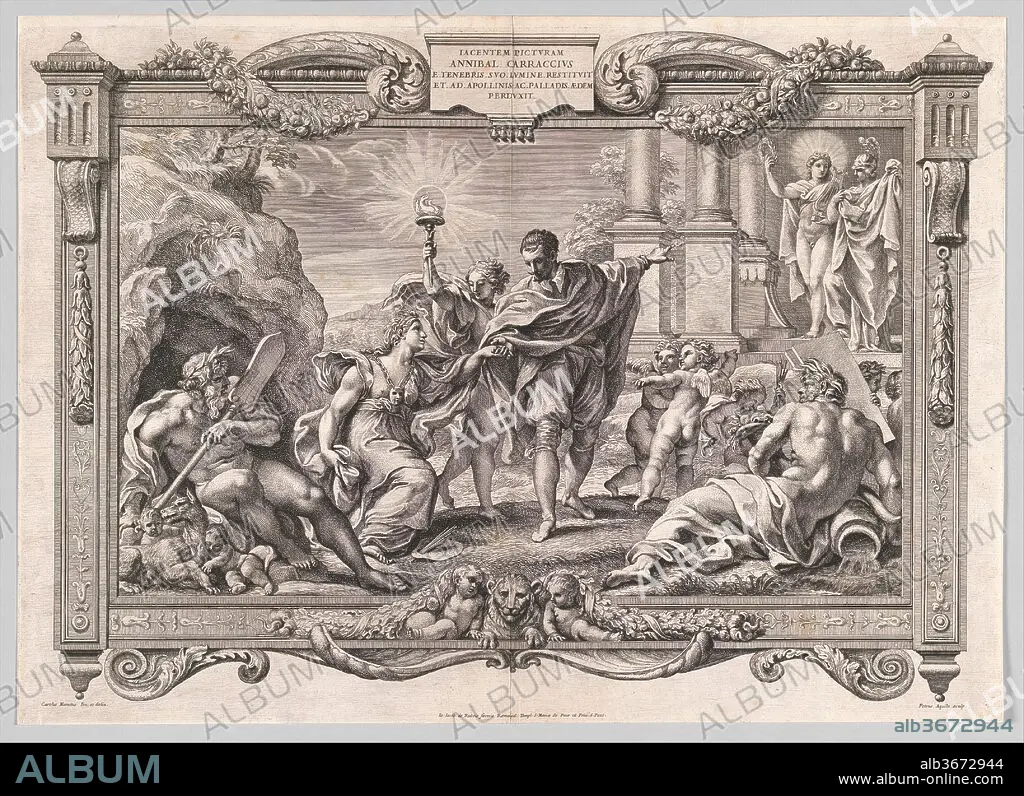
PIETRO AQUILA, AFTER CARLO MARATTI. Annibale Carracci Introduces Painting to Apollo and Minerva
| Compartir |
|---|
 Pinterest Pinterest |
 Twitter Twitter |
 Facebook Facebook |
 Copiar enlace Copiar enlace |
 Email Email |
|
Añadir a otro lightbox |
|
Añadir a otro lightbox |


¿Ya tienes cuenta? Iniciar sesión
¿No tienes cuenta? Regístrate
Compra esta imagen.
Selecciona el uso:

Título: Annibale Carracci Introduces Painting to Apollo and Minerva
Descripción:
Traducción automática: Annibale Carracci introduce la pintura a Apolo y Minerva. Artista: Según Carlo Maratti (italiano, Camerano 1625-1713 Roma); Pietro Aquila (italiano, Marsala, Sicilia 1650-1692/1700 Roma). Dimensiones: Hoja (recortada a placa): 18 1/8 × 25 1/4 pulgadas (46 × 64,1 cm). Editor: Giovanni Giacomo De Rossi (italiano, Roma 1627-1691 Roma). Serie/Portafolio: Publicado en Galeria Farnesianae Icones..., 1674. Fecha: 1674. Esta estampa apareció como frontispicio de un libro de grabados que representaban los frescos pintados por Annibale Carracci en la Galería Farnese en Roma. Al igual que la publicación del libro, este frontispicio fue parte de un esfuerzo concertado para elevar al pintor, activo a finales del siglo XVII, a la categoría de mito. Aquí vemos a Aníbal acompañado por el Genio sacando a la Pintura de una cueva oscura (símbolo de la oscuridad y la oscuridad en la que se decía que había caído la pintura a finales del siglo XVI) hacia ese reino exaltado y luminoso donde podría ser recibida por Apolo y Minerva. La idea es muy similar a la del grabado de Pietro Testa, "El triunfo de la pintura en el Parnaso", en el que la pintura es recibida en el Parnaso, y el diseño de Maratti también puede haberse inspirado en la interpretación posterior y más personal del tema de Testa, en la que el artista está acompañado, como aquí, por una figura con una antorcha encendida. El dios del río más cercano a Aníbal representa la ciudad de Roma, donde la Galería Farnese de Aníbal dio la mayor prueba de su genio. El otro dios del río representa a Bolonia, donde nació Annibale y, junto con su hermano y su primo, fundó una influyente academia de arte. Giovanni Pietro Bellori, el anticuario y crítico de arte que había organizado la publicación con De' Rossi y escrito el texto que la acompañaba, había publicado recientemente una serie de biografías de artistas que también buscaban promover a Annibale como el pintor ideal cuyo renacimiento de la tradición de Rafael debería ser un modelo para todos los artistas. Carlo Maratti, el exitoso pintor y líder de la Academia romana que diseñó esta alegoría, se había formado en la tradición de Carracci y deseaba defender esa tradición frente a otras tendencias artísticas prominentes en Roma. El hábil grabador siciliano Pietro Aquila era amigo de Maratti y colaboraba frecuentemente con Bellori.
Annibale Carracci Introduces Painting to Apollo and Minerva. Artist: After Carlo Maratti (Italian, Camerano 1625-1713 Rome); Pietro Aquila (Italian, Marsala, Sicily 1650-1692/1700 Rome). Dimensions: Sheet (Trimmed to plate): 18 1/8 × 25 1/4 in. (46 × 64.1 cm). Publisher: Giovanni Giacomo De Rossi (Italian, Rome 1627-1691 Rome). Series/Portfolio: Published in Galeria Farnesianae Icones..., 1674. Date: 1674.
This print appeared as a frontispiece to a book of etchings depicting the frescoes painted by Annibale Carracci in the Farnese Gallery in Rome. Like the publication of the book itself, this frontispiece was part of a concerted effort to raise the painter, active at the turn of the seventeenth century, to mythical status. Here we see Annibale accompanied by Genius bringing Painting out of a dark cave (symbolic of the obscurity and darkness into which painting was said to have fallen in the late sixteenth century) into that exalted and luminous realm where she could be welcomed by Apollo and Minerva. The idea is very much like that of Pietro Testa's etching, 'The Triumph of Painting on Parnassus', in which Painting is welcomed on Parnassus, and Maratti's design may also have received inspiration from Testa's later and more personal interpretation of the theme, in which the artist is accompanied, as here, by a figure with a flaming torch. The river god nearest Annibale signifies the city of Rome, where Annibale's Farnese Gallery gave the greatest proof of his genius. The other river god stands for Bologna, where Annibale was born and, together with his brother and cousin, founded an influential academy of art.
Giovanni Pietro Bellori, the antiquarian and art critic who had organized the publication with de' Rossi and written the accompanying text, had recently published a series of artists' lives that also sought to promote Annibale as the ideal painter whose revival of the tradition of Raphael should be a model for all artists. Carlo Maratti, the successful painter and leader of the Roman Academy who designed this allegory, had been trained in the Carracci tradition, and wished to uphold that tradition in the face of other artistic trends prominent in Rome. The highly skilled Sicilian printmaker Pietro Aquila was a friend of Maratti and frequently collaborated with Bellori.
Técnica/material: etching and engraving
Museo: Metropolitan Museum of Art, New York, USA
Editor: Giovanni Giacomo De Rossi (Italian, Rome 1627-1691 Rome)
Crédito: Album
Tamaño imagen: 4315 × 3132 px | 38.7 MB
Tamaño impresión: 36.5 × 26.5 cm | 1698.8 × 1233.1 in (300 dpi)
Palabras clave: AFTER CARLO MARATTI • DIBUJOS Y GRABADOS • EUROPA • GRABADO • ITALIA • METROPOLITAN MUSEUM OF ART, NEW YORK, USA • PIETRO AQUILA
