

alb5534573
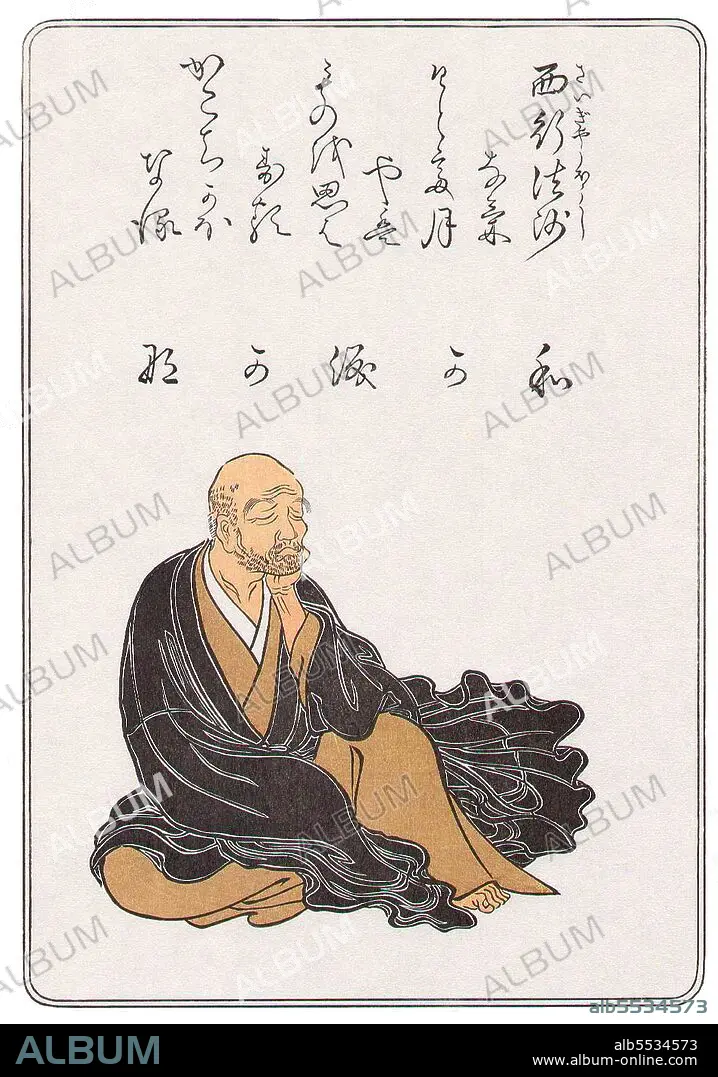
Japan: The Monk Saigyo Hoshi, a celebrated poet of the late Heian and Kamakura Periods (1118-1190). Katsukawa Shunsho (1726-1793)
| Compartir |
|---|
 Pinterest Pinterest |
 Twitter Twitter |
 Facebook Facebook |
 Copiar enlace Copiar enlace |
 Email Email |
|
Añadir a otro lightbox |
|
Añadir a otro lightbox |


¿Ya tienes cuenta? Iniciar sesión
¿No tienes cuenta? Regístrate
Compra esta imagen.
Selecciona el uso:

Título: Japan: The Monk Saigyo Hoshi, a celebrated poet of the late Heian and Kamakura Periods (1118-1190). Katsukawa Shunsho (1726-1793)
Descripción: Ver traducción automática
Born Sato Norikiyo (?? ??) in Kyoto to a noble family, Saigyo lived during the traumatic transition of power between the old court nobles and the new samurai warriors. After the start of the Age of Mappo (1052), Buddhism was considered to be in decline and no longer as effective a means of salvation. These cultural shifts during his lifetime led to a sense of melancholy in his poetry. As a youth, he worked as a guard to retired Emperor Toba, but in 1140 at age 22, for reasons now unknown, he quit worldly life to become a monk, taking the religious name En'i (??). He later took the pen name, 'Saigyo' meaning Western Journey, a reference to Amida Buddha and the Western paradise. He lived alone for long periods in his life in Saga, Mt Koya, Mt Yoshino, Ise, and many other places, but he is more known for the many long, poetic journeys he took to Northern Honshu that would later inspire Basho in his Narrow Road to the Interior. He was a good friend of Fujiwara no Teika. Some main collections of Saigyo's work are in the Sankashu, Shin Kokin Wakashu, and Shika Wakashu. He died in Hirokawa Temple in Kawachi Province (present-day Osaka Prefecture) at age 72.
Born Sato Norikiyo (?? ??) in Kyoto to a noble family, Saigyo lived during the traumatic transition of power between the old court nobles and the new samurai warriors. After the start of the Age of Mappo (1052), Buddhism was considered to be in decline and no longer as effective a means of salvation. These cultural shifts during his lifetime led to a sense of melancholy in his poetry. As a youth, he worked as a guard to retired Emperor Toba, but in 1140 at age 22, for reasons now unknown, he quit worldly life to become a monk, taking the religious name En'i (??). He later took the pen name, 'Saigyo' meaning Western Journey, a reference to Amida Buddha and the Western paradise. He lived alone for long periods in his life in Saga, Mt Koya, Mt Yoshino, Ise, and many other places, but he is more known for the many long, poetic journeys he took to Northern Honshu that would later inspire Basho in his Narrow Road to the Interior. He was a good friend of Fujiwara no Teika. Some main collections of Saigyo's work are in the Sankashu, Shin Kokin Wakashu, and Shika Wakashu. He died in Hirokawa Temple in Kawachi Province (present-day Osaka Prefecture) at age 72.
Crédito: Album / Pictures From History/Universal Images Group
Autorizaciones: ? Cesión de modelo: No - ? Cesión de propiedad: No
¿Preguntas relacionadas con los derechos?
¿Preguntas relacionadas con los derechos?
Tamaño imagen: 3500 × 4993 px | 50.0 MB
Tamaño impresión: 29.6 × 42.3 cm | 1378.0 × 1965.7 in (300 dpi)
