

alb5535896
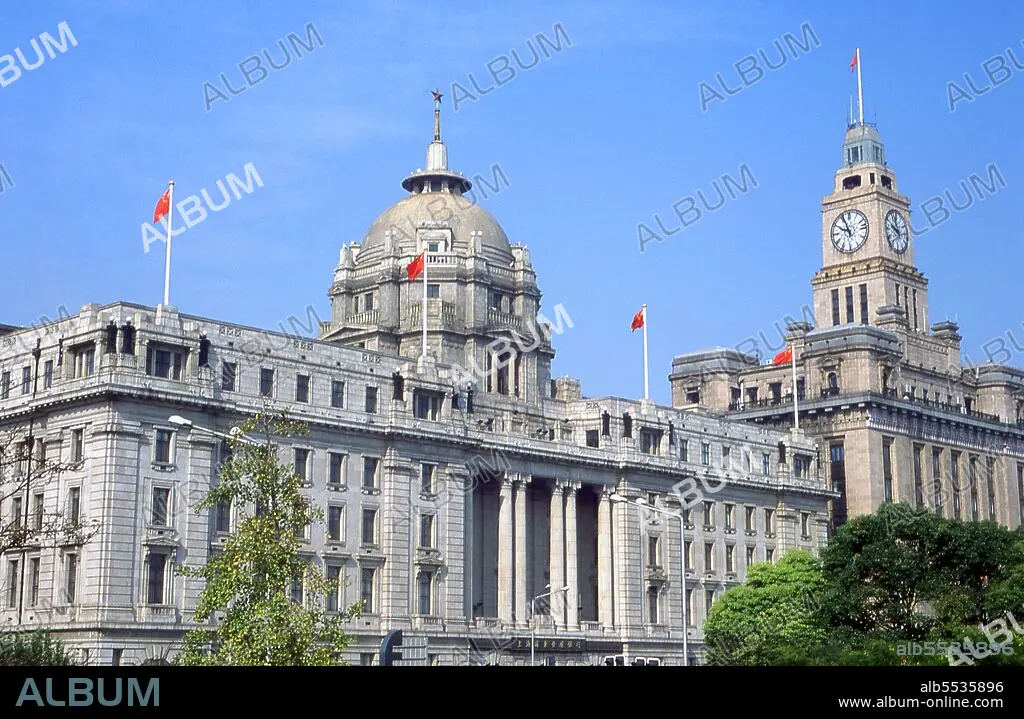
China: The old Hongkong and Shanghai Bank building (left) and the old Customs House (right), The Bund, Zhongshan Donglu, Shanghai.
| Compartir |
|---|
 Pinterest Pinterest |
 Twitter Twitter |
 Facebook Facebook |
 Copiar enlace Copiar enlace |
 Email Email |
|
Añadir a otro lightbox |
|
Añadir a otro lightbox |


¿Ya tienes cuenta? Iniciar sesión
¿No tienes cuenta? Regístrate
Compra esta imagen.
Selecciona el uso:

Título: China: The old Hongkong and Shanghai Bank building (left) and the old Customs House (right), The Bund, Zhongshan Donglu, Shanghai.
Descripción: Ver traducción automática
The Bund (Chinese: Wàitan) is an area of Huangpu District in central Shanghai. The area centres on a section of Zhongshan Road (East-1 Zhongshan Road) within the former Shanghai International Settlement, which runs along the western bank of the Huangpu River, facing Pudong, in the eastern part of Huangpu District. The Bund usually refers to the buildings and wharves on this section of the road, as well as some adjacent areas. Shanghai began life as a fishing village, and later as a port receiving goods carried down the Yangzi River. From 1842 onwards, in the aftermath of the first Opium War, the British opened a ‘concession’ in Shanghai where drug dealers and other traders could operate undisturbed. French, Italians, Germans, Americans and Japanese all followed. By the 1920s and 1930s, Shanghai was a boom town and an international byword for dissipation. When the Communists won power in 1949, they transformed Shanghai into a model of the Revolution.
The Bund (Chinese: Wàitan) is an area of Huangpu District in central Shanghai. The area centres on a section of Zhongshan Road (East-1 Zhongshan Road) within the former Shanghai International Settlement, which runs along the western bank of the Huangpu River, facing Pudong, in the eastern part of Huangpu District. The Bund usually refers to the buildings and wharves on this section of the road, as well as some adjacent areas. Shanghai began life as a fishing village, and later as a port receiving goods carried down the Yangzi River. From 1842 onwards, in the aftermath of the first Opium War, the British opened a ‘concession’ in Shanghai where drug dealers and other traders could operate undisturbed. French, Italians, Germans, Americans and Japanese all followed. By the 1920s and 1930s, Shanghai was a boom town and an international byword for dissipation. When the Communists won power in 1949, they transformed Shanghai into a model of the Revolution.
Crédito: Album / David Henley/Pictures from History/Universal Images Group
Autorizaciones: ? Cesión de modelo: No - ? Cesión de propiedad: No
¿Preguntas relacionadas con los derechos?
¿Preguntas relacionadas con los derechos?
Tamaño imagen: 5100 × 3318 px | 48.4 MB
Tamaño impresión: 43.2 × 28.1 cm | 2007.9 × 1306.3 in (300 dpi)
Palabras clave: ARCHITECTURAL • ARCHITECTURE • ARQUITECTONICA • ARQUITECTONICO • ARQUITECTURA • ASIA • ASIATICO • BANCA • BANCO • CHINA • CHINO • HISTORIA • HISTORICO • PORCELANA
