

alb3991368
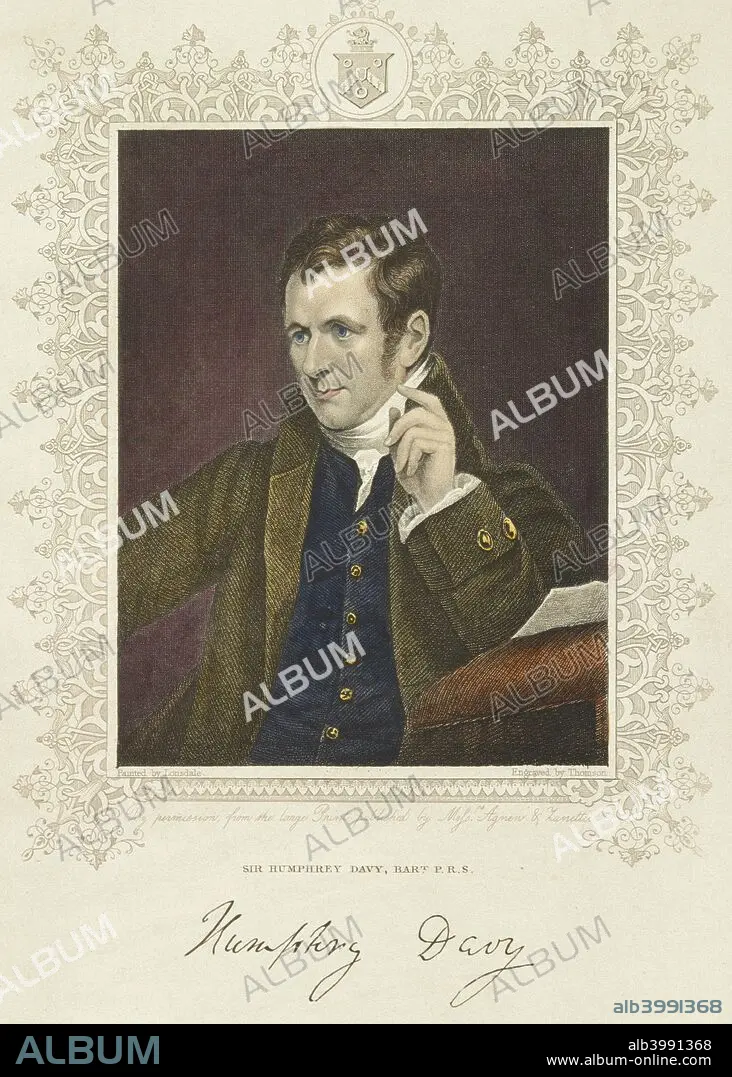
Humphry Davy, British chemist and inventor, 1801 Artist: Thomson
| Compartir |
|---|
 Pinterest Pinterest |
 Twitter Twitter |
 Facebook Facebook |
 Copiar enlace Copiar enlace |
 Email Email |
|
Añadir a otro lightbox |
|
Añadir a otro lightbox |


¿Ya tienes cuenta? Iniciar sesión
¿No tienes cuenta? Regístrate
Compra esta imagen.
Selecciona el uso:

Título: Humphry Davy, British chemist and inventor, 1801 Artist: Thomson
Descripción: Ver traducción automática
Humphry Davy, British chemist and inventor, 1801. Davy (1778-1829) discovered the anaesthetic effects of laughing gas (nitrous oxide). In 1801 he was appointed lecturer at the Royal Institution, where he investigated, with his assistant Michael Faraday (1791-1867), his theory of volcanic action. Using electrolysis, Davy isolated the metals barium, calcium, magnesium, potassium, sodium and strontium, as well as proving that chlorine was a chemical element. He is probably best known for his invention in 1815 of the miners' safety lamp, which enabled deeper, more gaseous seams to be mined without risk of explosion.
Humphry Davy, British chemist and inventor, 1801. Davy (1778-1829) discovered the anaesthetic effects of laughing gas (nitrous oxide). In 1801 he was appointed lecturer at the Royal Institution, where he investigated, with his assistant Michael Faraday (1791-1867), his theory of volcanic action. Using electrolysis, Davy isolated the metals barium, calcium, magnesium, potassium, sodium and strontium, as well as proving that chlorine was a chemical element. He is probably best known for his invention in 1815 of the miners' safety lamp, which enabled deeper, more gaseous seams to be mined without risk of explosion.
Crédito: Album / Oxford Science Archive / Heritage Images
Autorizaciones: ? Cesión de modelo: No - ? Cesión de propiedad: No
¿Preguntas relacionadas con los derechos?
¿Preguntas relacionadas con los derechos?
Tamaño imagen: 3534 × 4944 px | 50.0 MB
Tamaño impresión: 29.9 × 41.9 cm | 1391.3 × 1946.5 in (300 dpi)
Palabras clave: ANESTESIA • BRITANICO • CHICO • CIENCIA • CIENTIFICO • COLOR • COLORIDO • ELECTROLISIS • GENTE • GRABADO • GRAN BRETAÑA • HOMBRE • HOMBRES • ILUMINACION • INDUSTRIA • INDUSTRIAS • INGLATERRA • INGLES • INVENTOR • JAMES • LAMPARA • MASCULINO • MEDICINA • MINERIA • OCUPACION • PAÍS • PORTRAIT • PROFESIÓN • QUIMICA • QUIMICO • RETRATO DE HOMBRE • RETRATO • SIGLO XIX • SIGLO • TRABAJO
