

alb3629464
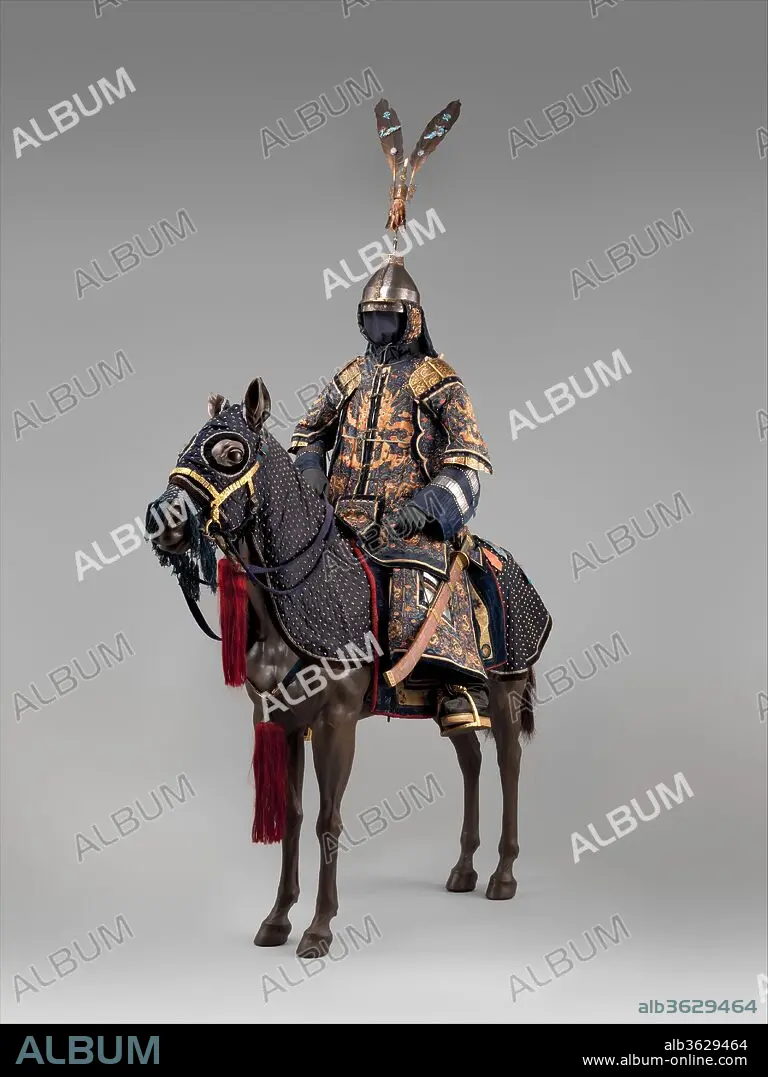
Ceremonial Armors for Man (Dingjia) and Horse
| Compartir |
|---|
 Pinterest Pinterest |
 Twitter Twitter |
 Facebook Facebook |
 Copiar enlace Copiar enlace |
 Email Email |
|
Añadir a otro lightbox |
|
Añadir a otro lightbox |


¿Ya tienes cuenta? Iniciar sesión
¿No tienes cuenta? Regístrate
Compra esta imagen.
Selecciona el uso:

Título: Ceremonial Armors for Man (Dingjia) and Horse
Descripción: Ver traducción automática
Ceremonial Armors for Man (Dingjia) and Horse. Culture: Chinese. Date: 18th century. The man's armor, known as dingjia (armor with nails), is a very elaborate example of the military costume worn at the imperial court by high-ranking officials in the eighteenth and nineteenth centuries. It consists of a jacket with sleeves and an ankle-length skirt constructed of narrow overlapping plates riveted inside the fabric layers with the securing rivet heads visible on the outside. Some of these plates, of brightly polished steel, are exposed on the arms and skirt. Although not intended for use in battle, the jacket is reinforced further with large shoulderpieces, panels under the arms, and a small panel of similar construction that covers the lower abdomen. This fashion thus combines the warrior's practical but usually plain armor and the ceremonial robes often worn over it. This example is embroidered with gold and colored silk thread, in traditional designs of dragons and waves. The delicately engraved and gilt steel plates at the shoulders repeat these motifs. The helmet is surmounted by a crest of sable tails, coral, and kingfisher feathers mounted with cloisonné enamels. The horse armor has no internal plates but only the rivet heads to give the outward appearance of armor.
Ceremonial Armors for Man (Dingjia) and Horse. Culture: Chinese. Date: 18th century. The man's armor, known as dingjia (armor with nails), is a very elaborate example of the military costume worn at the imperial court by high-ranking officials in the eighteenth and nineteenth centuries. It consists of a jacket with sleeves and an ankle-length skirt constructed of narrow overlapping plates riveted inside the fabric layers with the securing rivet heads visible on the outside. Some of these plates, of brightly polished steel, are exposed on the arms and skirt. Although not intended for use in battle, the jacket is reinforced further with large shoulderpieces, panels under the arms, and a small panel of similar construction that covers the lower abdomen. This fashion thus combines the warrior's practical but usually plain armor and the ceremonial robes often worn over it. This example is embroidered with gold and colored silk thread, in traditional designs of dragons and waves. The delicately engraved and gilt steel plates at the shoulders repeat these motifs. The helmet is surmounted by a crest of sable tails, coral, and kingfisher feathers mounted with cloisonné enamels. The horse armor has no internal plates but only the rivet heads to give the outward appearance of armor.
Técnica/material: Steel, copper, gold, silk, leather, hair
Museo: Metropolitan Museum of Art, New York, USA
Crédito: Album
Autorizaciones: ? Cesión de modelo: No - ? Cesión de propiedad: No
¿Preguntas relacionadas con los derechos?
¿Preguntas relacionadas con los derechos?
Tamaño imagen: 3202 × 4268 px | 39.1 MB
Tamaño impresión: 27.1 × 36.1 cm | 1260.6 × 1680.3 in (300 dpi)
Palabras clave: ACERO • ALEACIÓN DE HIERRO • ARMADURA • ARMAS Y ARMADURA • ARMEROS • ASIA • CABELLO • CHINA • COBRE • CUERO • METAL • METROPOLITAN MUSEUM OF ART, NEW YORK, USA • ORO • SEDA
