

alb9077267
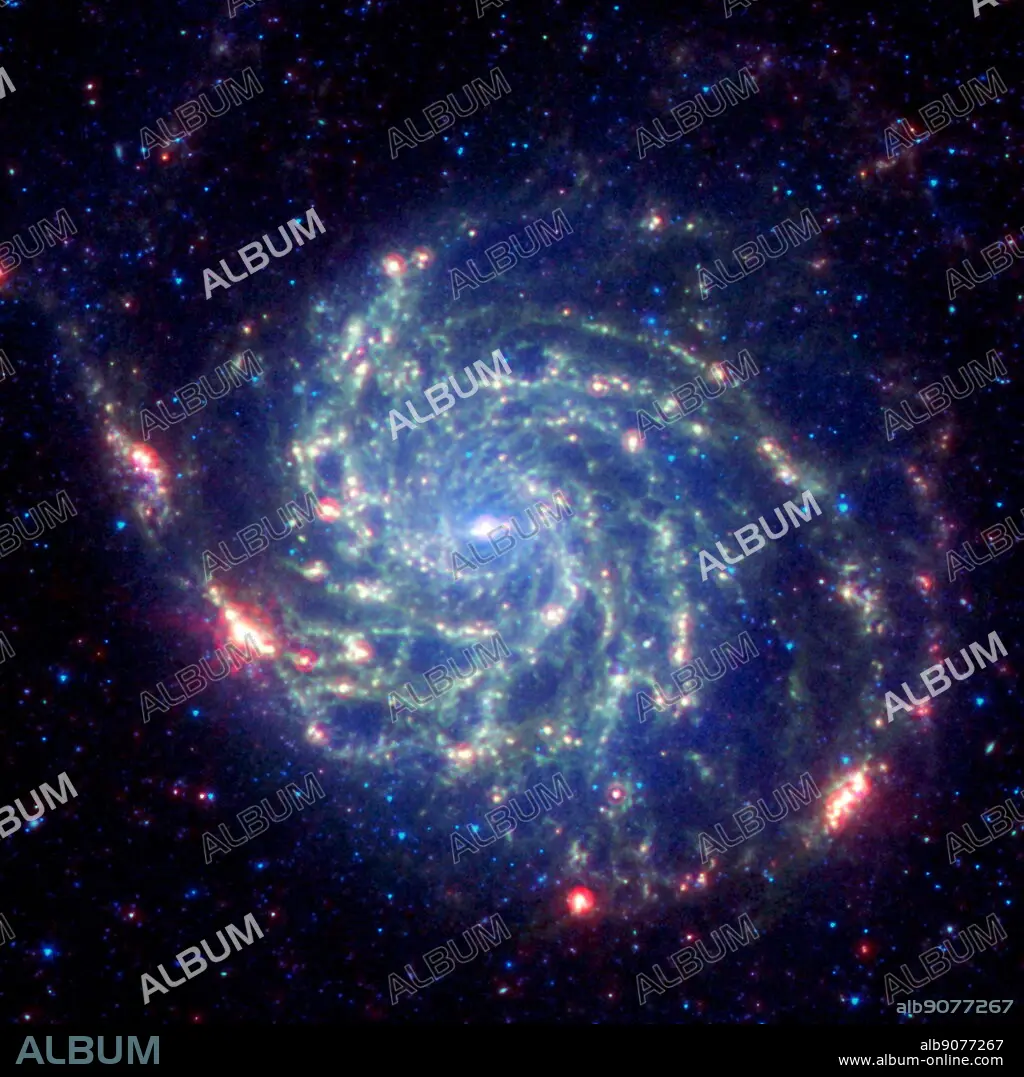
The galaxy Messier 101 is a swirling spiral of stars, gas, and dust. Messier 101 is nearly twice as wide as our Milky Way galaxy. Spitzer's view, taken in infrared light, reveals the galaxy's delicate dust lanes as yellow-green filaments. Such dense dust clouds are where new stars can form. In this image, dust warmed by the light of hot, young stars glows red. The rest of the galaxy's hundreds of billions of stars are less prominent and form a blue haze. Astronomers can use infrared light to examine the dust clouds where stars are born.
| Compartir |
|---|
 Pinterest Pinterest |
 Twitter Twitter |
 Facebook Facebook |
 Copiar enlace Copiar enlace |
 Email Email |
|
Añadir a otro lightbox |
|
Añadir a otro lightbox |


¿Ya tienes cuenta? Iniciar sesión
¿No tienes cuenta? Regístrate
Compra esta imagen.
Selecciona el uso:

Descripción: Ver traducción automática
The galaxy Messier 101 is a swirling spiral of stars, gas, and dust. Messier 101 is nearly twice as wide as our Milky Way galaxy. Spitzer's view, taken in infrared light, reveals the galaxy's delicate dust lanes as yellow-green filaments. Such dense dust clouds are where new stars can form. In this image, dust warmed by the light of hot, young stars glows red. The rest of the galaxy's hundreds of billions of stars are less prominent and form a blue haze. Astronomers can use infrared light to examine the dust clouds where stars are born.
The galaxy Messier 101 is a swirling spiral of stars, gas, and dust. Messier 101 is nearly twice as wide as our Milky Way galaxy. Spitzer's view, taken in infrared light, reveals the galaxy's delicate dust lanes as yellow-green filaments. Such dense dust clouds are where new stars can form. In this image, dust warmed by the light of hot, young stars glows red. The rest of the galaxy's hundreds of billions of stars are less prominent and form a blue haze. Astronomers can use infrared light to examine the dust clouds where stars are born.
Crédito: Album / World History Archive
Autorizaciones: ? Cesión de modelo: No - ? Cesión de propiedad: No
¿Preguntas relacionadas con los derechos?
¿Preguntas relacionadas con los derechos?
Tamaño imagen: 4200 × 4200 px | 50.5 MB
Tamaño impresión: 35.6 × 35.6 cm | 1653.5 × 1653.5 in (300 dpi)
Palabras clave: ASTRONOMIA • ESPACIAL • ESPACIALES • ESPACIO • ESTELAR
