

alb9204113
Exoplanets, Planetary System Comparisons
| Compartir |
|---|
 Pinterest Pinterest |
 Twitter Twitter |
 Facebook Facebook |
 Copiar enlace Copiar enlace |
 Email Email |
|
Añadir a otro lightbox |
|
Añadir a otro lightbox |


¿Ya tienes cuenta? Iniciar sesión
¿No tienes cuenta? Regístrate
Compra esta imagen.
Selecciona el uso:

Título: Exoplanets, Planetary System Comparisons
Descripción: Ver traducción automática
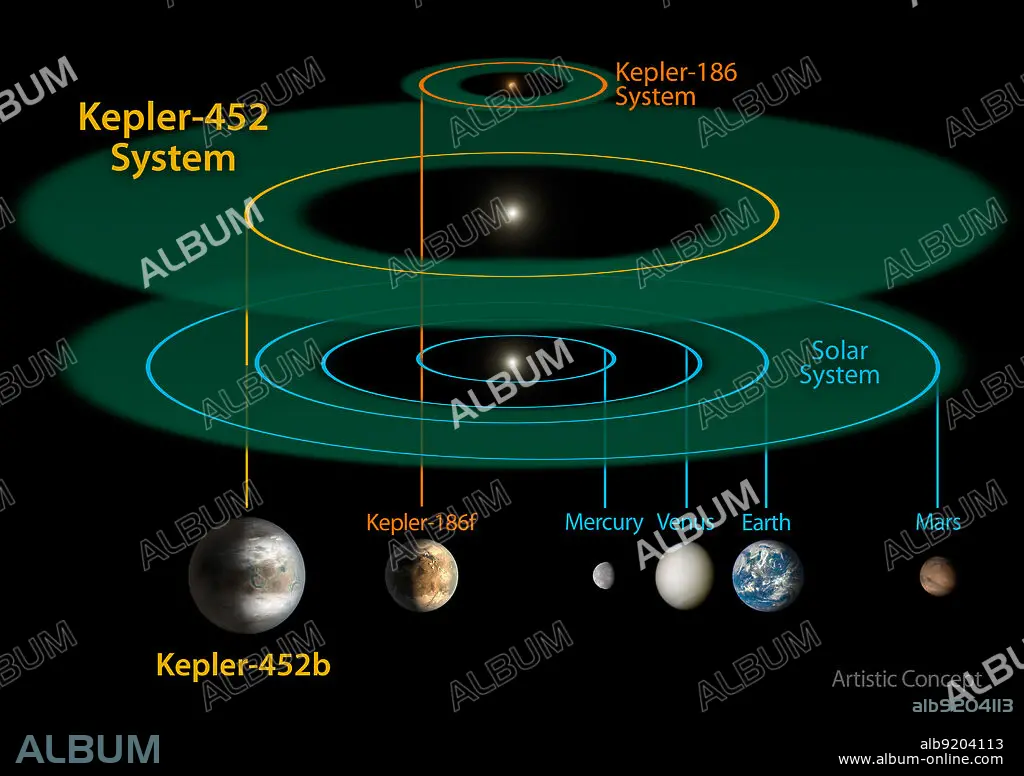
This size and scale of the Kepler-452 system compared alongside the Kepler-186 system and the solar system. Kepler-186 is a miniature solar system that would fit entirely inside the orbit of Mercury. The habitable zone of Kepler-186 is very small compared to that of Kepler-452 or the sun because it is a much smaller, cooler star. The size and extent of the habitable zone of Kepler-452 is nearly the same as that of the sun, but is slightly bigger because Kepler-452 is somewhat older, bigger and brighter. The size of the orbit of Kepler-452b is nearly the same as that of Earth at 1.05 astronomical units (an astronomical unit is the distance between Earth and the sun). Kepler-452b orbits its star once every 385 days. NASA Ames manages Kepler's ground system development, mission operations and science data analysis. NASA's Jet Propulsion Laboratory in Pasadena, Calif., managed Kepler mission development. Ball Aerospace & Technologies Corp. in Boulder, Colo., developed the Kepler flight system and supports mission operations with JPL at the Laboratory for Atmospheric and Space Physics at the University of Colorado in Boulder. The Space Telescope Science Institute in Baltimore archives, hosts and distributes the Kepler science data. Kepler is NASA's 10th Discovery Mission and is funded by NASA's Science Mission Directorate at the agency's headquarters in Washington. Release date July 23, 2015.
This size and scale of the Kepler-452 system compared alongside the Kepler-186 system and the solar system. Kepler-186 is a miniature solar system that would fit entirely inside the orbit of Mercury. The habitable zone of Kepler-186 is very small compared to that of Kepler-452 or the sun because it is a much smaller, cooler star. The size and extent of the habitable zone of Kepler-452 is nearly the same as that of the sun, but is slightly bigger because Kepler-452 is somewhat older, bigger and brighter. The size of the orbit of Kepler-452b is nearly the same as that of Earth at 1.05 astronomical units (an astronomical unit is the distance between Earth and the sun). Kepler-452b orbits its star once every 385 days. NASA Ames manages Kepler's ground system development, mission operations and science data analysis. NASA's Jet Propulsion Laboratory in Pasadena, Calif., managed Kepler mission development. Ball Aerospace & Technologies Corp. in Boulder, Colo., developed the Kepler flight system and supports mission operations with JPL at the Laboratory for Atmospheric and Space Physics at the University of Colorado in Boulder. The Space Telescope Science Institute in Baltimore archives, hosts and distributes the Kepler science data. Kepler is NASA's 10th Discovery Mission and is funded by NASA's Science Mission Directorate at the agency's headquarters in Washington. Release date July 23, 2015.
Crédito: Album / NASA/Ames/JPL-Caltech / Science Source
Autorizaciones: ? Cesión de modelo: No - ? Cesión de propiedad: No
¿Preguntas relacionadas con los derechos?
¿Preguntas relacionadas con los derechos?
Tamaño imagen: 4500 × 3176 px | 40.9 MB
Tamaño impresión: 38.1 × 26.9 cm | 1771.7 × 1250.4 in (300 dpi)
Palabras clave: 2015 • ARTE • ASTRONOMIA • AÑOS 2010 • CELESTE • CELESTIAL • CUERPO • ESPACIAL • ESPACIALES • ESPACIO • GRAFICO • ILUSTRACION • ILUSTRACIONES • KEPLER • MISION • OBSERVATORIO • PLANETA • PLANETARIO • PLANETARIOS • PROFUNDA • S. XXI • SIGLO XXI • SIGLO • SISTEMA • TERRESTRE
