

alb4380310
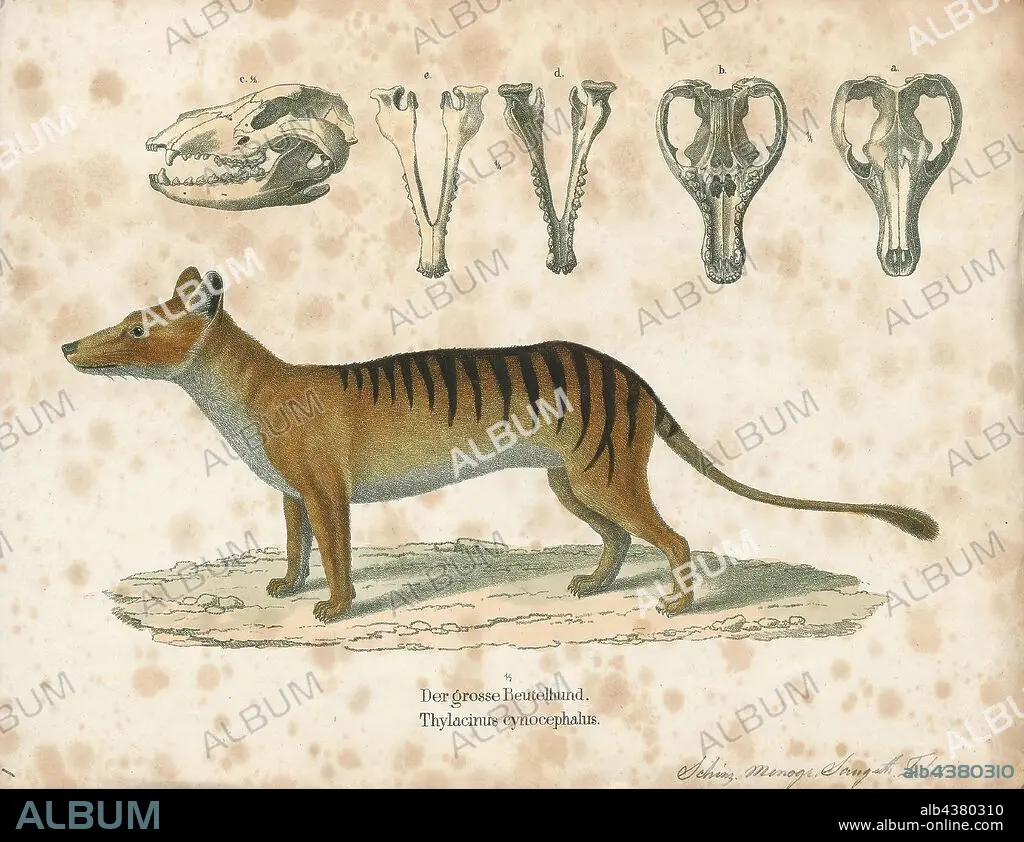
Thylacinus cynocephalus, Print, The thylacine (Thylacinus cynocephalus), now extinct, is one of the largest known carnivorous marsupials, evolving about 4 million years ago. The last known live animal was captured in 1933 in Tasmania. It is commonly known as the Tasmanian tiger because of its striped lower back, or the Tasmanian wolf because of its canid-like characteristics. It was native to Tasmania, New Guinea, and the Australian mainland., 1700-1880.
| Compartir |
|---|
 Pinterest Pinterest |
 Twitter Twitter |
 Facebook Facebook |
 Copiar enlace Copiar enlace |
 Email Email |
|
Añadir a otro lightbox |
|
Añadir a otro lightbox |


¿Ya tienes cuenta? Iniciar sesión
¿No tienes cuenta? Regístrate
Compra esta imagen.
Selecciona el uso:

Descripción: Ver traducción automática
Thylacinus cynocephalus, Print, The thylacine (Thylacinus cynocephalus), now extinct, is one of the largest known carnivorous marsupials, evolving about 4 million years ago. The last known live animal was captured in 1933 in Tasmania. It is commonly known as the Tasmanian tiger because of its striped lower back, or the Tasmanian wolf because of its canid-like characteristics. It was native to Tasmania, New Guinea, and the Australian mainland., 1700-1880
Thylacinus cynocephalus, Print, The thylacine (Thylacinus cynocephalus), now extinct, is one of the largest known carnivorous marsupials, evolving about 4 million years ago. The last known live animal was captured in 1933 in Tasmania. It is commonly known as the Tasmanian tiger because of its striped lower back, or the Tasmanian wolf because of its canid-like characteristics. It was native to Tasmania, New Guinea, and the Australian mainland., 1700-1880
Crédito: Album / quintlox
Autorizaciones: ? Cesión de modelo: No - ? Cesión de propiedad: No
¿Preguntas relacionadas con los derechos?
¿Preguntas relacionadas con los derechos?
Tamaño imagen: 4788 × 3690 px | 50.5 MB
Tamaño impresión: 40.5 × 31.2 cm | 1885.0 × 1452.8 in (300 dpi)
