

alb5483590
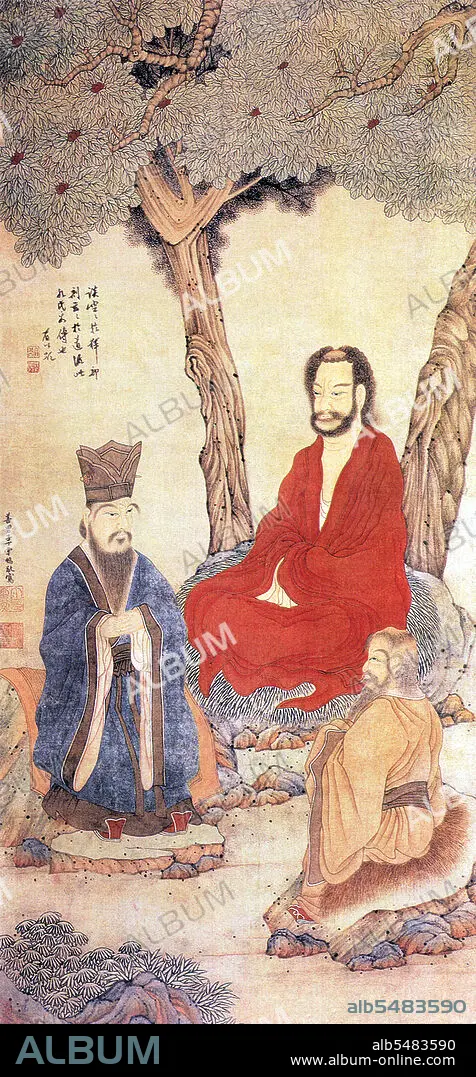
Confucius, Laozi and a Buddhist arhat.
| Compartir |
|---|
 Pinterest Pinterest |
 Twitter Twitter |
 Facebook Facebook |
 Copiar enlace Copiar enlace |
 Email Email |
|
Añadir a otro lightbox |
|
Añadir a otro lightbox |


¿Ya tienes cuenta? Iniciar sesión
¿No tienes cuenta? Regístrate
Compra esta imagen.
Selecciona el uso:

Título: Confucius, Laozi and a Buddhist arhat.
Descripción: Ver traducción automática
Laozi (Lao Tzu, c. 6th century BCE) was a mystic philosopher of ancient China. His association with the Daodejing (Tao Te Ching) has led him to be traditionally considered the founder of Taoism (also spelled 'Daoism'). He is also revered as a deity in most religious forms of the Taoist religion, which often refers to Laozi as Taishang Laojun, or 'One of the Three Pure Ones'. Laozi translated literally from Chinese means 'old master' or 'old one', and is generally considered honorific. The philosophy of Confucius emphasises personal and governmental morality, correctness of social relationships, justice and sincerity. These values gained prominence in China during the Han Dynasty(206 BC 220 AD). Confucius' thoughts have been developed into a system of philosophy known as Confucianism. It was introduced to Europe by the Italian Jesuit Matteo Ricci, who was the first to Latinise the name as 'Confucius'. His teachings may be found in the Analects of Confucius, a collection of brief aphoristic fragments, which was compiled many years after his death.
Laozi (Lao Tzu, c. 6th century BCE) was a mystic philosopher of ancient China. His association with the Daodejing (Tao Te Ching) has led him to be traditionally considered the founder of Taoism (also spelled 'Daoism'). He is also revered as a deity in most religious forms of the Taoist religion, which often refers to Laozi as Taishang Laojun, or 'One of the Three Pure Ones'. Laozi translated literally from Chinese means 'old master' or 'old one', and is generally considered honorific. The philosophy of Confucius emphasises personal and governmental morality, correctness of social relationships, justice and sincerity. These values gained prominence in China during the Han Dynasty(206 BC 220 AD). Confucius' thoughts have been developed into a system of philosophy known as Confucianism. It was introduced to Europe by the Italian Jesuit Matteo Ricci, who was the first to Latinise the name as 'Confucius'. His teachings may be found in the Analects of Confucius, a collection of brief aphoristic fragments, which was compiled many years after his death.
Crédito: Album / Pictures From History/Universal Images Group
Autorizaciones: ? Cesión de modelo: No - ? Cesión de propiedad: No
¿Preguntas relacionadas con los derechos?
¿Preguntas relacionadas con los derechos?
Tamaño imagen: 2850 × 6128 px | 50.0 MB
Tamaño impresión: 24.1 × 51.9 cm | 1122.0 × 2412.6 in (300 dpi)
