

alb3824450
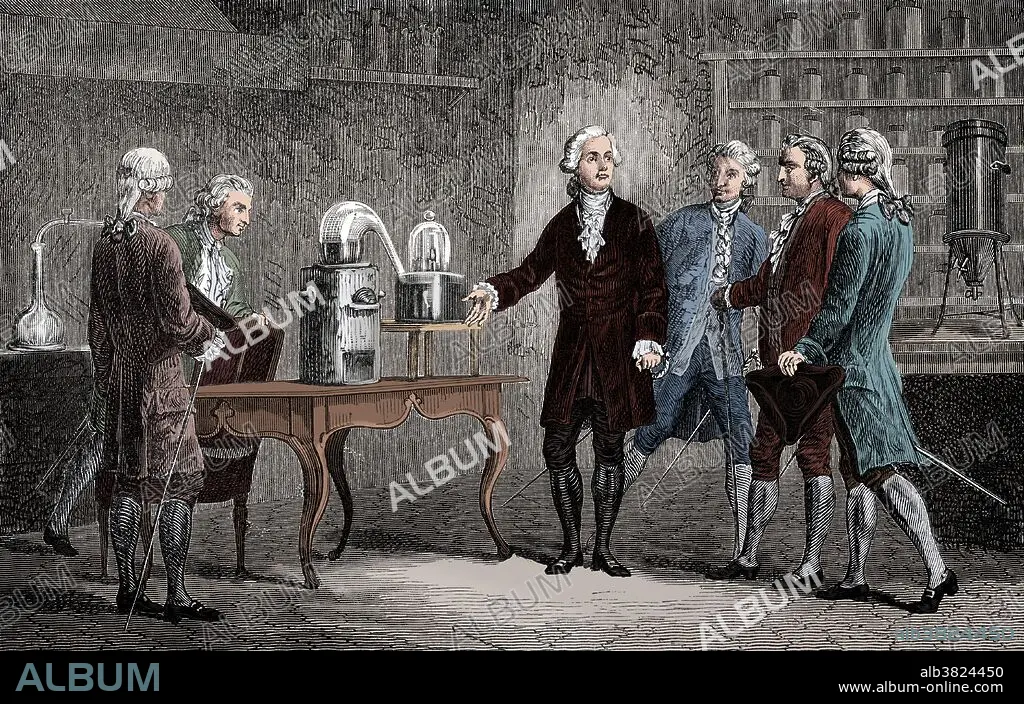
Lavoisier's Air Composition Experiment, 1776
| Compartir |
|---|
 Pinterest Pinterest |
 Twitter Twitter |
 Facebook Facebook |
 Copiar enlace Copiar enlace |
 Email Email |
|
Añadir a otro lightbox |
|
Añadir a otro lightbox |


¿Ya tienes cuenta? Iniciar sesión
¿No tienes cuenta? Regístrate
Compra esta imagen.
Selecciona el uso:

Título: Lavoisier's Air Composition Experiment, 1776
Descripción:
Traducción automática: Lavoisier muestra a sus compañeros científicos su experimento que reveló la composición del aire, 1776. Antoine-Laurent Lavoisier (26 de agosto de 1743 - 8 de mayo de 1794) fue un químico francés considerado el fundador de la química moderna por cambiar la ciencia de una cualitativa a una cuantitativa. Reconoció y nombró al oxígeno y al hidrógeno, y se opuso a la teoría del flogisto. Ayudó a construir el sistema métrico, escribió la primera lista extensa de elementos y ayudó a reformar la nomenclatura química. Fue el primero en establecer que el azufre era un elemento (1777) en lugar de un compuesto. Descubrió que, aunque la materia puede cambiar su forma o figura, su masa siempre permanece igual. Su libro Métodos de nomenclatura química de 1787 estableció el método de nombrar sustancias por su composición de elementos, que todavía se utiliza en la actualidad. Fue tildado de traidor por la Convención bajo Maximilien de Robespierre durante el Reinado del Terror. Fue juzgado, condenado y guillotinado el 8 de mayo de 1794, a la edad de 50 años. Un año y medio después de su muerte, Lavoisier fue exonerado por el gobierno francés. Cuando sus pertenencias privadas fueron entregadas a su viuda, se incluyó una breve nota que decía "A la viuda de Lavoisier, quien fue condenada falsamente". Grabado de "Vies des savants illustres" de Louis Figuier
Lavoisier showing fellow scientists his experiment which revealed the composition of air, 1776. Antoine-Laurent Lavoisier (August 26, 1743 - May 8, 1794) was a French chemist who is considered the founder of modern chemistry for changing the science from a qualitative to a quantitative one. He recognized and named oxygen and hydrogen, and opposed the phlogiston theory. He helped construct the metric system, wrote the first extensive list of elements, and helped to reform chemical nomenclature. He was the first to establish that sulfur was an element (1777) rather than a compound. He discovered that, although matter may change its form or shape, its mass always remains the same. His book Methods of Chemical Nomenclature of 1787 set the method of naming substances by their composition of elements, which is still used today. He was branded a traitor by the Convention under Maximilien de Robespierre during the Reign of Terror. He was tried, convicted, and guillotined on May 8, 1794, at the age of 50. A year and a half after his death, Lavoisier was exonerated by the French government. When his private belongings were delivered to his widow, a brief note was included, reading "To the widow of Lavoisier, who was falsely convicted". Engraving from "Vies des savants illustres" by Louis Figuier.
Crédito: Album / Science Source
Autorizaciones: ? Cesión de modelo: No - ? Cesión de propiedad: No
¿Preguntas relacionadas con los derechos?
¿Preguntas relacionadas con los derechos?
Tamaño imagen: 4650 × 2958 px | 39.4 MB
Tamaño impresión: 39.4 × 25.0 cm | 1830.7 × 1164.6 in (300 dpi)
Palabras clave: 1776 • ANTOINE LAURENT DE LAVOISIER • ARTE • CIENCIA • CIENTIFICO • COLOR • COLOREADA • DEMOSTRACION • DIBUJO • EJECUTADO • ÉLÉMENTS • EUROPEA • EUROPEAS • EUROPEO • EUROPEOS • EXPERIMENTO • FAMOSA • FAMOSO • FAMOSOS • FIGURA • FRANCES • GENTE • GRABADO • HISTORIA • HISTORICO • HOMBRE • HOMBRES • ILUSTRACION • ILUSTRACIONES • IMPORTANTE • LAVOISIER • MASCULINO • METODOLOGIA • OBRA DE ARTE • PERSONA • PERSONALIDAD • PERSONALIDADES • QUIMICA • QUIMICO • RETRATO DE HOMBRE • S. XVIII • SIGLO XVIII
