

alb9203402
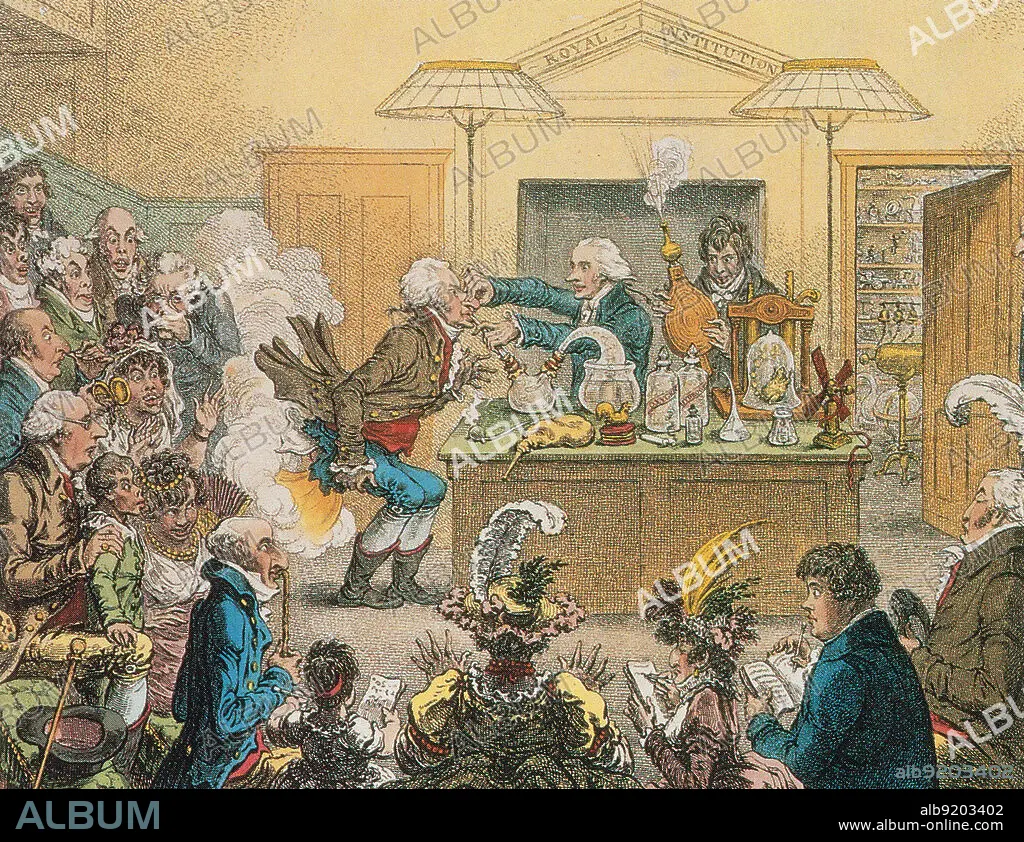
New Discoveries in Pneumaticks, 1802
| Compartir |
|---|
 Pinterest Pinterest |
 Twitter Twitter |
 Facebook Facebook |
 Copiar enlace Copiar enlace |
 Email Email |
|
Añadir a otro lightbox |
|
Añadir a otro lightbox |


¿Ya tienes cuenta? Iniciar sesión
¿No tienes cuenta? Regístrate
Compra esta imagen.
Selecciona el uso:

Título: New Discoveries in Pneumaticks, 1802
Descripción:
Traducción automática: Sir Humphry Davy (1778-1829) fue un químico e inventor inglés. Fue educado en Truro y luego fue aprendiz de un cirujano de Penzance. En 1797 se dedicó a la química y Thomas Beddoes lo contrató como asistente en su Institución Médica Neumática en Bristol. Aquí experimentó con varios gases nuevos y descubrió el efecto anestésico del gas de la risa (óxido nitroso). Se convirtió en un conferenciante famoso y bien pagado. En este grabado de 1802 se satirizan las celebradas manifestaciones públicas de Hius sobre los efectos del gas de la risa.
Sir Humphry Davy, (1778-1829) was a English chemist and inventor. He was educated in Truro and then apprenticed to a Penzance surgeon. In 1797 he took up chemistry and was taken on by Thomas Beddoes, as an assistant at his Medical Pneumatic Institution in Bristol. Here he experimented with various new gases and discovered the anesthetic effect of laughing gas (nitrous oxide). He became a famous and well paid lecturer. Hius celebrated public demonstrations of the effects of laughing gas are lampooned in this etching from 1802.
Crédito: Album / New York Public Library / Science Source
Autorizaciones: ? Cesión de modelo: No - ? Cesión de propiedad: No
¿Preguntas relacionadas con los derechos?
¿Preguntas relacionadas con los derechos?
Tamaño imagen: 3844 × 2960 px | 32.6 MB
Tamaño impresión: 32.5 × 25.1 cm | 1513.4 × 1165.4 in (300 dpi)
Palabras clave: 1778 • 1802 • 1829 • ANESTESIA • ARTE • CIENCIA • CIENTIFICO • DEMOSTRACION • DENSIDAD • DESCUBRIMIENTO • EUROPA • EXPERIMENTO • GRABADO • HISTORIA • HISTORICO • ILUSTRACION • ILUSTRACIONES • INGLATERRA • INGLES • INSTITUO • INVENTOR • NUEVA • NUEVO • ÓXIDO • PROFESOR • PUBLICO • QUIMICA • QUIMICO • S. XIX • S. XVIII • SIGLO XIX • SIGLO XVIII • SIGLO • SIR
