

alb3803638
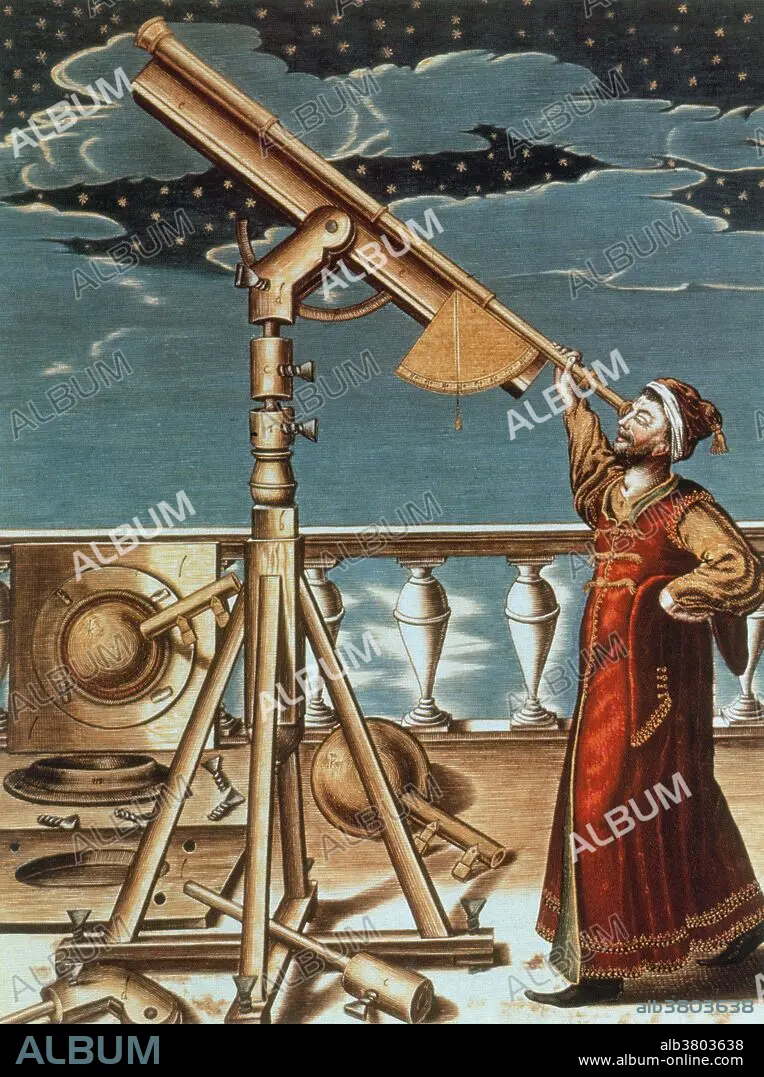
Johannes Hevelius, Polish Astronomer
| Compartir |
|---|
 Pinterest Pinterest |
 Twitter Twitter |
 Facebook Facebook |
 Copiar enlace Copiar enlace |
 Email Email |
|
Añadir a otro lightbox |
|
Añadir a otro lightbox |


¿Ya tienes cuenta? Iniciar sesión
¿No tienes cuenta? Regístrate
Compra esta imagen.
Selecciona el uso:

Título: Johannes Hevelius, Polish Astronomer
Descripción:
Traducción automática: Hevelius observando el cielo nocturno, 1647. Johannes Hevelius (28 de enero de 1611 - 28 de enero de 1687) fue un astrónomo polaco. Se le recuerda como el fundador de la topografía lunar, quien también describió diez nuevas constelaciones (siete de las cuales todavía son reconocidas por los astrónomos). También fue concejal, alcalde de Danzig y su padre, un rico comerciante de origen bohemio, le enseñó el arte de elaborar cerveza. En 1641 construyó un observatorio en los tejados de sus tres casas unidas. El observatorio era conocido con el nombre de Sternenburg (Castillo de las Estrellas). Hizo observaciones de manchas solares, 1642-1645, dedicó cuatro años a trazar mapas de la superficie lunar y descubrió la libración de la Luna en longitud. Descubrió cuatro cometas, en 1652, 1661, 1672 y 1677. Estos descubrimientos lo llevaron a su tesis de que tales cuerpos giran alrededor del Sol en trayectorias parabólicas. Su observatorio, sus instrumentos y sus libros fueron destruidos por un incendio en 1679. Rápidamente reparó los daños lo suficiente como para poder observar el gran cometa de diciembre de 1680. Su salud se había deteriorado por el impacto del incendio de 1679 y murió en su 76 cumpleaños.
Hevelius observing the night sky, 1647. Johannes Hevelius (January 28, 1611 - January 28, 1687) was a Polish astronomer. He is remembered as the founder of founder of lunar topography, who also described ten new constellations (seven of which are still recognized by astronomers). He was also a councilor, mayor of Danzig and was taught the art of brewing from his father, a wealthy merchant of Bohemian origin. In 1641 he built an observatory on the roofs of his three connected houses. The observatory was known by the name Sternenburg (Star Castle). He made observations of sunspots, 1642-1645, devoted four years to charting the lunar surface and discovered the Moon's libration in longitude. He discovered four comets, in 1652, 1661,1672 and 1677. These discoveries led to his thesis that such bodies revolve around the Sun in parabolic paths. His observatory, instruments and books were destroyed by fire in 1679. He promptly repaired the damage enough to enable him to observe the great comet of December 1680. His health had suffered from the shock of the 1679 fire, and he died on his 76th birthday.
Crédito: Album / Science Source / New York Public Library
Autorizaciones: ? Cesión de modelo: No - ? Cesión de propiedad: No
¿Preguntas relacionadas con los derechos?
¿Preguntas relacionadas con los derechos?
Tamaño imagen: 2826 × 3786 px | 30.6 MB
Tamaño impresión: 23.9 × 32.1 cm | 1112.6 × 1490.6 in (300 dpi)
Palabras clave: 1647 • ARTE • ASTRONOMIA • ASTRONOMO • CIENCIA • DIBUJO • EUROPEA • EUROPEAS • EUROPEO • EUROPEOS • FAMOSA • FAMOSO • FAMOSOS • FIGURA • FUNDADOR • GENTE • HISTORIA • HISTORICO • HOMBRE • HOMBRES • ILUSTRACION • ILUSTRACIONES • IMPORTANTE • JAN • JURISPRUDENCIA • MASCULINO • OBRA DE ARTE • PERSONA • PERSONALIDAD • PERSONALIDADES • POLACA • POLACO • POLITICA • PORTRAIT • RETRATO DE HOMBRE • RETRATO • SIGLO XVII
