

alb9098106
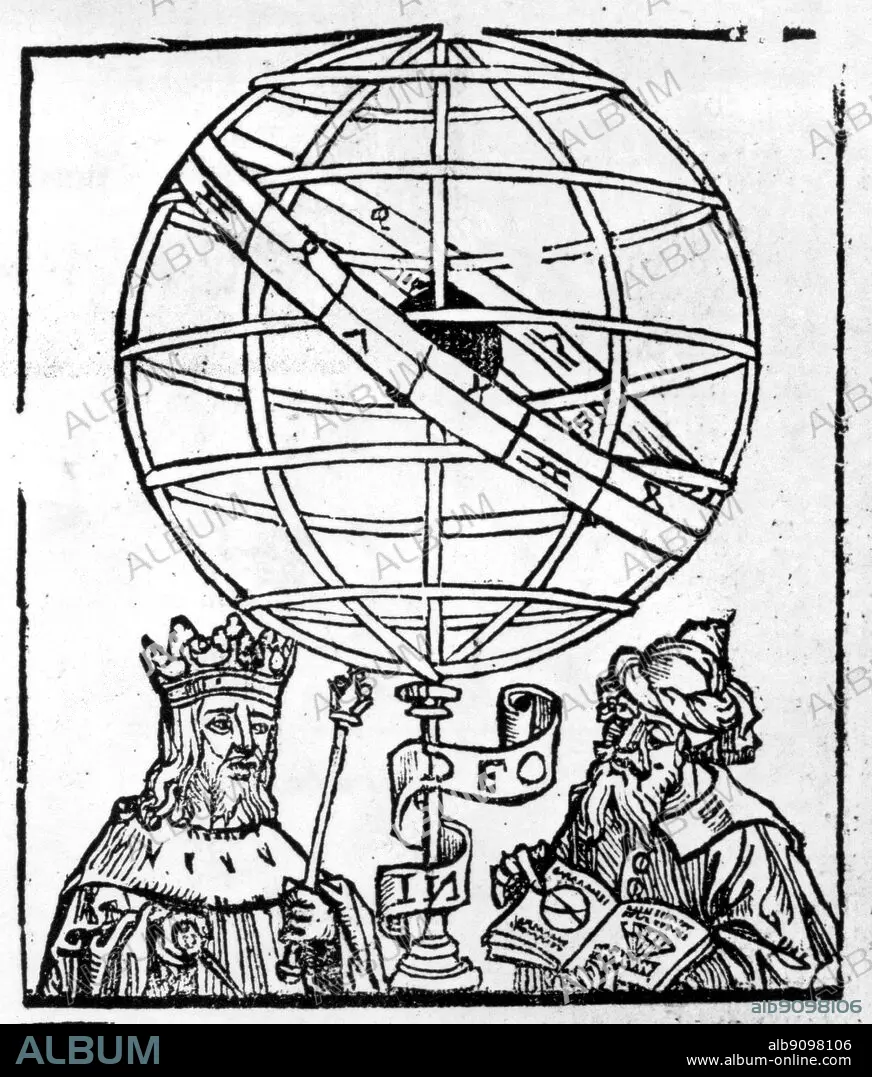
Frontispiece from Sacrobosco's Treatise of the Sphere - Reliable information about the life of Johannes de Sacrobosco is scarce, and standard sources such as the Dictionary of Scientific Biography have unfortunately included as fact material deriving from the speculations and inventions of sixteenth- and seventeenth-century antiquarians. On the basis of a statement made in 1271 by his commentator Robertus Anglicus, he is believed to have been of English origin; his name is frequently anglicised as John of Holywood. At some time in the earlier part of the thirteenth century (according to a seventeenth-century account, it was June 5th 1221) he arrived in Paris and formed an association with the university there, although whether it was initially as an arts student or as a licentiate (one who, by virtue of having been made a master of arts at another university was already qualified to teach) is not clear. It is presumed that at some point he was enrolled as a regent master lecturing on mathematics and astronomy. After his death, which may have occurred in 1256, a memorial was constructed in the monastery of St. Mathurin, closely associated with the University of Paris. This was decorated with an astronomical instrument, perhaps an astrolabe, and a few lines of Latin verse which referred to Sacrobosco's calendrical work; it is no longer extant.
| Compartir |
|---|
 Pinterest Pinterest |
 Twitter Twitter |
 Facebook Facebook |
 Copiar enlace Copiar enlace |
 Email Email |
|
Añadir a otro lightbox |
|
Añadir a otro lightbox |


¿Ya tienes cuenta? Iniciar sesión
¿No tienes cuenta? Regístrate
Compra esta imagen.
Selecciona el uso:

Descripción: Ver traducción automática
Frontispiece from Sacrobosco's Treatise of the Sphere - Reliable information about the life of Johannes de Sacrobosco is scarce, and standard sources such as the Dictionary of Scientific Biography have unfortunately included as fact material deriving from the speculations and inventions of sixteenth- and seventeenth-century antiquarians. On the basis of a statement made in 1271 by his commentator Robertus Anglicus, he is believed to have been of English origin; his name is frequently anglicised as John of Holywood. At some time in the earlier part of the thirteenth century (according to a seventeenth-century account, it was June 5th 1221) he arrived in Paris and formed an association with the university there, although whether it was initially as an arts student or as a licentiate (one who, by virtue of having been made a master of arts at another university was already qualified to teach) is not clear. It is presumed that at some point he was enrolled as a regent master lecturing on mathematics and astronomy. After his death, which may have occurred in 1256, a memorial was constructed in the monastery of St. Mathurin, closely associated with the University of Paris. This was decorated with an astronomical instrument, perhaps an astrolabe, and a few lines of Latin verse which referred to Sacrobosco's calendrical work; it is no longer extant.
Frontispiece from Sacrobosco's Treatise of the Sphere - Reliable information about the life of Johannes de Sacrobosco is scarce, and standard sources such as the Dictionary of Scientific Biography have unfortunately included as fact material deriving from the speculations and inventions of sixteenth- and seventeenth-century antiquarians. On the basis of a statement made in 1271 by his commentator Robertus Anglicus, he is believed to have been of English origin; his name is frequently anglicised as John of Holywood. At some time in the earlier part of the thirteenth century (according to a seventeenth-century account, it was June 5th 1221) he arrived in Paris and formed an association with the university there, although whether it was initially as an arts student or as a licentiate (one who, by virtue of having been made a master of arts at another university was already qualified to teach) is not clear. It is presumed that at some point he was enrolled as a regent master lecturing on mathematics and astronomy. After his death, which may have occurred in 1256, a memorial was constructed in the monastery of St. Mathurin, closely associated with the University of Paris. This was decorated with an astronomical instrument, perhaps an astrolabe, and a few lines of Latin verse which referred to Sacrobosco's calendrical work; it is no longer extant.
Crédito: Album / TopFoto
Autorizaciones: ? Cesión de modelo: No - ? Cesión de propiedad: No
¿Preguntas relacionadas con los derechos?
¿Preguntas relacionadas con los derechos?
Tamaño imagen: 3521 × 4135 px | 41.7 MB
Tamaño impresión: 29.8 × 35.0 cm | 1386.2 × 1628.0 in (300 dpi)
Palabras clave: DESCUBRIMIENTO • EXPLORACION • MARITIMO
