

alb5144314
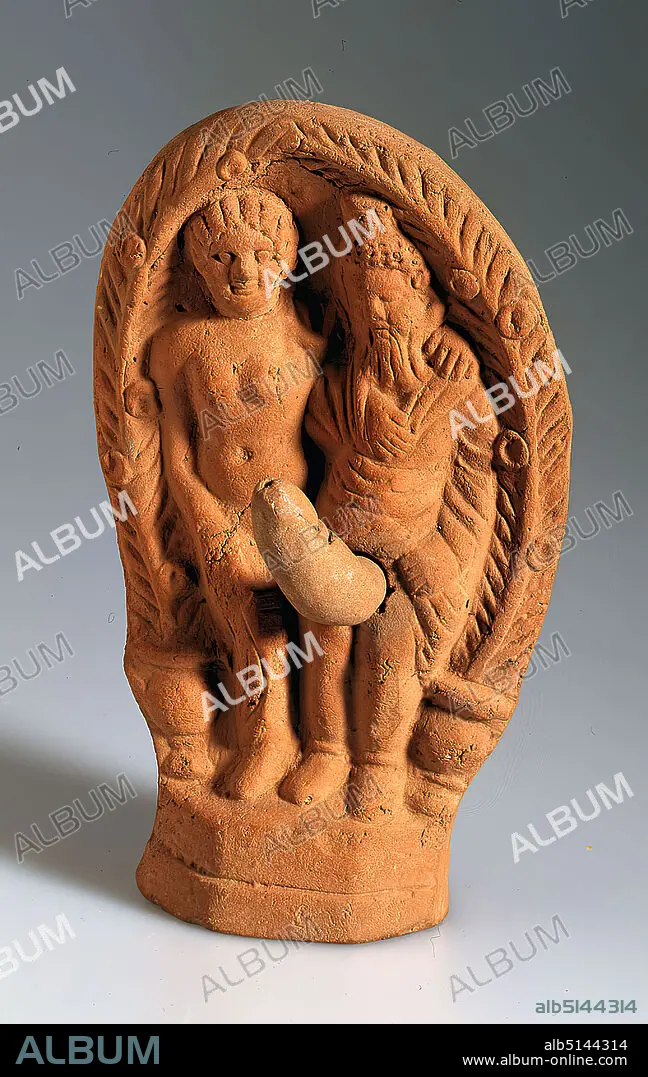
Aphrodite and Priapos in a palm arbour, Clay, pressed into the form, hand modeled, fired (ceramic), Total: Height: 15 cm; Width: 9.8 cm; Depth: 5.4 cm, ceramic, Gods (classical. Mythology), Hellenism, In an arbour, which is made of two vessels with palm fronds, Aphrodite and her son Priapos are standing on a raised base on the left and on the right. The goddess is dressed only with a cloak draped around her hips and falling to the ground. The hair is combined in a curly hairstyle. She has put her left arm around Priapos. This one is bald and bearded. On his head he carries a wreath and a basket (Greek kalathos). He has raised his long robe; an inserted oversized phallus is visible. Aphrodite and Priapos are to be connected as deities of love and desire with fertility cults and are accordingly depicted in a body-stressed manner. As a talisman, such figures were hung up in the house or at the entrance and thus ensured the protection of the two gods. The figure belongs to the group of the so-called Fayum terracottas. In Alexandria, the international, Greek-influenced center of Egypt, lives a multicultural society of Egyptians, Orientals, Greeks, Romans, Jews and others, whose different religious ideas are gradually blending together. Insights into this world of faith are provided by the so-called Fayum terracottas. They are part of the religious household, children's toys, knick-knacks, but also cult symbols, grave goods, pilgrimage images, votive offerings and magical objects for banishing evil forces. They can be found in houses, graves and sanctuaries.
| Compartir |
|---|
 Pinterest Pinterest |
 Twitter Twitter |
 Facebook Facebook |
 Copiar enlace Copiar enlace |
 Email Email |
|
Añadir a otro lightbox |
|
Añadir a otro lightbox |


¿Ya tienes cuenta? Iniciar sesión
¿No tienes cuenta? Regístrate
Compra esta imagen.
Selecciona el uso:

Descripción: Ver traducción automática
Aphrodite and Priapos in a palm arbour, Clay, pressed into the form, hand modeled, fired (ceramic), Total: Height: 15 cm; Width: 9.8 cm; Depth: 5.4 cm, ceramic, Gods (classical. Mythology), Hellenism, In an arbour, which is made of two vessels with palm fronds, Aphrodite and her son Priapos are standing on a raised base on the left and on the right. The goddess is dressed only with a cloak draped around her hips and falling to the ground. The hair is combined in a curly hairstyle. She has put her left arm around Priapos. This one is bald and bearded. On his head he carries a wreath and a basket (Greek kalathos). He has raised his long robe; an inserted oversized phallus is visible. Aphrodite and Priapos are to be connected as deities of love and desire with fertility cults and are accordingly depicted in a body-stressed manner. As a talisman, such figures were hung up in the house or at the entrance and thus ensured the protection of the two gods. The figure belongs to the group of the so-called Fayum terracottas. In Alexandria, the international, Greek-influenced center of Egypt, lives a multicultural society of Egyptians, Orientals, Greeks, Romans, Jews and others, whose different religious ideas are gradually blending together. Insights into this world of faith are provided by the so-called Fayum terracottas. They are part of the religious household, children's toys, knick-knacks, but also cult symbols, grave goods, pilgrimage images, votive offerings and magical objects for banishing evil forces. They can be found in houses, graves and sanctuaries.
Aphrodite and Priapos in a palm arbour, Clay, pressed into the form, hand modeled, fired (ceramic), Total: Height: 15 cm; Width: 9.8 cm; Depth: 5.4 cm, ceramic, Gods (classical. Mythology), Hellenism, In an arbour, which is made of two vessels with palm fronds, Aphrodite and her son Priapos are standing on a raised base on the left and on the right. The goddess is dressed only with a cloak draped around her hips and falling to the ground. The hair is combined in a curly hairstyle. She has put her left arm around Priapos. This one is bald and bearded. On his head he carries a wreath and a basket (Greek kalathos). He has raised his long robe; an inserted oversized phallus is visible. Aphrodite and Priapos are to be connected as deities of love and desire with fertility cults and are accordingly depicted in a body-stressed manner. As a talisman, such figures were hung up in the house or at the entrance and thus ensured the protection of the two gods. The figure belongs to the group of the so-called Fayum terracottas. In Alexandria, the international, Greek-influenced center of Egypt, lives a multicultural society of Egyptians, Orientals, Greeks, Romans, Jews and others, whose different religious ideas are gradually blending together. Insights into this world of faith are provided by the so-called Fayum terracottas. They are part of the religious household, children's toys, knick-knacks, but also cult symbols, grave goods, pilgrimage images, votive offerings and magical objects for banishing evil forces. They can be found in houses, graves and sanctuaries.
Personas: TUMBAS (active 1940s)
Crédito: Album / quintlox
Autorizaciones: ? Cesión de modelo: No - ? Cesión de propiedad: No
¿Preguntas relacionadas con los derechos?
¿Preguntas relacionadas con los derechos?
Tamaño imagen: 2732 × 4320 px | 33.8 MB
Tamaño impresión: 23.1 × 36.6 cm | 1075.6 × 1700.8 in (300 dpi)
Palabras clave: ADORNO • AFRODITA • ALEJANDRIA • ALFARERIA • AMOR • AMULETO • ARCILLA • BARBUDO • BASKET • BEARDED • CABELLERA • CABELLO • CABEZA • CADERAS, LAS • CALVO • CASA • CASAS • CERÁMICA • CERÁMICO • CESTA • CESTO • CIFRAS • CLÁSICA • CLASICO • COMBINADO • CREENCIA • DE PIE • DECORACION • DECORATIVO • DEIDADES • DESEAR • DESEO • DIOSA • DIOSES • DISPARARON • EGIPCIA • EGIPCIAS • EGIPCIO • EGIPCIOS • EGIPTO • EN • ENTRADA • ESTAR DE PIE • EXVOTOS • FE • GRIEGOS • GROUP • GRUPO • GRUPO. • HAIR • INTERNACIONAL • IZQUIERDA • JUDIO • JUDIOS • MITOLOGIA • MUNDO • OBJETO DE ARCILLA • OBJETO DE CERAMICA • ORNAMENTACIÓN • ORNAMENTO • ORNAMENTOS • PELO CABELLO • PELO • PERGOLA • PRESIONADO • PROFUNDIDAD • PROTECCION • RELIGION • ROMANOS • SUELO • TALISMAN • TERRACOTA • TERRACOTTA • TUMBAS
