

alb9408337
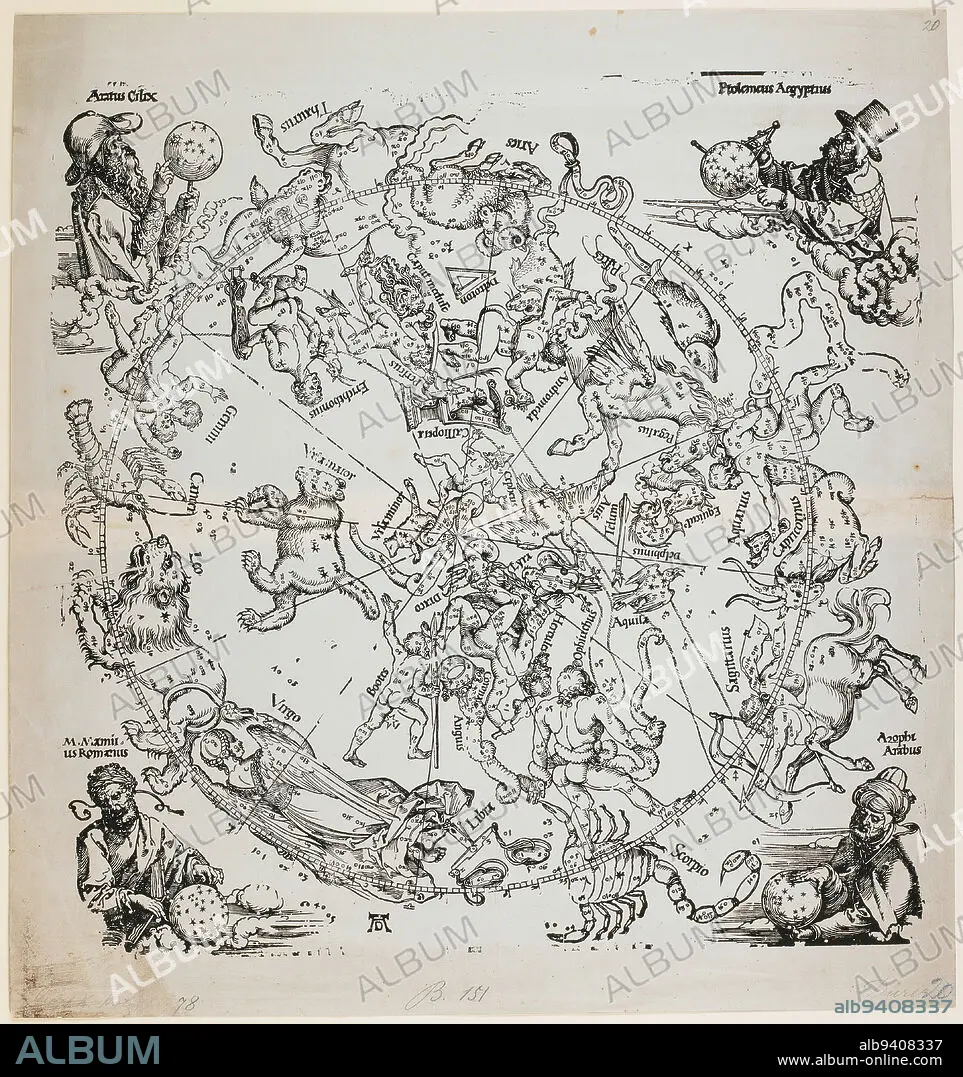
The Northern Hemisphere of the Celestial Globe, 1515 (probably printed 17th century), Albrecht Dürer, German, 14711528, 19 9/16 x 18 3/8 in. (49.69 x 46.67 cm) (sheet), Woodcut, Germany, 16th century, Albrecht Dürer's renowned celestial maps of the northern and southern hemisphere were the first star charts ever to be printed. The 48 classical constellations-the twelve signs of the zodiac, Orion, the Great Bear, and so on-that make of up core of these charts were carefully catalogued by Ptolemy in his Almagest. There were a number of drawn precedents of celestial maps found in Arabic and European illuminated manuscripts, and Dürer's designs, in fact, rely heavily on two drawn on vellum in Nuremberg, his hometown. Yet he updated the positions of the stars to show their locations around 1500, working closely with Nuremberg mathematician Conrand Heinfogel and the imperial astronomer Johann Stabius, who commissioned these woodcuts. A century of celestial globe makers took their information from these pioneering star charts, including Gerard Mercator whose 1551 globe is coming on loan from the Adler Planetarium (beginning October 15).
| Compartir |
|---|
 Pinterest Pinterest |
 Twitter Twitter |
 Facebook Facebook |
 Copiar enlace Copiar enlace |
 Email Email |
|
Añadir a otro lightbox |
|
Añadir a otro lightbox |


¿Ya tienes cuenta? Iniciar sesión
¿No tienes cuenta? Regístrate
Compra esta imagen.
Selecciona el uso:

Descripción:
Traducción automática: El hemisferio norte del globo celeste, 1515 (probablemente impreso en el siglo XVII), Alberto Durero, alemán, 1471-1528, 49,69 x 46,67 cm (hoja), xilografía, Alemania, siglo XVI, Los famosos mapas celestes de Alberto Durero del hemisferio norte y sur fueron los primeros mapas estelares que se imprimieron. Las 48 constelaciones clásicas (los doce signos del zodíaco, Orión, la Osa Mayor, etc.) que forman el núcleo de estos mapas fueron catalogadas cuidadosamente por Ptolomeo en su Almagesto. Se encontraron varios precedentes dibujados de mapas celestes en manuscritos iluminados árabes y europeos, y los diseños de Durero, de hecho, se basan en gran medida en dos dibujados en pergamino en Núremberg, su ciudad natal. Sin embargo, actualizó las posiciones de las estrellas para mostrar sus ubicaciones alrededor de 1500, en estrecha colaboración con el matemático de Núremberg Conrand Heinfogel y el astrónomo imperial Johann Stabius, quien encargó estos grabados en madera. Un siglo de fabricantes de globos celestes tomaron su información de estos mapas estelares pioneros, incluido Gerard Mercator, cuyo globo de 1551 llegará en préstamo del Planetario Adler (a partir del 15 de octubre).
The Northern Hemisphere of the Celestial Globe, 1515 (probably printed 17th century), Albrecht Dürer, German, 14711528, 19 9/16 x 18 3/8 in. (49.69 x 46.67 cm) (sheet), Woodcut, Germany, 16th century, Albrecht Dürer's renowned celestial maps of the northern and southern hemisphere were the first star charts ever to be printed. The 48 classical constellations-the twelve signs of the zodiac, Orion, the Great Bear, and so on-that make of up core of these charts were carefully catalogued by Ptolemy in his Almagest. There were a number of drawn precedents of celestial maps found in Arabic and European illuminated manuscripts, and Dürer's designs, in fact, rely heavily on two drawn on vellum in Nuremberg, his hometown. Yet he updated the positions of the stars to show their locations around 1500, working closely with Nuremberg mathematician Conrand Heinfogel and the imperial astronomer Johann Stabius, who commissioned these woodcuts. A century of celestial globe makers took their information from these pioneering star charts, including Gerard Mercator whose 1551 globe is coming on loan from the Adler Planetarium (beginning October 15).
Personas: GREAT BEAR
Crédito: Album / quintlox
Autorizaciones: ? Cesión de modelo: No - ? Cesión de propiedad: No
¿Preguntas relacionadas con los derechos?
¿Preguntas relacionadas con los derechos?
Tamaño imagen: 4342 × 4618 px | 57.4 MB
Tamaño impresión: 36.8 × 39.1 cm | 1709.4 × 1818.1 in (300 dpi)
Palabras clave: 1500 • ALEMAN • ALEMANA • ALEMANES • ALEMANIA • ARABE • ARABES • CLAUDIO PTOLOMEO • GRABADO EN MADERA • GREAT BEAR • HEMISFERIO NORTE • IMPRESA • IMPRESO • NUMERO • NUREMBERG • ORION • PTOLOMEO • S. XVI • SÁBANA • SIGLO XVI • SIGLO • TARJETAS • UBICACIONES • VITELA • XILOGRAFIA • XILOGRAFÍAS • ZODIACO
