

alb5535802
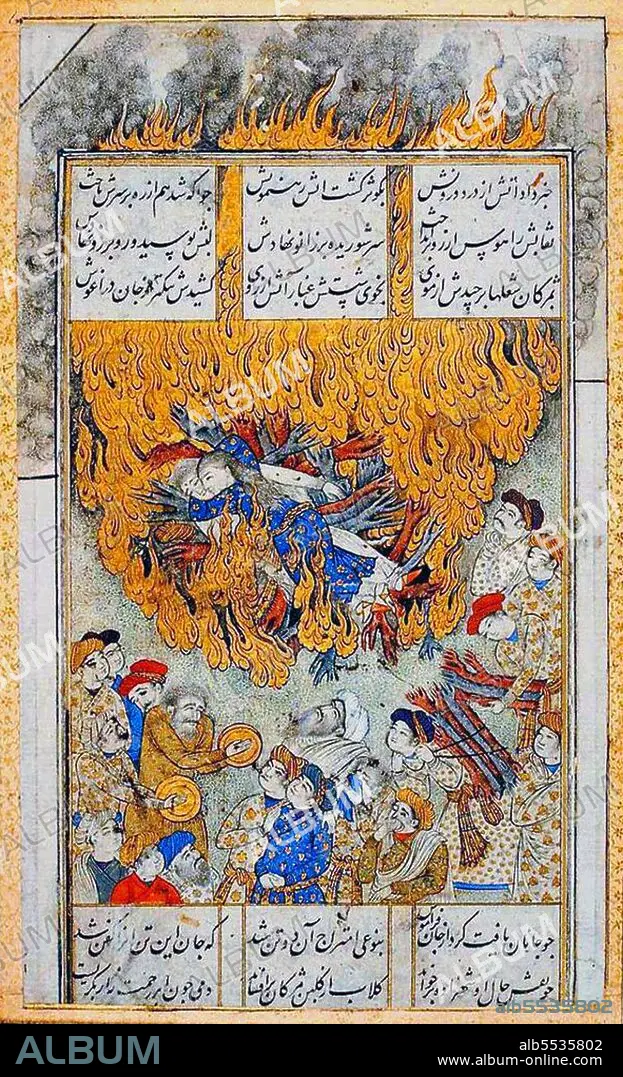
Iran / Persia: Safavid Dynasty miniature of the Hindu custom of sati or sutee. A wife throws herself on the funeral pyre of her husband. Attributed to Muhammad Qasim, early 17th century.
| Compartir |
|---|
 Pinterest Pinterest |
 Twitter Twitter |
 Facebook Facebook |
 Copiar enlace Copiar enlace |
 Email Email |
|
Añadir a otro lightbox |
|
Añadir a otro lightbox |


¿Ya tienes cuenta? Iniciar sesión
¿No tienes cuenta? Regístrate
Compra esta imagen.
Selecciona el uso:

Título: Iran / Persia: Safavid Dynasty miniature of the Hindu custom of sati or sutee. A wife throws herself on the funeral pyre of her husband. Attributed to Muhammad Qasim, early 17th century.
Descripción: Ver traducción automática
Sati (Devanagari: ???, the feminine of sat 'true'; also called suttee) was a social funeral practice among some Indian communities in which a recently widowed woman would immolate herself on her husband’s funeral pyre. The practice was banned several times, with the current ban dating to 1829 by the British. The term is derived from the original name of the goddess Sati, also known as Dakshayani, who self-immolated because she was unable to bear her father Daksha's humiliation of her (living) husband Shiva. The term may also be used to refer to the widow. The term sati is now sometimes interpreted as 'chaste woman'. Sati appears in both Hindi and Sanskrit texts, where it is synonymous with 'good wife'; the spelling suttee was commonly used by Anglo-Indian English writers.
Sati (Devanagari: ???, the feminine of sat 'true'; also called suttee) was a social funeral practice among some Indian communities in which a recently widowed woman would immolate herself on her husband’s funeral pyre. The practice was banned several times, with the current ban dating to 1829 by the British. The term is derived from the original name of the goddess Sati, also known as Dakshayani, who self-immolated because she was unable to bear her father Daksha's humiliation of her (living) husband Shiva. The term may also be used to refer to the widow. The term sati is now sometimes interpreted as 'chaste woman'. Sati appears in both Hindi and Sanskrit texts, where it is synonymous with 'good wife'; the spelling suttee was commonly used by Anglo-Indian English writers.
Crédito: Album / Pictures from History/Universal Images Group
Autorizaciones: ? Cesión de modelo: No - ? Cesión de propiedad: No
¿Preguntas relacionadas con los derechos?
¿Preguntas relacionadas con los derechos?
Tamaño imagen: 3104 × 5100 px | 45.3 MB
Tamaño impresión: 26.3 × 43.2 cm | 1222.0 × 2007.9 in (300 dpi)
