

alb9849495
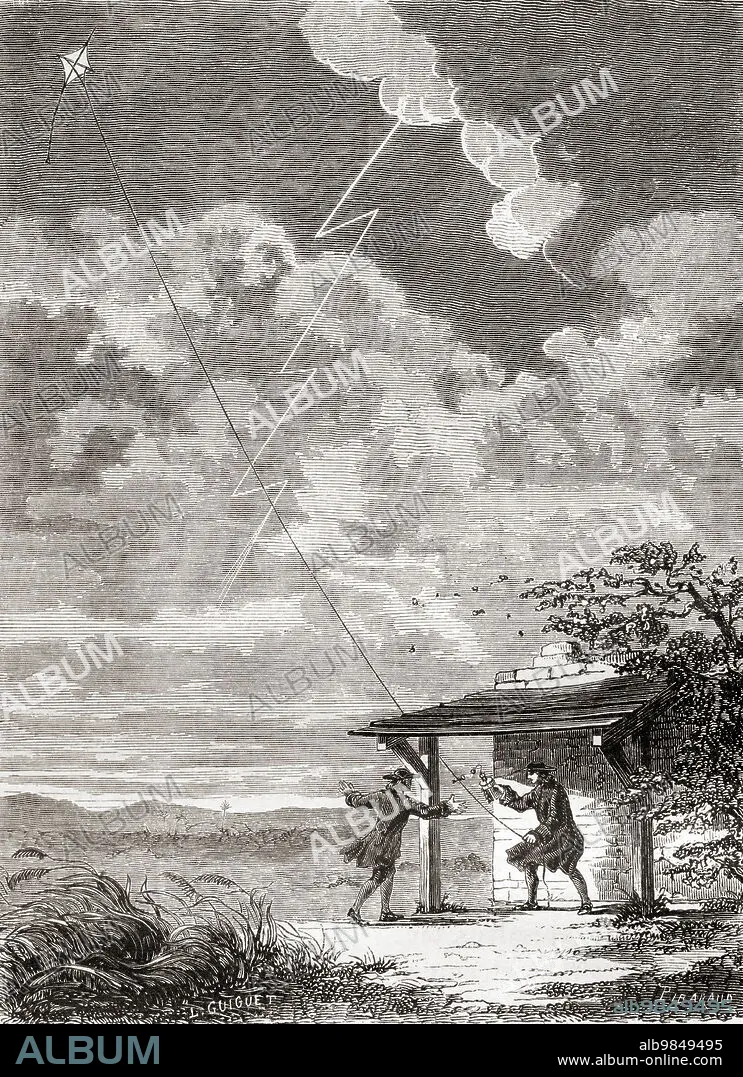
Benjamin Franklin (1706-1790) and his son William, performing their famous experiment on 15 June 1752, flying a kite in a thunderstorm. A metal wire on the kite attracted a lightning strike and electricity flowed down the string to a key, charging a Leyden jar (capacitor) seen near Franklin's hand. This experiment proved that lightning was an electrical phenomenon, and supported Franklin's invention of lightning rods. From Les Merveilles de la Science, published 1870.
| Compartir |
|---|
 Pinterest Pinterest |
 Twitter Twitter |
 Facebook Facebook |
 Copiar enlace Copiar enlace |
 Email Email |
|
Añadir a otro lightbox |
|
Añadir a otro lightbox |


¿Ya tienes cuenta? Iniciar sesión
¿No tienes cuenta? Regístrate
Compra esta imagen.
Selecciona el uso:

Descripción: Ver traducción automática
Benjamin Franklin (1706-1790) and his son William, performing their famous experiment on 15 June 1752, flying a kite in a thunderstorm. A metal wire on the kite attracted a lightning strike and electricity flowed down the string to a key, charging a Leyden jar (capacitor) seen near Franklin's hand. This experiment proved that lightning was an electrical phenomenon, and supported Franklin's invention of lightning rods. From Les Merveilles de la Science, published 1870.
Benjamin Franklin (1706-1790) and his son William, performing their famous experiment on 15 June 1752, flying a kite in a thunderstorm. A metal wire on the kite attracted a lightning strike and electricity flowed down the string to a key, charging a Leyden jar (capacitor) seen near Franklin's hand. This experiment proved that lightning was an electrical phenomenon, and supported Franklin's invention of lightning rods. From Les Merveilles de la Science, published 1870.
Crédito: Album / Universal Images Group / Ken Welsh
Autorizaciones: ? Cesión de modelo: No - ? Cesión de propiedad: No
¿Preguntas relacionadas con los derechos?
¿Preguntas relacionadas con los derechos?
Tamaño imagen: 3602 × 4963 px | 51.1 MB
Tamaño impresión: 30.5 × 42.0 cm | 1418.1 × 1953.9 in (300 dpi)
