

alb4844186
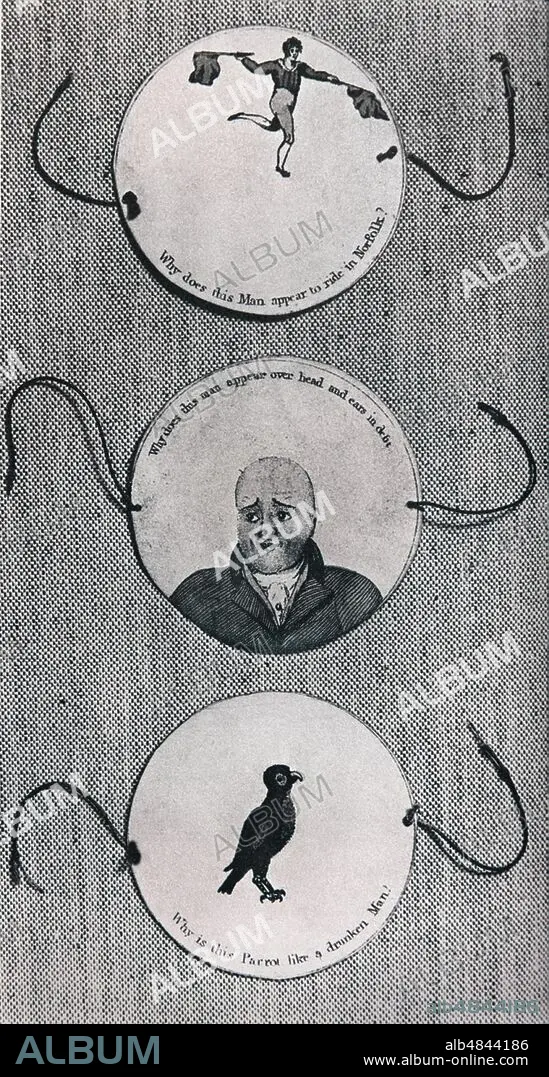
HISTORY OF PHOTOGRAPHY AND CINEMA The 'toy' called taumatropium, described by the British physician dr. John Ayrton Paris (1785-24 December 1856), exploits the phenomenon of image persistence on the retina to amaze the little ones, but also the great ones of the early nineteenth century, completing 'magically' the half images that are on the two sides of a cardboard disc (see the other side in FSNgilardi_52742. jpg). When the lines are rotated quickly with the fingers, the two images seem to merge into one. In the figure above the horse appears the acrobat, in the middle the wig covers the head of the bald, at the bottom of the cage encloses the bird. United Kingdom,1825
| Compartir |
|---|
 Pinterest Pinterest |
 Twitter Twitter |
 Facebook Facebook |
 Copiar enlace Copiar enlace |
 Email Email |
|
Añadir a otro lightbox |
|
Añadir a otro lightbox |


¿Ya tienes cuenta? Iniciar sesión
¿No tienes cuenta? Regístrate
Compra esta imagen.
Selecciona el uso:

Título: HISTORY OF PHOTOGRAPHY AND CINEMA The 'toy' called taumatropium, described by the British physician dr. John Ayrton Paris (1785-24 December 1856), exploits the phenomenon of image persistence on the retina to amaze the little ones, but also the great ones of the early nineteenth century, completing 'magically' the half images that are on the two sides of a cardboard disc (see the other side in FSNgilardi_52742. jpg). When the lines are rotated quickly with the fingers, the two images seem to merge into one. In the figure above the horse appears the acrobat, in the middle the wig covers the head of the bald, at the bottom of the cage encloses the bird. United Kingdom,1825
Descripción: Ver traducción automática
HISTORY OF PHOTOGRAPHY AND CINEMA The 'toy' called taumatropium, described by the British physician dr. John Ayrton Paris (1785 - 24 December 1856), exploits the phenomenon of image persistence on the retina to amaze the little ones, but also the great ones of the early nineteenth century, completing 'magically' the half images that are on the two sides of a cardboard disc (see the other side in FSNgilardi_52742.jpg). When the lines are rotated quickly with the fingers, the two images seem to merge into one. In the figure above the horse appears the acrobat, in the middle the wig covers the head of the bald, at the bottom of the cage encloses the bird. United Kingdom, 1825
HISTORY OF PHOTOGRAPHY AND CINEMA The 'toy' called taumatropium, described by the British physician dr. John Ayrton Paris (1785 - 24 December 1856), exploits the phenomenon of image persistence on the retina to amaze the little ones, but also the great ones of the early nineteenth century, completing 'magically' the half images that are on the two sides of a cardboard disc (see the other side in FSNgilardi_52742.jpg). When the lines are rotated quickly with the fingers, the two images seem to merge into one. In the figure above the horse appears the acrobat, in the middle the wig covers the head of the bald, at the bottom of the cage encloses the bird. United Kingdom, 1825
Crédito: Album / Fototeca Gilardi/Universal Images Group
Autorizaciones: ? Cesión de modelo: No - ? Cesión de propiedad: No
¿Preguntas relacionadas con los derechos?
¿Preguntas relacionadas con los derechos?
Tamaño imagen: 1900 × 3543 px | 19.3 MB
Tamaño impresión: 16.1 × 30.0 cm | 748.0 × 1394.9 in (300 dpi)
Palabras clave: CINETICA • HISTORIA DE LA FOTOGRAFIA • ILUSION OPTICA • JUGAR • OPTICA • VISTA (SENTIDO) • VISTA
