

alb3665296
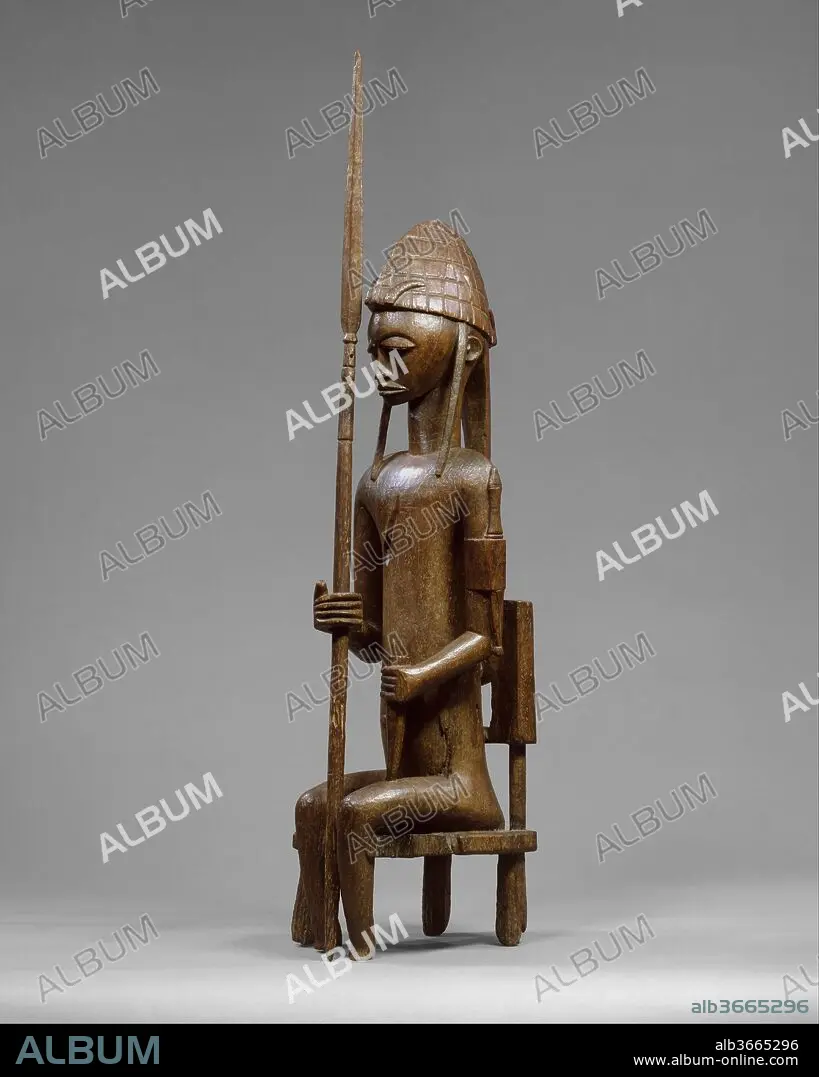
Seated Male Figure with Lance
| Compartir |
|---|
 Pinterest Pinterest |
 Twitter Twitter |
 Facebook Facebook |
 Copiar enlace Copiar enlace |
 Email Email |
|
Añadir a otro lightbox |
|
Añadir a otro lightbox |


¿Ya tienes cuenta? Iniciar sesión
¿No tienes cuenta? Regístrate
Compra esta imagen.
Selecciona el uso:

Título: Seated Male Figure with Lance
Descripción: Ver traducción automática
Seated Male Figure with Lance. Culture: Bamana peoples. Dimensions: H. 35 3/8 x W. 9 x D. 10 3/8in. (89.9 x 22.9 x 26.4cm). Date: 16th-19th century. Bamana figures such as this were the focal point of celebrations of the "Jo" and "Gwan" initiation societies (associations of men and women) in several villages in southern Mali. This work depicts an idealized male leader that would have been the companion to a similarly attired mother and child representation. For annual rituals, a community's collection of a series of such works were removed from shrines, cleaned and oiled, decorated with cloth and beads, and displayed in the village square as a group. The mother and child and her male counterpart were placed in central positions of honor, distinguished by attributes of their extraordinary physical and supernatural powers. This figure is depicted wearing a hunter's hat adorned with animal horns and amulets. The amulets serve to heighten his powers of perception and in doing so augment his abilities to find game. He holds a lance considered a "weapon of distinction." Such arms, relics of heroic ancestors, were handed down from father to son at the time of initiation. The knife worn on his upper arm is also associated with hunting and is of the type frequently seen on older examples of Bamana sculpture, including terracottas dating as far back as the twelfth century. The heavily lidded eyes, closed mouth, and arms held close to the body suggest a sense of calm and self-possession, accentuating the stature and respect commanded by the figure.
Seated Male Figure with Lance. Culture: Bamana peoples. Dimensions: H. 35 3/8 x W. 9 x D. 10 3/8in. (89.9 x 22.9 x 26.4cm). Date: 16th-19th century. Bamana figures such as this were the focal point of celebrations of the "Jo" and "Gwan" initiation societies (associations of men and women) in several villages in southern Mali. This work depicts an idealized male leader that would have been the companion to a similarly attired mother and child representation. For annual rituals, a community's collection of a series of such works were removed from shrines, cleaned and oiled, decorated with cloth and beads, and displayed in the village square as a group. The mother and child and her male counterpart were placed in central positions of honor, distinguished by attributes of their extraordinary physical and supernatural powers. This figure is depicted wearing a hunter's hat adorned with animal horns and amulets. The amulets serve to heighten his powers of perception and in doing so augment his abilities to find game. He holds a lance considered a "weapon of distinction." Such arms, relics of heroic ancestors, were handed down from father to son at the time of initiation. The knife worn on his upper arm is also associated with hunting and is of the type frequently seen on older examples of Bamana sculpture, including terracottas dating as far back as the twelfth century. The heavily lidded eyes, closed mouth, and arms held close to the body suggest a sense of calm and self-possession, accentuating the stature and respect commanded by the figure.
Técnica/material: MADERA
Museo: Metropolitan Museum of Art, New York, USA
Crédito: Album
Autorizaciones: ? Cesión de modelo: No - ? Cesión de propiedad: No
¿Preguntas relacionadas con los derechos?
¿Preguntas relacionadas con los derechos?
Tamaño imagen: 3276 × 4094 px | 38.4 MB
Tamaño impresión: 27.7 × 34.7 cm | 1289.8 × 1611.8 in (300 dpi)
Palabras clave: AFRICA • BOUGOUNI • ESCULTURA • MADERA • MALI • MALI, BOUGOUNI OR DIOILA REGION • METROPOLITAN MUSEUM OF ART, NEW YORK, USA
